
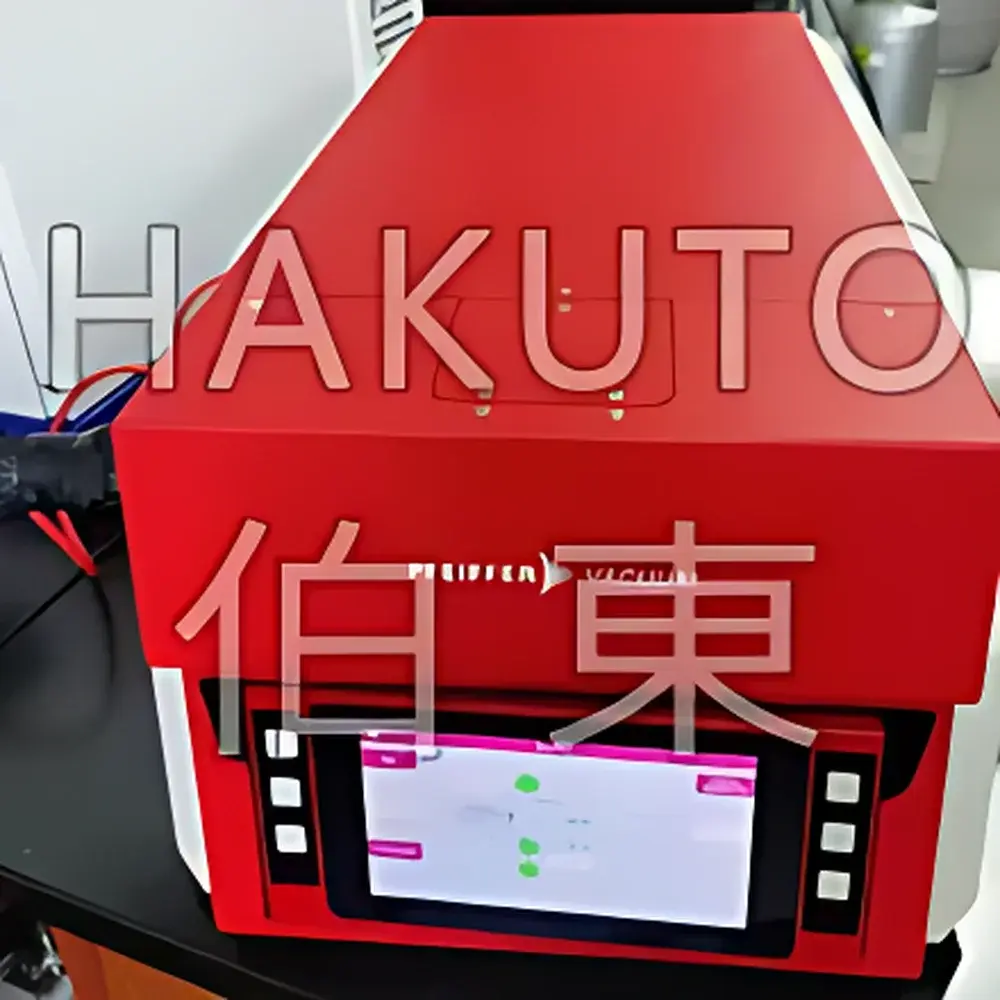
Pfeiffer Vacuum Omnistar GSD350 O3 Online Mass Spectrometer with Integrated Gas Separation Testing System
| Brand | Pfeiffer Vacuum |
|---|---|
| Origin | Germany |
| Model | GSD350 O3 |
| Mass Range | 1–100 amu |
| Maximum Inlet Pressure | 1200 hPa |
| Detection Limit | < 100 ppb |
| Gas Flow Rate | 1–2 sccm (at 0 °C) |
| Analog Inputs | 5 × (−10 to +10 V), 14/16 bit |
| Capillary Material | Stainless Steel |
| Capillary Length | 1 m |
| Sample Inlet Heating Temperature | Up to 200 °C |
| Filament Type | Iridium, Dual Y₂O₃-coated |
Overview
The Pfeiffer Vacuum Omnistar GSD350 O3 is a high-performance, benchtop online mass spectrometer engineered for real-time, quantitative gas-phase analysis in dynamic process environments. Designed specifically for integration with gas separation test systems—such as membrane permeation rigs, catalytic reactor effluent lines, or PSA (pressure swing adsorption) validation setups—it operates on the principle of quadrupole mass filtering combined with electron ionization (EI). The system delivers rapid, multi-component detection and quantification across a mass range of 1–100 amu, enabling continuous monitoring of key process gases including CH₄, CO, C₂H₂, and CO₂. Its robust inlet architecture—including heated stainless-steel capillary sampling (up to 200 °C), pressure-tolerant differential pumping stages, and dual iridium filaments with yttria coating—ensures long-term stability under variable flow and compositional conditions typical of laboratory-scale separation studies.
Key Features
- Quadrupole mass analyzer with unit-mass resolution and <100 ppb detection limit for trace species in complex gas matrices
- Differential vacuum system supporting stable operation at up to 1200 hPa inlet pressure—eliminating need for external pressure-reduction valves in many separation-system interfaces
- Heated capillary inlet (1 m stainless steel, max. 200 °C) minimizes condensation and surface adsorption of polar or heavy molecules during transient gas sampling
- Dual iridium filaments with Y₂O₃ coating provide extended lifetime and consistent ionization efficiency, critical for unattended, long-duration experiments
- Analog input capability (5 channels, ±10 V, 14/16-bit resolution) enables synchronized acquisition of auxiliary sensor data (e.g., pressure, temperature, flow) alongside mass spectral signals
- Modular design facilitates direct coupling to custom-built gas separation test platforms via standardized flanged connections and compatible gas-handling protocols
Sample Compatibility & Compliance
The GSD350 O3 is validated for use with non-corrosive, non-condensable gas mixtures commonly encountered in gas separation R&D—including hydrocarbons (CH₄, C₂H₂), permanent gases (CO, CO₂, N₂, O₂, H₂), and inert carrier media (He, Ar). It complies with IEC 61000-6-3 (EMC emission standards) and meets CE marking requirements for laboratory instrumentation. When operated under GLP-compliant workflows, its analog I/O and timestamped spectral output support audit-ready data capture. While not intrinsically rated for hazardous area use, it may be deployed in Class 1 Div 2 environments when installed with appropriate purge or isolation enclosures per local ATEX/IECEx guidelines.
Software & Data Management
Control and data acquisition are managed via Pfeiffer’s proprietary HiQuad software suite, which supports MCD (Multi-Component Detection) quantitative mode—a calibration-based algorithm that applies pre-defined response factors and background correction to deliver real-time concentration values without manual peak integration. Raw and processed data are stored in HDF5 format with embedded metadata (time stamps, instrument settings, calibration history), ensuring full traceability. The software exports to CSV, ASCII, and MATLAB-compatible formats; optional OPC UA server integration enables seamless connectivity to SCADA or LIMS platforms for centralized process analytics. Audit trail functionality satisfies FDA 21 CFR Part 11 requirements when configured with user authentication and electronic signature modules.
Applications
- Real-time monitoring of membrane selectivity and permeability during mixed-gas testing (e.g., CO₂/CH₄ separation)
- In situ quantification of reaction intermediates and byproducts in catalytic gas-phase reactions coupled to separation units
- Dynamic breakthrough curve analysis in adsorbent evaluation (e.g., CO₂ capture materials under humidified feed streams)
- Leak detection and residual gas analysis in ultra-high-purity separation system commissioning
- Method development and validation for USP and ASTM D7897-compliant gas purity verification
FAQ
What carrier gas is recommended for interfacing with gas separation test systems?
Helium is the default carrier gas due to its inertness, high ionization cross-section, and compatibility with Pfeiffer’s EI source. Nitrogen may be used where helium supply is constrained, though sensitivity for low-mass species (e.g., H₂, He) will be reduced.
Can the GSD350 O3 quantify isotopic ratios (e.g., ¹³CO₂ vs. ¹²CO₂)?
No—the system is optimized for unit-mass resolution and quantitative multi-species tracking, not high-resolution isotopic discrimination. For isotopic analysis, a magnetic sector or TOF-MS configuration would be required.
Is remote diagnostics supported?
Yes—HiQuad includes secure remote access via TLS-encrypted VNC, allowing authorized service engineers to perform firmware updates, vacuum diagnostics, and filament health assessment without on-site visits.
How frequently must the system be recalibrated for long-term stability?
Under stable operating conditions with consistent gas matrix and flow, a full multi-point calibration every 72 hours is sufficient for ≤2% RSD in quantitation. Daily zero-point verification using pure carrier gas is recommended.
Does the system support automated sequence control for unattended operation?
Yes—HiQuad’s scripting engine supports time-triggered or event-driven acquisition sequences, including automatic switching between calibration and sample modes, making it suitable for overnight permeation or adsorption kinetic studies.




