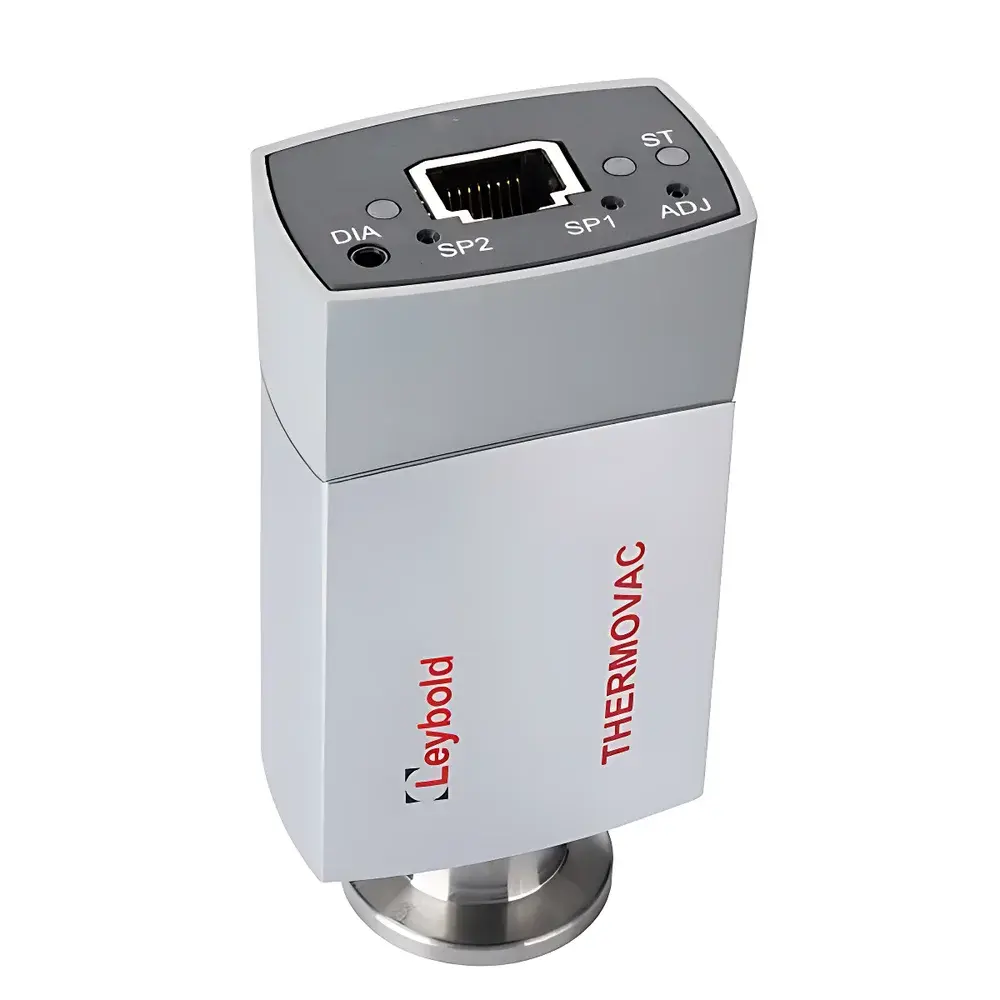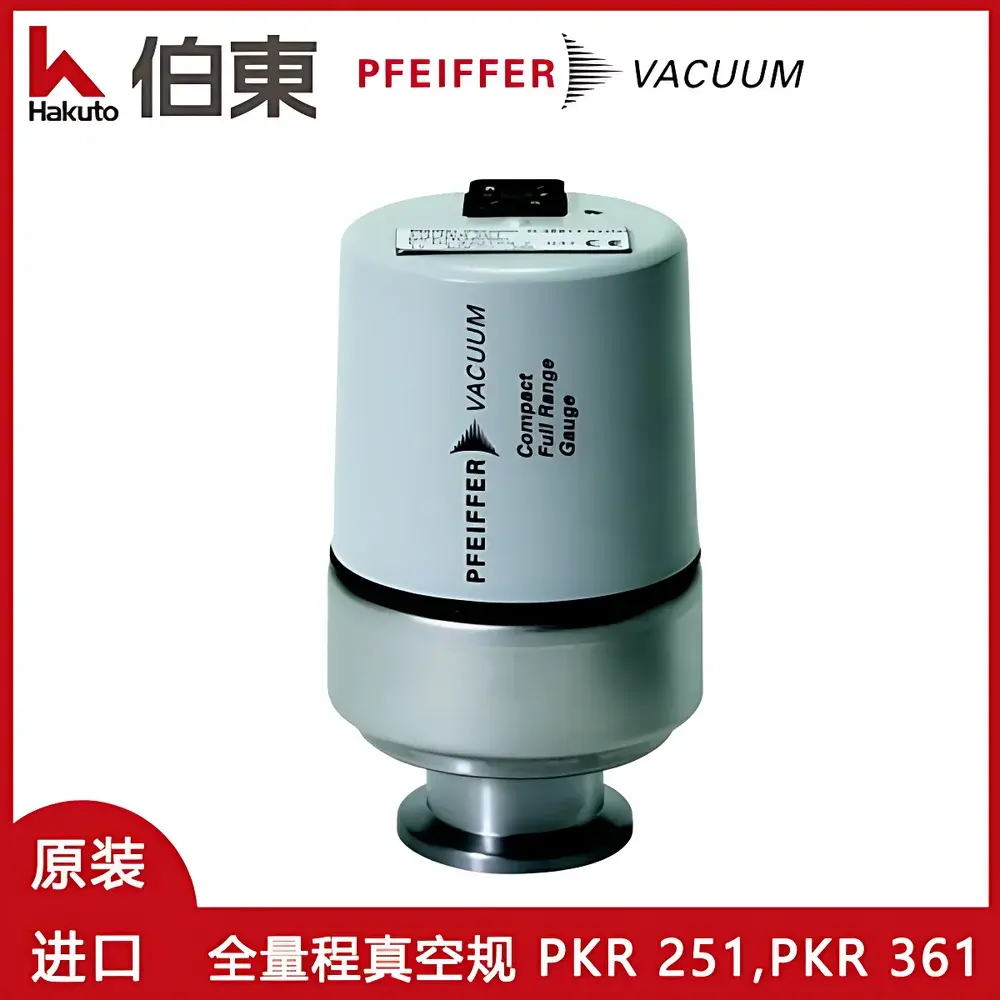
Pfeiffer Vacuum PKR251 Full-Range Vacuum Gauge
| Brand | Pfeiffer Vacuum |
|---|---|
| Origin | Germany |
| Model | PKR251 |
| Measurement Principle | Integrated Pirani and Cold Cathode Gauge |
| Range | 5×10⁻⁹ to 1000 hPa (air/N₂) |
| Vacuum Port | DN25 ISO-KF, DN40 ISO-KF, DN40 CF-F |
| Max. Absolute Pressure | 10,000 hPa (inert gases, <55 °C) |
| Accuracy | ±30% (1×10⁻⁸–100 hPa) |
| Repeatability | ±5% (1×10⁻⁸–100 hPa) |
| Output Signal | 0–10.5 V analog |
| Supply Voltage | 15.0–30.0 V DC |
Overview
The Pfeiffer Vacuum PKR251 is a compact, dual-sensor full-range vacuum gauge engineered for continuous, reliable pressure monitoring across ultra-high vacuum (UHV), high vacuum (HV), medium vacuum (MV), and rough vacuum regimes. Combining a thermally compensated Pirani sensor and a cold cathode (Penning-type) ionization gauge in a single robust housing, the PKR251 eliminates the need for separate gauges or manual switching between measurement principles. Its seamless transition between sensors ensures uninterrupted data acquisition from 5×10⁻⁹ hPa up to 1000 hPa—covering over 12 decades of pressure—without recalibration or mechanical intervention. Designed for integration into OEM vacuum systems, coating chambers, analytical instrumentation (e.g., mass spectrometers, electron microscopes), and semiconductor process tools, the PKR251 delivers stable, traceable measurements under dynamic pumping conditions and variable gas compositions (N₂, air, Ar, He). The gauge operates on a wide DC supply range (15–30 V), features low power consumption, and maintains thermal stability via internal compensation algorithms, minimizing drift during extended operation.
Key Features
- Dual-sensor architecture: Integrated Pirani (for 10⁻³–1000 hPa) and cold cathode (for 5×10⁻⁹–10⁻² hPa) transducers ensure continuous coverage without dead zones or signal discontinuity.
- Multi-port compatibility: Standardized mounting interfaces include DN25 ISO-KF, DN40 ISO-KF, and DN40 CF-F flanges, enabling direct installation on diffusion pumps, turbomolecular pumps, load locks, and vacuum chambers per ISO 2861 and DIN 28403 standards.
- Chemical resilience: Housing and sensor elements are constructed from stainless steel (AISI 304/316) and ceramic insulators, offering resistance to common process gases and mild corrosive vapors encountered in plasma etching, sputtering, and vacuum drying applications.
- Analog output with linear voltage scaling: Provides a 0–10.5 V DC output proportional to logarithmic pressure, compatible with PLCs, DAQ systems, and industrial SCADA platforms without additional signal conditioning.
- Robust electromagnetic compatibility (EMC): Compliant with EN 61326-1 (industrial environment) and CE-marked for unrestricted use in EU-based R&D and production facilities subject to IEC 61000-6-2/6-3.
Sample Compatibility & Compliance
The PKR251 is calibrated for nitrogen and dry air but exhibits predictable cross-sensitivity for common process gases (Ar, O₂, H₂, He) — correction factors are documented in Pfeiffer’s official calibration handbook (Ref. TD-PKR251-EN Rev. 4.2). It is not suitable for reactive halogenated gases (e.g., Cl₂, NF₃), condensable vapors (e.g., water, solvents above 10⁻² hPa), or oxidizing atmospheres exceeding 55 °C. For GLP/GMP-regulated environments, the gauge supports audit-ready operation when paired with Pfeiffer’s TPG300 series controllers, which provide electronic calibration logs, timestamped configuration history, and user-access-level management aligned with FDA 21 CFR Part 11 requirements. All units are manufactured in accordance with ISO 9001:2015 and tested per ISO 3567 (vacuum gauge performance verification).
Software & Data Management
While the PKR251 operates as a stand-alone analog transducer, it is fully interoperable with Pfeiffer’s digital ecosystem. When connected to a TPG300 or VACUU·BUS® controller, users gain access to real-time pressure logging, automatic sensor validation, and remote firmware updates via Ethernet or RS485. Data export complies with ASTM E1461-22 (standard practice for vacuum system data recording) and supports CSV, XML, and OPC UA formats. The integrated diagnostics monitor filament health, discharge stability, and thermal offset drift—triggering configurable alarms before measurement uncertainty exceeds ±10% of specified repeatability.
Applications
- Process monitoring in physical vapor deposition (PVD) and chemical vapor deposition (CVD) systems requiring stable base pressure and rapid response during chamber venting.
- Leak detection support in helium mass spectrometer leak testers, where accurate roughing-stage pressure control improves sensitivity and reduces false positives.
- UHV beamline instrumentation in synchrotron and free-electron laser facilities, where long-term stability and minimal outgassing (<1×10⁻¹¹ mbar·L/s) are critical.
- Quality assurance in vacuum packaging lines for pharmaceutical blister packs and food-grade barrier films, meeting ISO 11607-2 compliance thresholds.
- Research-grade vacuum characterization in cryogenic adsorption studies, surface science experiments, and thin-film growth kinetics.
FAQ
Can the PKR251 be used in oxygen-rich or hydrogen environments?
Yes, within its specified pressure range and temperature limits; however, cold cathode operation in pure H₂ requires derating due to reduced ionization efficiency—consult Pfeiffer Technical Note TN-PKR-H2 for corrected calibration curves.
Is factory recalibration required annually?
No mandatory annual recalibration is stipulated; however, Pfeiffer recommends verification against a certified reference standard (e.g., MKS Baratron 627B) every 12–24 months in GMP-critical processes, per ISO/IEC 17025 guidelines.
Does the PKR251 support digital communication protocols such as Modbus RTU?
Not natively—the PKR251 outputs only analog voltage. Digital protocol support requires integration with a Pfeiffer TPG300 controller or third-party analog-to-Modbus converter compliant with IEC 61158.
What is the maximum allowable bakeout temperature?
The gauge head is rated for continuous operation at ≤80 °C; bakeout above this temperature may compromise cold cathode insulation integrity and void warranty.
How does the PKR251 handle transient pressure spikes during rapid venting?
Its cold cathode sensor automatically suppresses discharge above 1×10⁻² hPa to prevent arcing; the Pirani channel remains active and provides stable readings up to 1000 hPa, ensuring no measurement gap during atmospheric re-entry.