
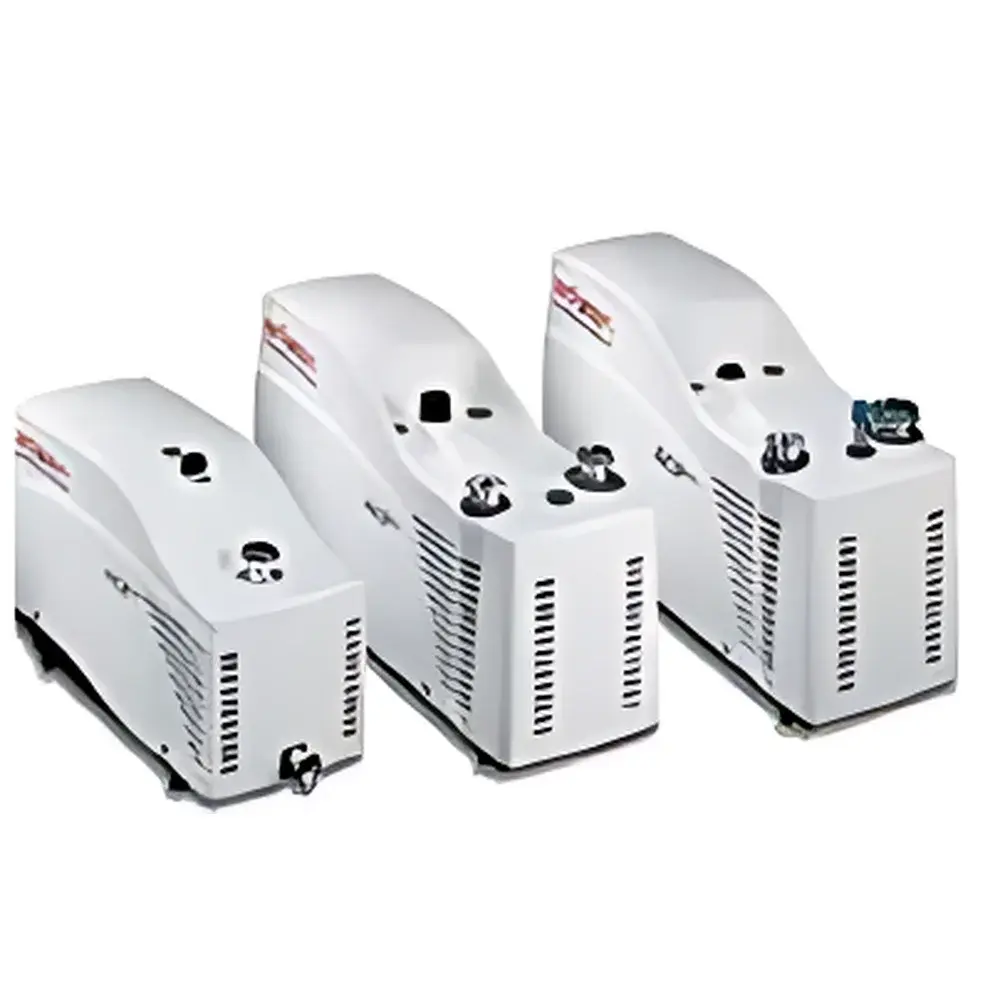
Pfeiffer Vacuum ACP 15/28/40 Dry Scroll Roughing Vacuum Pump
| Brand | Pfeiffer Vacuum |
|---|---|
| Origin | Germany |
| Model | ACP 15, ACP 28, ACP 40 |
| Ultimate Pressure (with gas ballast) | ≤ 0.1 mbar |
| Pumping Speed | 14–37 m³/h |
| Max. Water Vapor Handling Capacity | 1000 g/h |
| Gas Ballast Flow Rate | > 2 Nm³/h (at 1 bar abs) |
| Leak Rate (He) | < 5 × 10⁻⁷ mbar·L/s |
| Weight | 23–32 kg |
| Certifications | CE, UL/CSA, SEMI S2 |
Overview
The Pfeiffer Vacuum ACP 15/28/40 series represents a high-performance line of dry scroll roughing vacuum pumps engineered for applications demanding oil-free, particle-free, and hydrocarbon-free vacuum environments. Based on multi-stage scroll technology originally pioneered by Adixen (acquired by Pfeiffer Vacuum in 2006), these pumps operate without internal lubricants or contacting seals between rotor and stator—eliminating wear debris, carbon contamination, and backstreaming of hydrocarbons. The core architecture relies on precision-machined, dynamically balanced spiral elements that compress gas through progressive volume reduction in a non-contact, frictionless motion. This design enables stable, repeatable performance across varying inlet pressures (1000 mbar to ≤ 0.1 mbar), with consistent ultimate vacuum and pumping speed independent of ambient voltage fluctuations or geographic location—enabled by integrated frequency-controlled AC motors.
Key Features
- Oil-free and maintenance-optimized architecture: No internal oil reservoirs, no sliding seals, and zero consumable wear parts in the compression stage—ensuring long-term stability and minimal downtime.
- Gas ballast system with three configurable modes (manual, capped, continuous): Optimized for water vapor removal; prevents condensation inside the pump chamber and maintains throughput when handling humid or condensable process gases.
- Extended service intervals: ACP 15 rated for 20,000 operating hours before scheduled maintenance; ACP 28 and ACP 40 rated for 22,000 hours—significantly reducing total cost of ownership versus conventional rotary vane or diaphragm pumps.
- Air-cooled design: Eliminates dependency on external cooling water circuits, simplifying installation, lowering infrastructure costs, and improving operational flexibility in laboratory and industrial settings.
- Industrial-grade connectivity: Standard RS485 interface for remote monitoring and control; optional Profibus-DP integration available upon request for compatibility with PLC-based vacuum systems.
- Multi-variant platform: Three application-specific configurations—SD (Standard), G (Corrosion-Resistant), and CV (Water-Vapor-Optimized)—each engineered to meet distinct chemical, thermal, and environmental demands without compromising base performance metrics.
Sample Compatibility & Compliance
The ACP series is compatible with inert, mildly reactive, and condensable gas loads typical in analytical instrumentation, surface science, and semiconductor R&D environments. SD variants are validated for clean, non-corrosive gas streams (e.g., N₂, Ar, He, dry air). G-series models incorporate dedicated purge gas inlets (R 1/4″ BSP) delivering neutral gas (N₂ or Ar) at 0.3 bar to protect bearings from trace halogens, HCl, or HF—making them suitable for etch, cleaning, or plasma-assisted processes under GLP-compliant workflows. CV variants feature enhanced gas ballast flow (>2 Nm³/h), external drain-equipped mufflers, and lip-seal protection ports to manage up to 1000 g/h of saturated water vapor at 30 °C and 100 mbar—fully compliant with ISO 8573-1 Class 4 for particulate and oil-free air quality. All units conform to CE Machinery Directive 2006/42/EC, UL/CSA 61010-1, and SEMI S2-0217 safety standards for semiconductor manufacturing equipment.
Software & Data Management
While the ACP pumps operate as standalone units with analog control inputs and digital status outputs, they integrate seamlessly into centralized vacuum management platforms via RS485 Modbus RTU protocol. Real-time parameters—including motor current, rotational speed, temperature at critical bearing zones, and operational state—are accessible for logging and trend analysis. When deployed in regulated environments (e.g., pharmaceutical QC labs or FDA-audited deposition facilities), the pump’s deterministic behavior—combined with external SCADA or LabVIEW-based supervision—supports 21 CFR Part 11-compliant audit trails when paired with timestamped, user-authenticated data acquisition systems. Firmware updates and configuration changes require physical access or authenticated serial connection—ensuring integrity of operational parameters during GMP-aligned validation protocols.
Applications
- Analytical instrumentation: Backing pumps for mass spectrometers (Q-TOF, GC-MS), residual gas analyzers (RGAs), and electron spectrometers requiring hydrocarbon-free base pressure.
- Surface science: Pre-vacuum stages for XPS, AES, and LEED systems where surface contamination must be minimized to sub-monolayer levels.
- Electron microscopy: Roughing support for TEM/SEM column vacuum systems, especially where oil diffusion or silicone outgassing would compromise imaging fidelity.
- Semiconductor & thin-film processing: Pre-evacuation and rough-pumping in PVD, CVD, and ALD tools; compatible with He recovery loops (CP variant) and UHV system backing via turbomolecular pump staging.
- Research & development laboratories: Versatile roughing solution for ultra-high vacuum (UHV) systems down to 10⁻⁸ mbar when coupled with ion or cryo pumps.
- Industrial drying and degassing: High water vapor tolerance enables reliable operation in vacuum ovens, freeze dryers, and moisture-sensitive packaging lines.
FAQ
What is the maximum allowable water vapor load for the ACP CV series?
The ACP 28 CV and ACP 40 CV models are rated for continuous water vapor handling up to 1000 g/h at 100 mbar inlet pressure and 30 °C ambient temperature—verified per ISO 6361-2 test methodology.
Can the ACP pump be used as a backing pump for turbomolecular pumps?
Yes—ACP 28 and ACP 40 provide sufficient speed and ultimate pressure (≤ 0.1 mbar with gas ballast) to serve as effective forepumps for turbomolecular pumps in UHV systems, particularly when paired with cold traps or cryo panels to suppress backstreaming.
Is the ACP series compliant with FDA 21 CFR Part 11 requirements?
The pump itself does not store electronic records; however, its RS485 interface supports integration into validated systems that implement electronic signatures, audit trails, and role-based access control—fulfilling Part 11 requirements at the system level.
What certifications apply to the ACP 15/28/40 series?
All models carry CE marking per EU Machinery and EMC Directives, UL/CSA 61010-1 certification for laboratory equipment safety, and SEMI S2-0217 certification for semiconductor manufacturing tool safety compliance.
How often does preventive maintenance need to be performed?
Per Pfeiffer Vacuum technical documentation: ACP 15 requires service every 20,000 operating hours; ACP 28 and ACP 40 every 22,000 hours—assuming nominal operating conditions and use of specified purge gases (for G/CV variants).





