
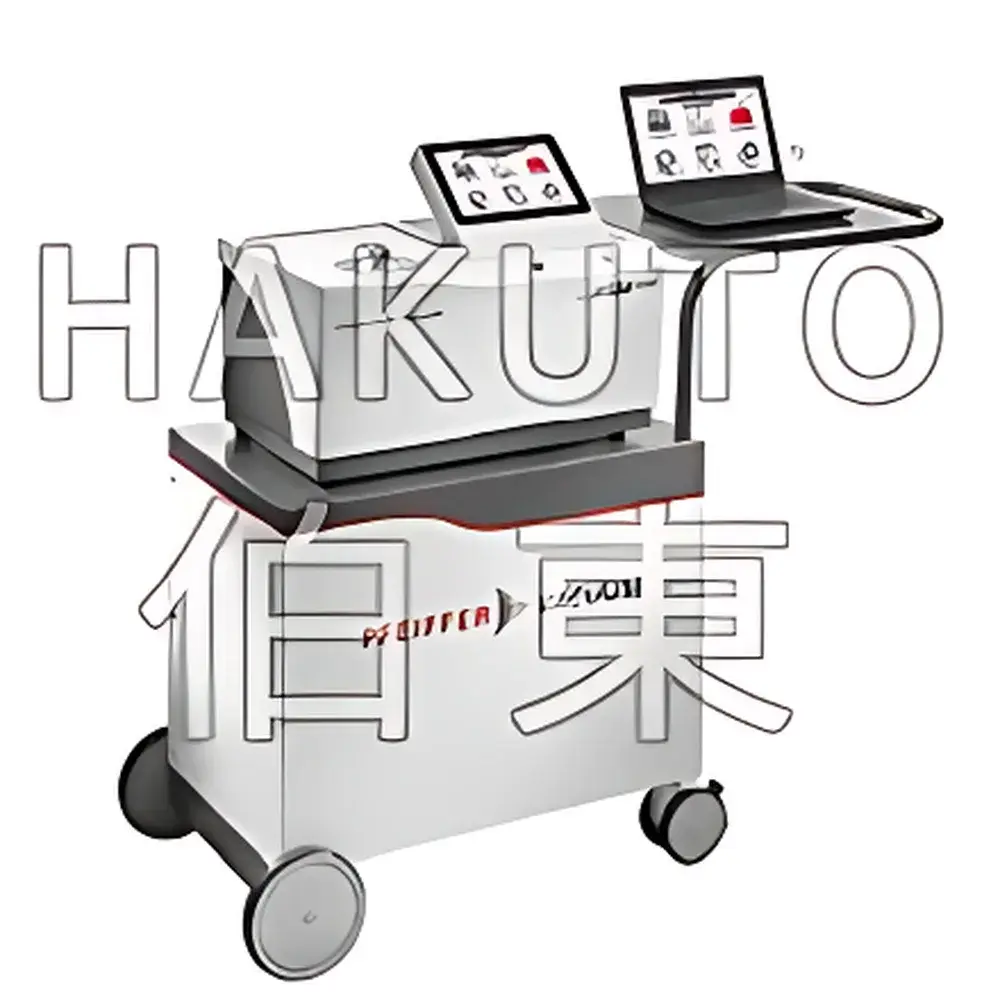
Pfeiffer Vacuum ASM 2000 Helium Mass Spectrometer Leak Detector for Pharmaceutical Packaging Integrity Testing
| Brand | Pfeiffer Vacuum |
|---|---|
| Origin | France |
| Manufacturer Type | Authorized Distributor |
| Origin Category | Imported |
| Model | ASM 2000 |
| Price Range | USD 42,000 – 70,000 (FOB) |
| Detection Principle | Quadrupole Mass Spectrometry (He⁺ at m/z = 4) |
| Measurement Method | Vacuum Mode & Sniffer Probe Mode |
| Quantitative Sensitivity (Vacuum Mode) | 1×10⁻⁸ – 1×10⁻⁵ mbar·L/s |
| Qualitative Sensitivity (Vacuum Mode, Coarse Scan) | 1×10⁻⁵ – 1×10⁻³ mbar·L/s |
| Gross Leak Detection Threshold | ≥1×10⁻³ mbar·L/s |
| Minimum Detectable Leak (Sniffer Mode) | >1×10⁻⁵ mbar·L/s |
| Helium Supply Pressure | 0.5–8 bar (rel) |
| Compressed Dry Air (CDA) Requirement | ISO 8573-1 Class 1.3.1, 4.5–10 bar (rel) |
| Nitrogen Purge Support | 0.5–8 bar (rel) |
| Power Input | 90–250 V AC, 50–60 Hz |
| Typical Power Consumption | 3,750 W |
| Dimensions (L×W×H, incl. trolley) | 1409 × 575 × 1194 mm |
| Acoustic Noise Level | <53 dB(A) |
Overview
The Pfeiffer Vacuum ASM 2000 Helium Mass Spectrometer Leak Detector is an engineered solution for deterministic, quantitative container closure integrity testing (CCIT) in regulated pharmaceutical manufacturing environments. It operates on the principle of quadrupole mass spectrometry, selectively detecting ionized helium (m/z = 4) introduced into or around sealed primary packaging—such as glass vials, pre-filled syringes, cartridges, and blister cavities. Unlike probabilistic dye ingress or pressure decay methods, helium mass spectrometry delivers trace-level detection with high reproducibility and unambiguous pass/fail outcomes. The ASM 2000 is designed to meet the stringent sensitivity requirements outlined in ASTM F2391–22 (“Standard Test Method for Measuring Package and Seal Integrity Using Helium as the Tracer Gas”) and aligns with FDA guidance on CCIT for sterile products, including those classified under USP . Its architecture integrates a high-throughput vacuum manifold, low-volume test chamber design, and proprietary automatic helium fill module—enabling rapid cycle times without compromising measurement stability or signal-to-noise ratio.
Key Features
- High-efficiency helium pumping system with optimized internal volume and flow path geometry for reduced background drift and enhanced response time
- Integrated automated helium dosing module with programmable pressure ramping, dwell time control, and purge sequencing—minimizing operator intervention and inter-batch variability
- Dual-mode operation: vacuum mode (for quantitative leak quantification) and sniffer probe mode (for localized gross leak localization during troubleshooting or process validation)
- Robust quadrupole mass filter with stable ion optics, calibrated against NIST-traceable helium standards, ensuring long-term measurement fidelity
- Compliance-ready hardware architecture supporting audit trails, user access levels, electronic signatures, and data export in CSV/Excel formats—facilitating 21 CFR Part 11 compliance when deployed with validated software protocols
- Modular vacuum train incorporating a turbomolecular pump and backing pump optimized for helium throughput and hydrocarbon-free operation—critical for GMP-compliant cleanroom integration
Sample Compatibility & Compliance
The ASM 2000 is validated for use with rigid and semi-rigid pharmaceutical packaging systems, including but not limited to: Type I borosilicate glass vials (2–50 mL), polymer-coated syringes, elastomeric stopper-sealed containers, and aluminum-based cartridge assemblies. It supports both whole-package testing and component-level evaluation (e.g., crimp seal integrity, plunger-barrel interface). Method development follows ISO 15142-1 (leak testing of medical devices) and ASTM F2391–22, with documented limit-of-detection (LOD) verification per ICH Q5C and Q2(R2) guidelines. All calibration procedures adhere to ISO/IEC 17025 requirements when performed by accredited service providers. The instrument’s helium recovery compatibility and CDA filtration compliance (ISO 8573-1 Class 1.3.1) ensure consistent performance in controlled environments subject to EU Annex 1 and PIC/S GMP standards.
Software & Data Management
The ASM 2000 runs on Pfeiffer Vacuum’s proprietary LeakTest Control Suite—a Windows-based application supporting method storage, real-time spectral monitoring, multi-channel data logging, and statistical process control (SPC) charting. Each test record includes timestamped metadata: operator ID, batch number, test parameters (fill pressure, dwell time, evacuation rate), raw ion current values, and pass/fail status. Audit trail functionality logs all configuration changes, user logins, and report generation events. Exported datasets are structured for direct ingestion into LIMS or MES platforms. Optional integration with LabArchives or Veeva Vault enables electronic batch record (EBR) linkage and long-term archival compliant with ALCOA+ principles.
Applications
- Final container closure integrity verification for lyophilized biologics and sterile injectables
- Process validation of stopper seating, crimping, and sealing operations in high-speed filling lines
- Stability study support—detecting micro-leaks that may compromise shelf-life under accelerated aging conditions
- Root cause analysis of sterility failures through precise leak localization using sniffer probe mapping
- Qualification of alternative packaging materials (e.g., cyclic olefin copolymer vials) against legacy glass benchmarks
- Supporting regulatory submissions (IND, BLA, MAA) with robust, science-based CCIT data packages
FAQ
What regulatory standards does the ASM 2000 support for pharmaceutical CCIT?
ASTM F2391–22, ISO 15142-1, USP , and FDA Guidance for Industry on Container Closure Integrity Testing (2022).
Can the ASM 2000 be integrated into an automated production line?
Yes—via Ethernet/IP or Modbus TCP interfaces; compatible with PLC-driven robotic handling systems and SCADA-level supervision.
Is helium recovery supported to reduce operational costs?
The system architecture allows integration with third-party helium recovery units; Pfeiffer Vacuum provides interface specifications and flow compatibility guidance.
What is the typical warm-up and stabilization time before first test?
Approximately 45 minutes from cold start, including turbomolecular pump spin-up, detector tuning, and background helium baseline stabilization.
Does the ASM 2000 require annual recalibration by a certified technician?
Yes—recommended annually or after major maintenance; calibration certificates include uncertainty budgets traceable to national metrology institutes.



