
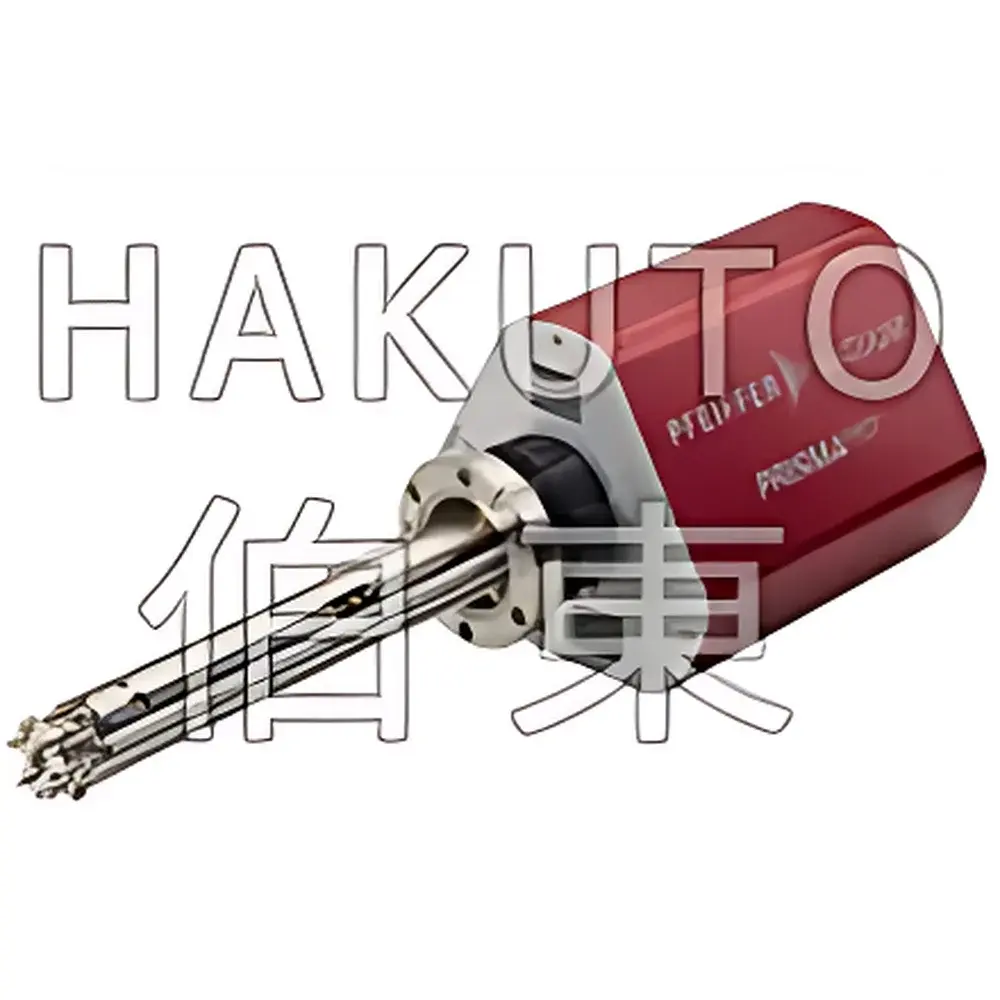
Pfeiffer PrismaPro Residual Gas Analyzer (RGA)
| Brand | Pfeiffer Vacuum |
|---|---|
| Origin | Germany |
| Model | PrismaPro |
| Detection Limit (C-SEM) | 3 × 10⁻¹⁵ hPa |
| Mass Range | up to 300 amu |
| Detector Options | Faraday Cup (F) and Combined Secondary Electron Multiplier / Faraday (C-SEM/F) |
| Quadrupole Dimensions | 6 mm Ø × 125 mm |
| Operating Pressure Range (C-SEM) | ≤ 5 × 10⁻⁵ hPa |
| Bakeout Temperature | 300 °C |
| Flange | DN 40 CF-F |
| Weight | 2.5–3.2 kg |
| Operating Temperature (Analyzer) | ≤ 200 °C (≤ 150 °C with SEM active) |
| Dwell Time | 1 ms – 16 s/amu |
| Interference at Adjacent Masses | < 10–50 ppm |
Overview
The Pfeiffer PrismaPro Residual Gas Analyzer is a high-performance quadrupole mass spectrometer engineered for real-time, quantitative and qualitative analysis of residual gas species in ultra-high vacuum (UHV) and high-vacuum (HV) environments. Based on robust quadrupole mass filter technology, the PrismaPro operates on the principle of mass-selective ion transmission—where ions generated in a dedicated electron-impact ion source are filtered according to their mass-to-charge ratio (m/z) by applying precisely tuned RF and DC voltages across four parallel rods. This enables deterministic identification and quantification of trace-level contaminants—including H₂O, CO, CO₂, N₂, O₂, Ar, CH₄, hydrocarbons, and process-specific volatiles—down to partial pressures as low as 3 × 10⁻¹⁵ hPa when equipped with the C-SEM detector. Designed for integration into vacuum system diagnostics, leak detection workflows, thin-film deposition monitoring, and accelerator beamline conditioning, the PrismaPro delivers metrological-grade reproducibility and long-term signal stability under continuous operation.
Key Features
- Modular architecture supporting field-swappable analyzer heads and electronics units—enabling rapid maintenance and configuration scalability without system venting.
- Dual filament ion source with automatic filament switching, extending operational lifetime and minimizing downtime during extended UHV monitoring campaigns.
- Integrated pressure measurement capability via direct connection to Pfeiffer’s digital vacuum gauges (e.g., TPG300 series), enabling synchronized total pressure and partial pressure correlation.
- Standard DN 40 CF-F flange interface ensures compatibility with ISO-KF, ISO-F, and ConFlat vacuum systems across semiconductor, R&D, and fusion research facilities.
- JSON-based remote control API and native support for RS-232, USB, and Ethernet interfaces simplify OEM integration and SCADA-level automation within Industry 4.0-compliant vacuum platforms.
- Bakeable to 300 °C while maintaining calibrated sensitivity—critical for applications requiring repeated thermal desorption cycles or stringent outgassing validation per ISO 10110-7 and ASTM E595.
Sample Compatibility & Compliance
The PrismaPro is optimized for gaseous samples in dynamic or static vacuum conditions ranging from 1 × 10⁻¹⁰ hPa to 5 × 10⁻⁵ hPa (with C-SEM). It supports direct sampling from vacuum chambers, load locks, sputtering systems, and molecular beam epitaxy (MBE) reactors without dilution or pre-concentration. Its ion source design minimizes memory effects and fragmentation bias—ensuring reliable speciation of reactive and condensable species such as silanes, ammonia, and halogenated precursors. The instrument complies with CE marking requirements and meets electromagnetic compatibility (EMC) standards per EN 61326-1. For regulated environments—including pharmaceutical lyophilization line qualification and medical device coating process validation—the PV MassSpec software optionally supports audit-trail-enabled operation aligned with FDA 21 CFR Part 11 and EU Annex 11 expectations when deployed with appropriate IT infrastructure controls.
Software & Data Management
PV MassSpec is the native Windows-based control and analysis suite, offering real-time spectral acquisition, multi-point trend logging, customizable alarm thresholds, and automated background subtraction. It provides full support for mass calibration (linear and quadratic), peak deconvolution of overlapping isotopic envelopes (e.g., ⁴⁰Ar vs. ⁴⁰Ca⁺), and quantitative analysis using relative sensitivity factors (RSFs) traceable to NIST SRM 1968. Raw data files (.pvm) are stored in open binary format with embedded metadata (timestamp, dwell time, filament status, gauge readings), enabling post-acquisition reprocessing and third-party import into MATLAB, Python (via pypvm), or LIMS platforms. Batch reporting templates can be exported to PDF or CSV with configurable headers for GLP/GMP documentation workflows.
Applications
- Leak detection and localization using helium or hydrogen tracer gases—leveraging sub-picoamp current resolution and <10 ppm adjacent-mass interference for unambiguous ⁴He⁺ identification.
- In-situ monitoring of vacuum chamber cleanliness during pump-down sequences, particularly in synchrotron beamline front-ends and gravitational wave detector vacuum systems.
- Process gas composition verification in plasma etch and PECVD tools—tracking endpoint signatures (e.g., SiF₄ depletion) and detecting unintended precursor decomposition products.
- Outgassing characterization of spacecraft materials per ECSS-Q-ST-70-02C, including water vapor evolution kinetics and volatile organic compound (VOC) profiling during thermal cycling.
- Fundamental surface science studies involving temperature-programmed desorption (TPD), where time-resolved mass spectra correlate adsorbate coverage with binding energy distributions.
FAQ
What vacuum interface options are available for the PrismaPro?
The standard configuration includes a DN 40 CF-F flange; optional adapters for DN 16, DN 25, and ISO-KF 40 are available upon request.
Can the PrismaPro operate continuously at elevated temperatures?
Yes—the analyzer head is rated for continuous operation up to 200 °C; however, when the C-SEM detector is active, maximum recommended temperature is reduced to 150 °C to preserve multiplier gain stability.
Is calibration required before each use?
No—factory calibration remains valid for ≥12 months under normal operating conditions; annual verification using certified gas mixtures (e.g., Air Liquide CalGas) is recommended for ISO/IEC 17025-compliant labs.
Does the system support automated sequence control?
Yes—via the JSON REST API or LabVIEW/VISA drivers, users can script multi-step acquisitions, pressure-triggered scans, and conditional data export routines.
How is data integrity ensured during long-term monitoring?
PV MassSpec logs all operator actions, parameter changes, and hardware events with timestamps; optional database backends (SQL Server, PostgreSQL) enable centralized storage with role-based access control and immutable audit trails.





