
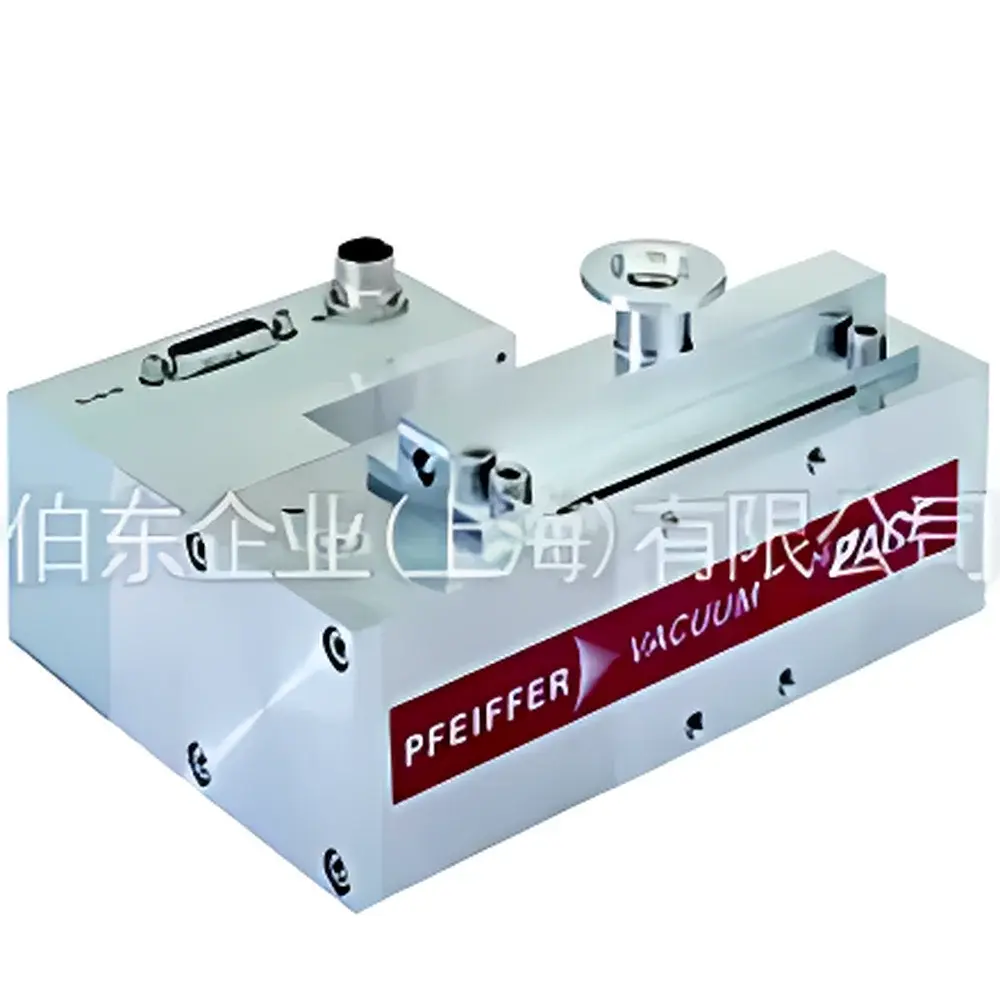
Pfeiffer Vacuum HiPace 10 Turbo Molecular Pump
| Brand | Pfeiffer Vacuum |
|---|---|
| Origin | Germany |
| Pump Type | Turbo Molecular Pump |
| Nitrogen Pumping Speed | 10 L/s |
| Ultimate Vacuum | < 5 × 10⁻⁵ hPa |
| Bearing System | Hybrid Ceramic Ball Bearings |
| Cooling | Natural Convection (Air-Cooled) |
| Drive Electronics | Integrated TC 110 Controller |
| Inlet Flange | DN 25 ISO-KF |
| Exhaust Flange | DN 16 ISO-KF / G 1/8" |
| Rated Speed | 90,000 rpm ±2% |
| Startup Time | 0.9 min |
| Weight | 1.8–2.0 kg |
| Protection Rating | IP54 |
| Certifications | SEMI S2, UL/cUL, CSA |
| Operating Voltage | 24 V DC (±5%) |
| Max. Permissible Magnetic Field | 3 mT |
| Compressibility Ratio (N₂) | 3 × 10⁶ |
| Communication Interface | RS-485 + Remote I/O |
Overview
The Pfeiffer Vacuum HiPace 10 is a compact, high-reliability turbo molecular pump engineered for ultra-high vacuum (UHV) generation in space-constrained laboratory and industrial applications. Utilizing proven drag-stage and turbine-stage rotor dynamics, the HiPace 10 achieves stable, oil-free vacuum generation through momentum transfer between rapidly rotating titanium-aluminum alloy blades and gas molecules. Its design adheres to fundamental kinetic theory of gases—operating efficiently in the molecular flow regime where mean free path exceeds chamber dimensions. With a nominal nitrogen pumping speed of 10 L/s and an ultimate pressure below 5 × 10⁻⁵ hPa (equivalent to 5 × 10⁻⁸ mbar), the HiPace 10 delivers consistent performance across low-to-moderate throughput environments, particularly where rapid pump-down cycles, minimal footprint, and long-term operational stability are critical.
Key Features
- Ultra-compact mechanical architecture: Total height under 150 mm and mass ≤ 2.0 kg enable integration into benchtop analytical instruments, portable vacuum systems, and modular UHV chambers.
- Integrated drive electronics via TC 110 controller: Provides real-time monitoring of rotational speed, bearing temperature, vibration signature, and power consumption—enabling predictive maintenance and fault diagnostics per ISO 13374 standards.
- Hybrid ceramic ball bearing system: Combines steel races with silicon nitride (Si₃N₄) balls to ensure low outgassing, high stiffness, and extended service life (>100,000 hours MTBF under nominal load conditions).
- Natural convection cooling: Eliminates requirement for external water or forced-air cooling circuits—reducing system complexity and increasing deployment flexibility in cleanroom or glovebox environments.
- Full angular mounting capability: Supports horizontal, vertical, or inverted installation without performance degradation, compliant with ISO 2858 mechanical orientation guidelines.
- Industrial-grade environmental resilience: IP54-rated enclosure protects against dust ingress and water splashing; certified to SEMI S2 (safety), UL 61010-1, and CSA C22.2 No. 61010-1 for use in Class I Div 2 hazardous locations.
Sample Compatibility & Compliance
The HiPace 10 maintains stable compression ratios across light and heavy process gases—N₂ (3 × 10⁶), He (3 × 10³), H₂ (3 × 10²), and Ar (2.5 × 10⁸)—making it suitable for residual gas analysis (RGA), electron microscopy, and leak detection systems handling reactive or corrosive species. It complies with ISO 27025 requirements for metrological traceability when used within accredited calibration laboratories. The pump’s materials—stainless steel housing, nickel-plated aluminum rotor, and fluoropolymer-sealed electrical interfaces—are selected to minimize catalytic surface reactions and meet ASTM F2027 (vacuum compatibility of materials) specifications. For regulated pharmaceutical or medical device manufacturing, its RS-485 interface supports audit-trail-capable communication protocols compatible with FDA 21 CFR Part 11–compliant SCADA systems.
Software & Data Management
The TC 110 controller features embedded firmware supporting Modbus RTU over RS-485 and discrete remote I/O signals (start/stop, fault reset, status LEDs). Optional Pfeiffer Vacuum Control Software (VACUU·VIEW) enables centralized configuration, trend logging of vacuum parameters (pressure, speed, current), and alarm threshold management. All operational data—including runtime hours, thermal history, and start-stop cycles—is stored non-volatilely and exportable in CSV format for GLP/GMP documentation. Firmware updates follow IEC 62443-3-3 security principles, with signed binaries and secure boot verification to prevent unauthorized modification.
Applications
- Electron microscopy: Primary vacuum stage for SEM and TEM columns requiring stable base pressure <1 × 10⁻⁵ hPa and low vibration transmission.
- Residual gas analyzers (RGAs) and quadrupole mass spectrometers: Maintains required conductance matching for optimal ion transmission efficiency.
- Leak detection systems: Paired with helium leak detectors operating at 10⁻⁷–10⁻⁹ mbar range; fast response time (<60 s to reach full speed) minimizes test cycle duration.
- Surface science instrumentation: Sputter deposition, XPS, and AES systems benefit from low hydrocarbon background and absence of oil backstreaming.
- Medical vacuum systems: Used in sterilization monitors and plasma-based surgical equipment meeting ISO 13485 quality system requirements.
- Nanofabrication R&D: Enables controlled vacuum environments for atomic layer deposition (ALD) and molecular beam epitaxy (MBE) precursor delivery subsystems.
FAQ
What pre-vacuum level is required before starting the HiPace 10?
The pump requires a foreline pressure ≤ 25 hPa (2.5 mbar) in nitrogen—typically achieved using a two-stage rotary vane pump or dry scroll pump.
Can the HiPace 10 be operated continuously at full speed?
Yes—its hybrid bearing design and thermal management allow indefinite operation at rated speed (90,000 rpm) under ambient temperatures up to 40 °C and relative humidity ≤ 80 % non-condensing.
Is the HiPace 10 compatible with aggressive process gases such as Cl₂ or NF₃?
While standard units are rated for inert and mildly corrosive gases, optional corrosion-resistant coatings (e.g., electroless nickel + PTFE impregnation) and specialized sealing materials are available upon request for halogenated chemistries.
Does the TC 110 controller support analog output signals?
No—the TC 110 provides only digital RS-485 and discrete I/O; analog output functionality requires an external signal converter or Pfeiffer’s optional VACUU·BUS gateway module.
How is bearing health monitored during operation?
Vibration amplitude, phase shift, and bearing temperature are continuously sampled at 1 kHz; deviations exceeding factory-set thresholds trigger diagnostic alerts via RS-485 or front-panel LED indicators per ISO 13373-1 vibration condition monitoring standards.



