
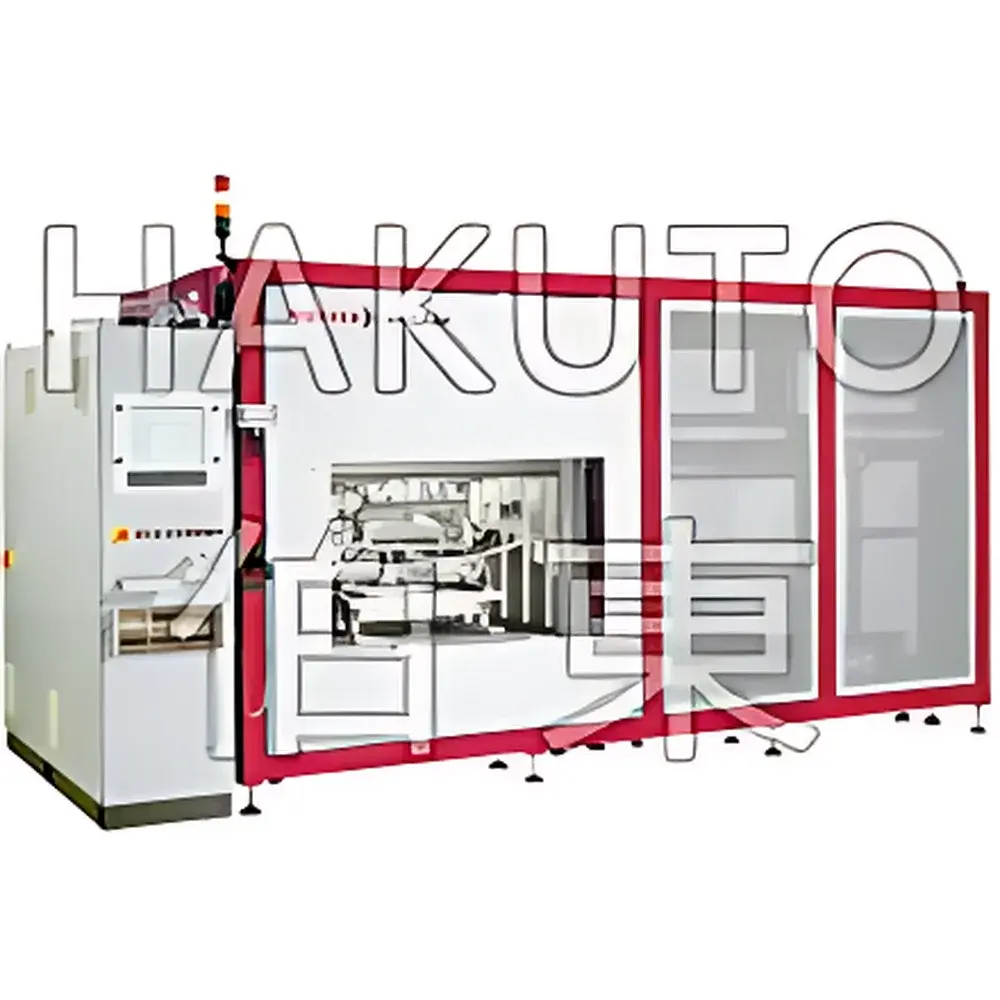
Helium Mass Spectrometer Leak Detection System for Automotive Fuel Tanks
| Origin | France |
|---|---|
| Manufacturer Type | Authorized Distributor |
| Origin Category | Imported |
| Model | Fuel Tank Leak Detection System |
| Price Range | USD 110,000 – 138,000 (FOB) |
| Minimum Detectable Leak Rate | 1.0 × 10⁻¹³ Pa·m³/s (in vacuum mode) |
| Configuration | Fully Automated, Custom-Engineered Integration |
| Optional Module | Helium Recovery System |
Overview
The Helium Mass Spectrometer Leak Detection System for Automotive Fuel Tanks is a high-sensitivity, vacuum-mode helium leak testing platform engineered specifically for the stringent quality assurance requirements of modern automotive fuel system manufacturing. Based on quadrupole mass spectrometry detection of helium tracer gas, this system operates on the principle of ionizing helium atoms (mass-to-charge ratio m/z = 4) in a high-vacuum environment and quantifying ion current proportional to leak magnitude. With a verified minimum detectable leak rate of 1.0 × 10⁻¹³ Pa·m³/s, it meets or exceeds the sensitivity thresholds mandated by ISO 15649, SAE J2045, and OEM-specific specifications for fuel containment integrity—critical for gasoline, ethanol-blend (E85), and hydrogen-fueled vehicle architectures.
Key Features
- Vacuum-integrated test chamber architecture with automated gate valve sequencing and pressure ramping control for repeatable test cycles
- Quadrupole mass spectrometer detector calibrated per ASTM E1772 standards, featuring long-term signal stability and low background noise (< 5 × 10⁻¹⁴ Pa·m³/s equivalent)
- Programmable test sequences supporting multi-point scanning, hold-time validation, and pass/fail logic with configurable alarm thresholds
- Integrated vacuum pumping station comprising turbomolecular pump (≥ 800 L/s N₂ speed) and backing dry scroll pump for rapid evacuation and stable base pressure (< 5 × 10⁻⁵ Pa)
- Industrial-grade PLC-based controller with CE-compliant safety interlocks, emergency stop circuitry, and dual-channel pressure monitoring
- Optional helium recovery module utilizing cryo-adsorption and membrane separation to achieve > 90% helium reuse efficiency, reducing operational gas consumption and lifecycle cost
Sample Compatibility & Compliance
This system is validated for non-destructive leak testing of welded, bonded, and crimped assemblies across the full fuel system supply chain—including but not limited to: stamped steel/aluminum fuel tanks, integrated fuel pumps, particulate-filter housings, high-pressure direct injection (GDI) injectors, capacitive fuel level sensors, and swirl pots used in turbocharged engine applications. All mechanical interfaces comply with ISO 2859-1 sampling plans for AQL 0.1%, and software operation supports 21 CFR Part 11-compliant electronic records when configured with audit trail, user authentication, and digital signature modules. System documentation includes IQ/OQ protocols aligned with GMP Annex 15 and IATF 16949 process validation frameworks.
Software & Data Management
The embedded test management software provides real-time spectral display, time-resolved leak rate trending, and automated report generation in PDF/CSV formats. Each test record captures timestamp, operator ID, chamber pressure history, helium partial pressure curve, final leak value, and pass/fail status—all stored with SHA-256 hash integrity verification. Data export supports OPC UA connectivity for MES integration (e.g., Siemens Opcenter, Rockwell FactoryTalk), enabling traceability from individual component test to final vehicle build log. Optional cloud-based analytics dashboard allows cross-shift performance benchmarking and statistical process control (SPC) charting per ISO 22514-2.
Applications
- Pre-assembly verification of fuel tank seam welds and bladder integrity prior to coating
- In-line end-of-line (EOL) testing of complete fuel modules under simulated thermal cycling conditions
- R&D validation of new gasket materials and sealing geometries under dynamic pressure loads
- Root cause analysis of field-return components using comparative leak mapping and helium accumulation profiling
- Supporting zero-defect initiatives in Tier-1 supplier audits per VW Group Formel Q and Ford Q1 requirements
FAQ
What vacuum level is required for optimal sensitivity during fuel tank testing?
A base pressure below 5 × 10⁻⁵ Pa is recommended to minimize background interference and ensure measurement repeatability within ±5% of full-scale range.
Can the system be integrated into an existing automated production line?
Yes—the platform supports standard industrial communication protocols (PROFINET, EtherNet/IP, Modbus TCP) and offers mechanical interface kits for robotic arm mounting and conveyor synchronization.
Is helium recovery economically justified for high-volume production?
For lines exceeding 200 units/day, the optional recovery module typically achieves ROI within 14–18 months based on helium cost avoidance and reduced cylinder handling labor.
Does the system support both vacuum and sniffer-mode operation?
This configuration is optimized for vacuum testing only; sniffer-mode capability requires separate probe-based instrumentation and is not included in the fuel tank system baseline.
How is calibration maintained across extended production runs?
Built-in automatic zero-check and span-check routines execute every 24 hours or per batch, with traceable calibration certificates issued annually against NIST-traceable helium leak standards (e.g., DCG-100 series).




