
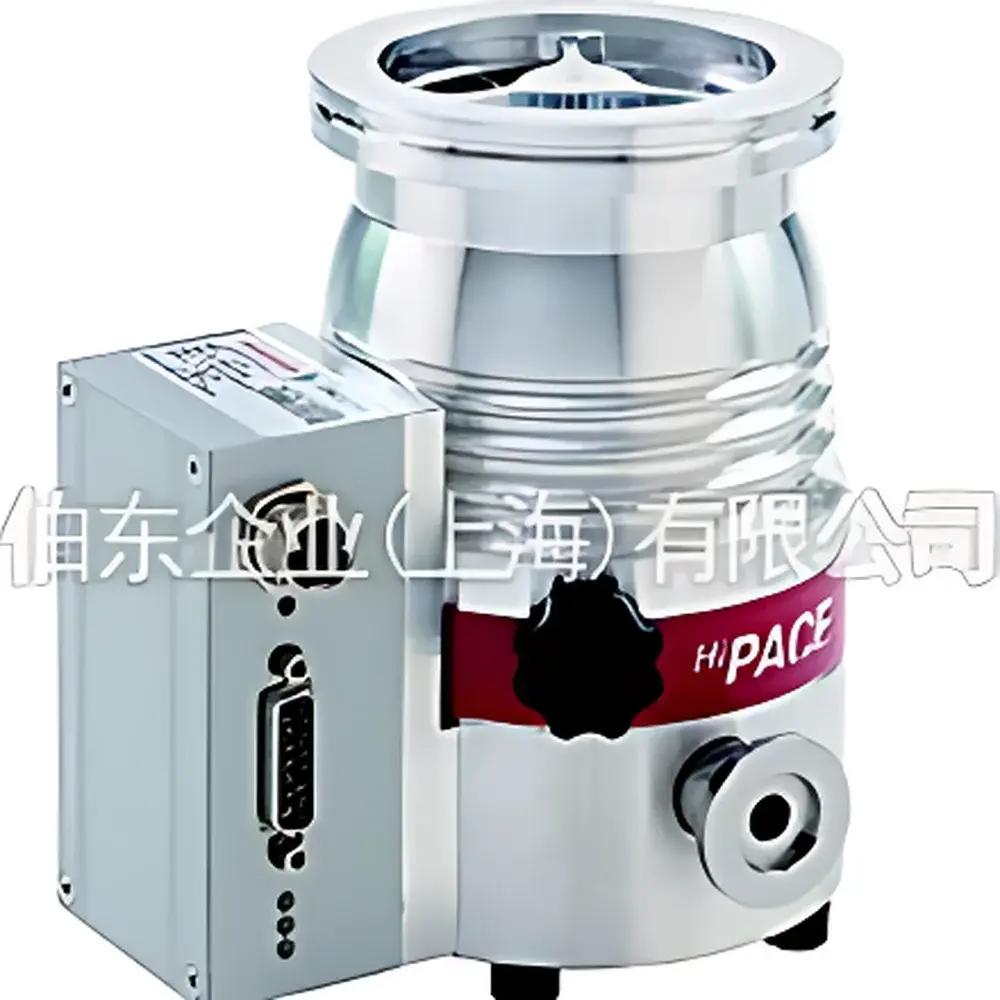
Pfeiffer Vacuum SplitFlow 80 Turbo Molecular Pump
| Brand | Pfeiffer Vacuum |
|---|---|
| Origin | Germany |
| Pump Type | Turbo Molecular Pump |
| Pumping Speed (N₂) | 53 L/s |
| Intermediate Port Speed (N₂) | 0.15 L/s |
| Ultimate Pressure (N₂) | < 4 × 10⁻⁷ hPa |
| Compression Ratio (N₂) | > 1 × 10⁸ |
| Max. Starting Pressure (N₂) | 20 hPa |
| Inlet Flange | DN 63 |
| Outlet Flange | G 1/4" |
| IP Rating | IP54 |
| Certifications | CE, UL/CSA, 2014/30/EU (EMC), 2014/35/EU (LVD) |
| Weight | 2.3 kg |
| Startup Time | ~1.8 min (to full speed) |
| Bearing System | Hybrid Ceramic Bearings |
| Max. Rotational Speed | 90,000 rpm |
| MTBF | ≥ 100,000 hours |
Overview
The Pfeiffer Vacuum SplitFlow 80 is a high-performance, oil-free turbo molecular pump engineered for demanding ultra-high vacuum (UHV) and high-vacuum (HV) applications in analytical instrumentation, R&D laboratories, and industrial process environments. Based on proven Couette-flow physics, the SplitFlow 80 utilizes a multi-stage rotor-stator configuration with precisely balanced titanium-alloy blades rotating at up to 90,000 rpm to achieve momentum transfer to gas molecules—enabling efficient compression and exhaust against atmospheric pressure. Its defining innovation is the integrated intermediate suction port, delivering an additional 0.15 L/s pumping capacity at the mid-stage—ideal for differential pumping of ion sources, mass spectrometer interfaces, or leak detection chambers where staged pressure gradients are critical. Designed and manufactured in Germany under strict ISO 9001 quality management, the SplitFlow 80 meets stringent requirements for long-term stability, low vibration, and electromagnetic compatibility (EMC Directive 2014/30/EU and Low Voltage Directive 2014/35/EU).
Key Features
- Compact, space-saving footprint (170 × 140 × 240 mm) optimized for integration into OEM systems such as helium mass spectrometer leak detectors and surface analysis tools.
- Hybrid ceramic bearing system ensuring mechanical robustness, minimal particle generation, and extended service life—validated MTBF ≥ 100,000 operating hours under continuous duty.
- Integrated digital controller with real-time monitoring of rotational speed, temperature, voltage, current, and fault diagnostics—enabling predictive maintenance and traceable operational history.
- IP54-rated enclosure suitable for laboratory and light-industrial environments, offering protection against dust ingress and water splashing from any direction.
- Compliance with UL/CSA safety standards and full CE marking—including conformity with RoHS and REACH directives—facilitating global deployment and regulatory acceptance.
- High compression ratios (>1 × 10⁸ for N₂; >1 × 10¹⁰ for H₂ and He) enabling effective pumping of light gases essential for residual gas analysis (RGA) and helium leak testing.
Sample Compatibility & Compliance
The SplitFlow 80 is compatible with inert, reactive, and corrosive gas species commonly encountered in vacuum-based analytical workflows—including N₂, Ar, O₂, H₂, He, CO, CO₂, and H₂O vapor—provided upstream foreline pressure remains within specified limits (≤20 hPa). It is routinely deployed in systems requiring compliance with ISO 20483 (vacuum metrology), ASTM E1998 (helium leak testing), and ISO 10110-7 (optical component vacuum processing). When integrated into GMP-regulated instrumentation (e.g., pharmaceutical residual solvent analyzers), its controller supports audit-trail-capable logging aligned with FDA 21 CFR Part 11 principles—though full electronic signature functionality requires external SCADA or LIMS integration.
Software & Data Management
The pump operates natively via its embedded microcontroller and communicates over RS-485 (Modbus RTU) or optional Ethernet (TCP/IP) for seamless integration into host control systems. Pfeiffer’s proprietary TPG300-compatible software suite provides remote configuration, real-time parameter visualization, event logging (start/stop cycles, alarms, thermal events), and firmware update capability. Logged data—including timestamps, rotational speed profiles, and temperature trends—can be exported in CSV format for QA documentation, calibration verification, and failure mode analysis. No cloud dependency or proprietary runtime is required; all functions execute locally to ensure deterministic response and data sovereignty.
Applications
- Helium mass spectrometer leak detection systems—leveraging the intermediate port for differential pumping of the ion source and analyzer chamber.
- Surface science instruments including XPS, AES, and LEED systems requiring stable UHV (<1 × 10⁻⁸ mbar) and low-vibration operation.
- R&D vacuum chambers for thin-film deposition (PVD, CVD), where rapid pump-down and high H₂/He throughput are critical.
- Accelerator beamlines and synchrotron front-ends demanding ultra-clean, hydrocarbon-free vacuum environments.
- OEM integration into compact analytical platforms—such as portable residual gas analyzers and miniaturized ion mobility spectrometers—where size, weight, and power efficiency are constrained.
FAQ
What fore-vacuum pump is recommended for use with the SplitFlow 80?
A two-stage rotary vane pump (e.g., Pfeiffer DuoLine series) or dry scroll pump rated for ≤0.1 mbar ultimate pressure and ≥10 m³/h displacement is recommended to maintain optimal backing pressure during startup and steady-state operation.
Can the SplitFlow 80 operate continuously at full speed?
Yes—the pump is rated for continuous 24/7 operation at nominal speed (90,000 rpm) under ambient temperatures ≤40 °C and relative humidity ≤80% non-condensing, provided adequate cooling airflow and electrical supply stability are maintained.
Is the intermediate port configurable for active gas injection or pressure regulation?
No—the intermediate port is a passive suction port only; it cannot be used for gas dosing or active pressure control. Its conductance and pumping speed are fixed by internal stage geometry.
Does the SplitFlow 80 support analog setpoint control (e.g., 0–10 V input)?
No—speed control is digital-only via Modbus or Ethernet commands. Analog interface is not supported; external PID loops must be implemented at the system controller level.
How is calibration traceability maintained for vacuum performance verification?
Pfeiffer provides factory calibration certificates traceable to PTB (Physikalisch-Technische Bundesanstalt) standards. End users may perform in-situ verification using calibrated capacitance manometers and standardized flow-rate test methods per ISO 3567.



