
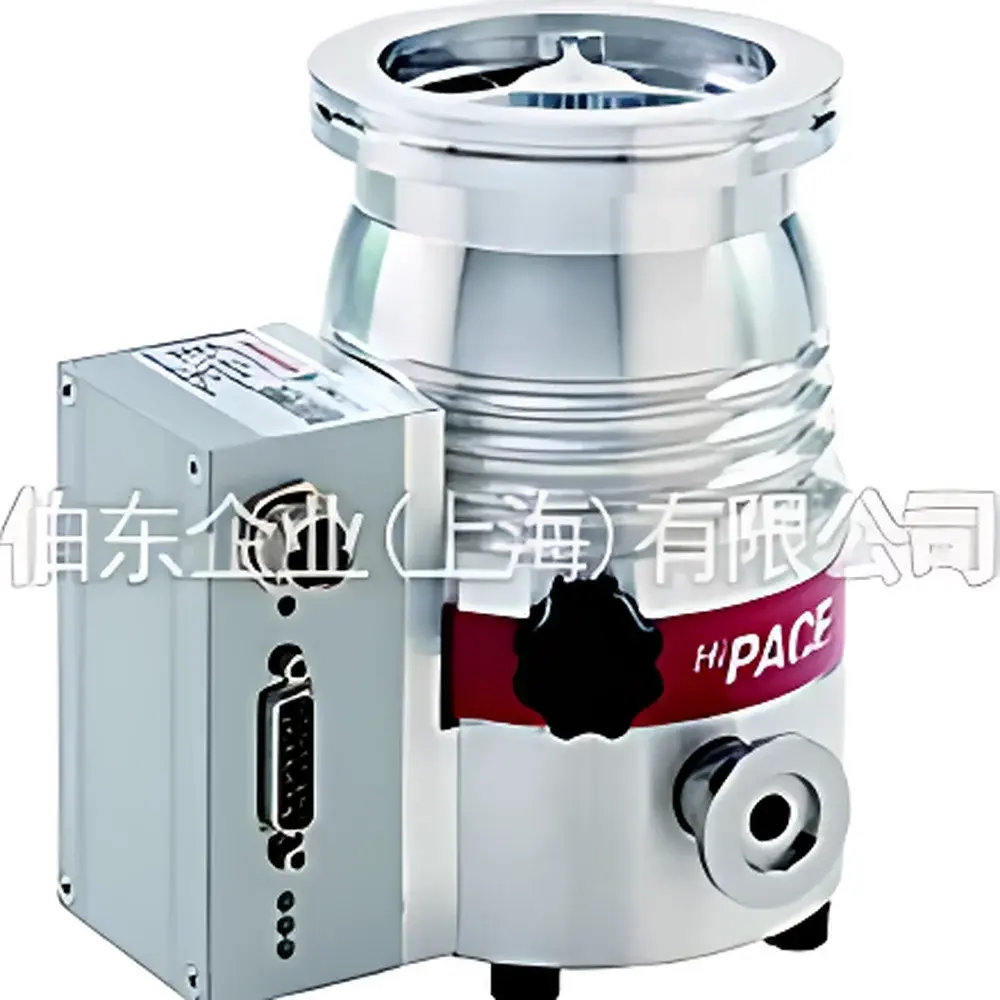
Pfeiffer Vacuum HiPace 60P Turbo Molecular Pump with Integrated TC 110 Controller
| Brand | Pfeiffer Vacuum |
|---|---|
| Origin | Germany |
| Pump Type | Oil-Free Turbo Molecular Pump |
| Nominal Pumping Speed (N₂) | 64 L/s |
| Ultimate Pressure | < 1 × 10⁻⁶ hPa |
| Bearing System | Hybrid Ceramic Ball Bearings |
| Cooling | Convection, Optional Forced Air or Water Cooling (75 L/h, 5–25 °C) |
| Inlet Flange | DN 63 ISO-K |
| Exhaust Flange | DN 16 ISO-KF / G¼" |
| Drive Electronics | TC 110 or TC 110 RS (RS-485 Remote Interface) |
| Rated Speed | 90,000 rpm (±2%) |
| Startup Time | ≤1.1 min |
| IP Rating | IP54 |
| Weight | 2.2–2.3 kg |
| Compression Ratios (Ar/H₂/He/N₂) | 2×10⁶ / 2×10² / 3.5×10³ / 1×10⁶ |
| Max. Pre-vacuum (N₂) | 4 hPa |
| Gas Flow at Full Speed (N₂) | 9.2 hPa·L/s |
| Operating Voltage | 24 V DC (±5%) |
| Max. Permissible Magnetic Field | 4 mT |
Overview
The Pfeiffer Vacuum HiPace 60P is a compact, high-reliability turbo molecular pump engineered for continuous operation in demanding industrial and analytical vacuum environments. Based on proven Holweck-free rotor-stator geometry, it employs a multi-stage axial compression design optimized for robustness against particulate-laden gas loads—making it especially suited for applications where process dust, sputtered material, or condensable vapors are present. Unlike conventional turbomolecular pumps relying on cascaded Holweck stages, the HiPace 60P utilizes a single, integrated rotor assembly with precision-machined titanium blades and ceramic ball bearings, delivering stable performance across variable inlet pressures and ambient conditions. Its ultimate pressure of <1 × 10⁻⁶ hPa (equivalent to <1 × 10⁻⁷ mbar) meets stringent requirements for residual gas analysis, electron microscopy, and thin-film deposition systems. The pump operates at a nominal rotational speed of 90,000 rpm (±2%), achieving a nitrogen pumping speed of 64 L/s at the DN 63 ISO-K inlet flange—consistent with ISO 21360-1 calibration standards.
Key Features
- Integrated TC 110 or TC 110 RS controller providing real-time monitoring, soft-start sequencing, overtemperature/overcurrent protection, and fault logging—fully compliant with IEC 61508 functional safety guidelines for critical vacuum systems.
- IP54-rated housing with built-in nitrogen purge port (G 1/8″) enabling operation in dusty or humid industrial settings without external enclosures.
- Hybrid ceramic ball bearing system ensuring >100,000 hours MTBF under continuous duty; eliminates lubricant degradation and hydrocarbon backstreaming.
- Omnidirectional mounting capability—supports vertical, horizontal, or inverted installation without performance derating.
- Flexible thermal management: standard convection cooling supplemented by optional forced-air or water-cooling (75 L/h flow, 5–25 °C inlet temperature), maintaining rotor thermal stability across ambient temperatures up to 40 °C.
- RS-485 digital interface (TC 110 RS variant) enables seamless integration into SCADA, PLC, or LabVIEW-controlled vacuum architectures with full remote start/stop, speed control, and diagnostic telemetry.
Sample Compatibility & Compliance
The HiPace 60P is designed for use with inert, non-corrosive, and non-condensable gases—including N₂, Ar, He, and H₂—and exhibits high compression ratios essential for effective backing pump isolation: Ar (2 × 10⁶), N₂ (1 × 10⁶), He (3.5 × 10³), and H₂ (2 × 10²). It complies with EU Machinery Directive 2006/42/EC, EMC Directive 2014/30/EU, and RoHS 2011/65/EU. For regulated laboratory environments, its TC 110 controller supports audit-trail-capable event logging and configurable password-protected parameter access—facilitating alignment with GLP and FDA 21 CFR Part 11 data integrity expectations when paired with validated vacuum system software.
Software & Data Management
The TC 110 controller firmware supports Pfeiffer’s proprietary Vacuum Control Suite (VCS) v4.x, enabling configuration, firmware updates, and trend analysis via USB or RS-485. Logged parameters include rotational speed, bearing temperature, motor current, power consumption, and error history—with timestamped entries stored in non-volatile memory. When deployed in networked vacuum systems, the TC 110 RS model allows Modbus RTU communication for centralized monitoring in ISO/IEC 17025-accredited testing laboratories. All operational data exports to CSV for traceability and long-term trending per ISO 10012:2003 measurement management requirements.
Applications
- Physical vapor deposition (PVD) and sputtering systems in photovoltaic and optical coating manufacturing—where resistance to metal particulates and stable base pressure are critical.
- Analytical instrumentation: scanning electron microscopes (SEM), focused ion beam (FIB) tools, residual gas analyzers (RGA), and small-footprint mass spectrometers requiring clean, oil-free vacuum below 10⁻⁶ hPa.
- Industrial leak detection systems operating under fluctuating load conditions—leveraging the pump’s tolerance to transient gas bursts and its fast restart capability (<1.1 min).
- Medical device sterilization chambers and vacuum-assisted packaging lines—validated for continuous operation under IP54-rated environmental conditions.
- Research-scale ultra-high vacuum (UHV) systems, particularly when staged with Pfeiffer’s ACP series dry scroll pumps or Duo series rotary vane pumps as forepumps.
FAQ
What is the maximum allowable pre-vacuum pressure before starting the HiPace 60P?
The pump must be started only after the foreline pressure drops to ≤4 hPa (N₂ equivalent); exceeding this threshold risks rotor overload and premature bearing wear.
Can the HiPace 60P be operated in a vertical orientation with downward exhaust?
Yes—its mechanical design permits unrestricted mounting orientation, including inverted configurations, without compromising pumping performance or bearing life.
Is water cooling mandatory for continuous operation?
No—convection cooling suffices for ambient temperatures ≤30 °C and duty cycles ≤80% of rated speed; water cooling is recommended for sustained operation above 35 °C ambient or full-speed duty in high-heat-load processes.
Does the TC 110 controller support analog setpoint inputs?
No—the TC 110 and TC 110 RS controllers accept only digital commands via front-panel buttons or RS-485; analog speed control requires an external signal converter compatible with Modbus RTU.
What maintenance intervals are recommended for the hybrid ceramic bearing system?
Under normal operating conditions (≤40 °C ambient, no chemical exposure), no scheduled maintenance is required; periodic verification of vibration spectra and bearing temperature trends is advised every 12 months per ISO 13374-1 condition monitoring standards.



