
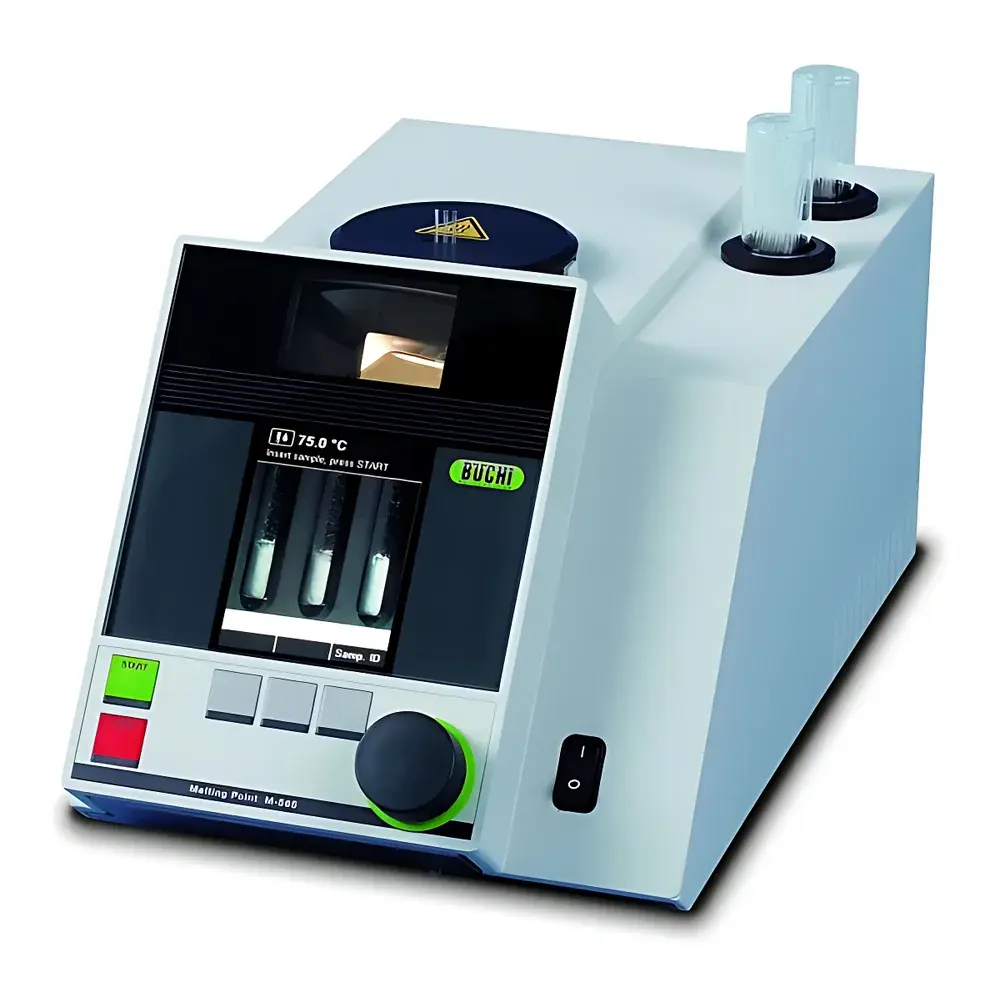
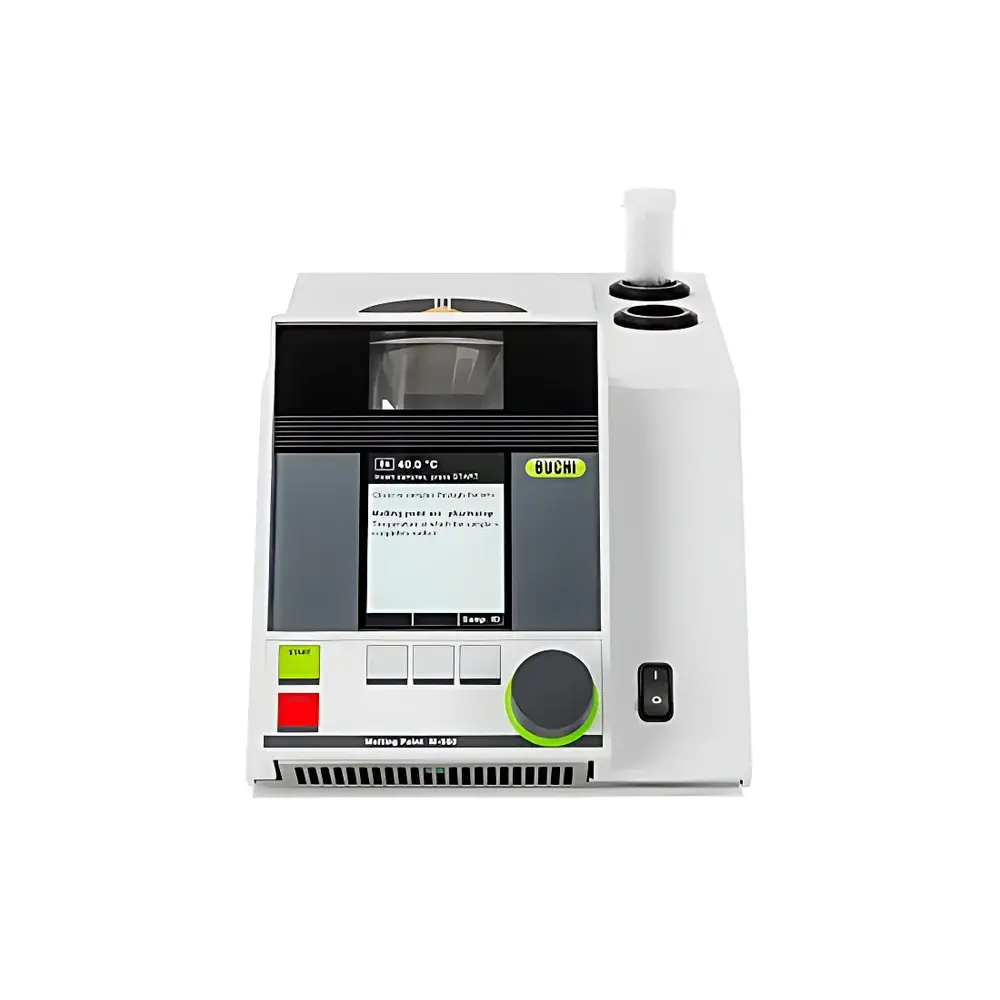
BUCHI M-560/M-565 Melting Point Apparatus
| Brand | BUCHI |
|---|---|
| Origin | Switzerland |
| Manufacturer | BUCHI AG |
| Type | Imported Instrument |
| Model | M-560 / M-565 |
| Temperature Range | Ambient to 400 °C |
| Heating Rates | 0.1, 0.2, 0.5, 1, 1.5, 2, 2.5, 3, 5, 10, 20 °C/min |
| Temperature Repeatability | ±0.1 °C |
| Temperature Accuracy | ±0.3 °C (≤100 °C), ±0.5 °C (≤250 °C), ±0.8 °C (≤400 °C) |
| Capillary Dimensions | 80 mm length × 1 mm diameter |
| Sample Capacity | 3 samples for melting point determination (M-565: automated & visual) |
| Temperature Resolution | 0.1 °C |
| Display | 3.5″ color TFT (320 × 240) |
| Heating Time | ~4 min (50 → 350 °C) |
| Cooling Time | ~10 min (350 → 50 °C) |
| Power Consumption | 150 W |
| Certifications | CE, UL |
| Dimensions (W × D × H) | 190 × 200 × 370 mm |
| Weight | 4.5 kg |
Overview
The BUCHI M-560 and M-565 Melting Point Apparatus are precision thermal analysis instruments engineered for reliable, reproducible determination of melting and boiling points in pharmaceutical, chemical, and academic laboratories. Based on the classic capillary tube method—standardized in pharmacopoeial monographs including Ph. Eur. 2.2.16, USP , and JP 6—the system employs controlled conductive heating within a thermostatically regulated metal bath. The M-560 is a manually operated instrument optimized for routine quality control, while the M-565 integrates real-time video imaging, automated endpoint detection, and digital data logging to support GLP/GMP-compliant workflows. Both models feature high-stability platinum resistance temperature sensors (PT100), microprocessor-based PID temperature control, and a uniform axial heating profile across the sample zone—ensuring minimal thermal gradient effects and high inter-laboratory comparability.
Key Features
- Two-platform design: M-560 for manual operation with visual observation; M-565 for fully automated analysis with integrated camera, image capture, and dynamic endpoint recognition.
- Triple-capillary holder enabling simultaneous measurement of up to three samples—ideal for method verification, reference standard comparison, or batch release testing.
- Robust aluminum heating block with rapid thermal response: achieves 50–350 °C in approximately 4 minutes and cools from 350–50 °C in ~10 minutes—minimizing turnaround time without compromising stability.
- High-resolution 3.5″ color TFT display (320 × 240 pixels) with intuitive icon-driven interface supporting five language options (English, German, French, Spanish, Chinese).
- Comprehensive regulatory compliance: preconfigured IQ/OQ documentation packages available for M-565; full traceability for audit readiness under FDA 21 CFR Part 11, EU Annex 11, and ISO/IEC 17025 requirements.
- Optional M-569 sample loader—a patented, spring-loaded capillary filling device ensuring consistent sample packing height and reduced operator variability.
Sample Compatibility & Compliance
The apparatus accepts standard 1 mm outer-diameter glass capillaries (80 mm length), compatible with crystalline organic compounds, APIs, polymers, and small-molecule intermediates. Sample preparation follows ICH Q5A and Ph. Eur. 2.2.16 guidelines: dry, finely powdered material packed to 3–5 mm height with uniform density. The M-565’s optical system enables real-time monitoring of meniscus formation, sintering, and collapse—critical for detecting eutectic behavior or polymorphic transitions. All operational parameters—including heating rate, dwell time, and video frame rate—are user-configurable and stored with timestamped metadata. Instrument qualification conforms to ASTM E324 and USP performance verification protocols. CE and UL certifications confirm electrical safety and electromagnetic compatibility per IEC 61010-1.
Software & Data Management
The M-565 operates with BUCHI’s proprietary MP Software v3.x, supporting local storage (internal flash memory), USB export (CSV, PDF, JPEG), and optional Ethernet connectivity for networked lab environments. Each measurement record includes raw temperature vs. time curves, annotated video clips (AVI format), operator ID, calibration status, and environmental conditions (if external sensor integrated). Audit trails log all parameter changes, user logins, and report generation events—enabling full 21 CFR Part 11 compliance when paired with electronic signatures and role-based access control. Data export formats are compatible with LIMS integration (e.g., LabWare, Thermo Fisher SampleManager) and statistical process control (SPC) platforms.
Applications
- Pharmaceutical QC/QA: identity confirmation and purity assessment of active pharmaceutical ingredients (APIs) per USP and EP 2.2.16.
- Polymorph screening: differentiation of solid-state forms via subtle melting onset shifts and plateau broadening.
- Chemical synthesis validation: verification of reaction completion and intermediate purity in R&D labs.
- Educational use: hands-on instruction in thermal behavior, phase transitions, and pharmacopoeial methodology.
- Regulatory submissions: generation of auditable, ALCOA+ compliant data packages for ANDA, NDA, and CMC sections.
FAQ
What pharmacopoeial standards does the M-565 comply with?
It meets Ph. Eur. 2.2.16, USP , JP 6, and Chinese Pharmacopoeia ChP 0612 requirements for melting point determination—including specifications for heating rate accuracy, temperature uniformity, and observer independence.
Can the M-565 be validated for GMP environments?
Yes. BUCHI provides documented IQ/OQ protocols with test scripts, acceptance criteria, and blank execution records—validated against ASTM E324 and internal SOPs aligned with ISO/IEC 17025.
Is the M-560 suitable for regulated work?
While the M-560 lacks automated data capture, it supports manual GLP documentation when used with calibrated thermometers, written SOPs, and printed reports via optional thermal printer interface.
How does the M-569 sample loader improve reproducibility?
The M-569 ensures consistent capillary fill height (±0.2 mm) and compaction force—reducing inter-operator variation in sample morphology, which directly impacts observed melting onset and range.
What maintenance is required for long-term accuracy?
Annual recalibration using NIST-traceable reference standards (e.g., indium, tin, zinc) is recommended. The heating block requires no consumables; only periodic cleaning of optical windows and capillary holder with lint-free ethanol wipes.



