
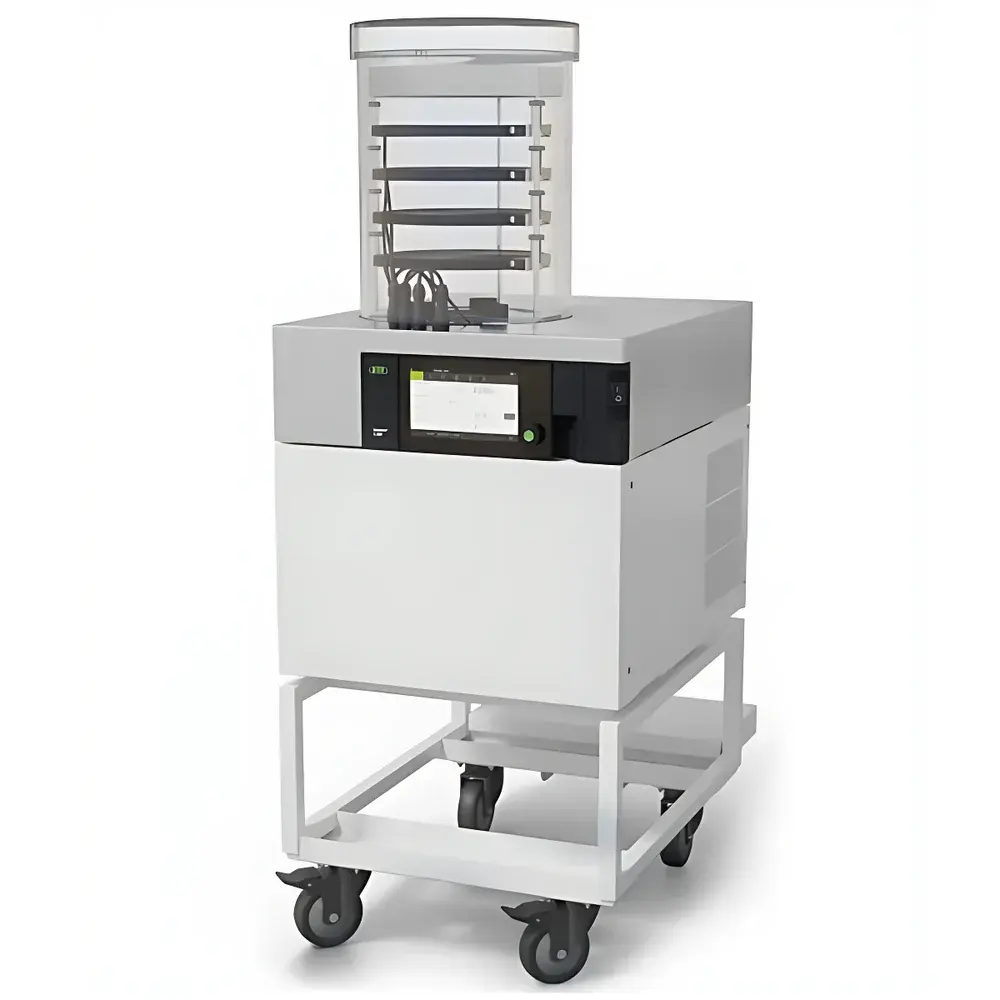
BUCHI L-250 Freeze Dryer
| Brand | BUCHI |
|---|---|
| Origin | Imported |
| Manufacturer Type | Manufacturer |
| Model | L-250 |
| Application Scope | Laboratory Use |
| Condenser Temperature | –85 °C |
| Condensation Capacity | 4 kg/24 h (water), 5 kg total |
| Refrigerant | Natural refrigerant with GWP = 4 |
| Noise Level | Reduced |
| Heat Emission | Low |
| Control System | Infinite-Control™ touchscreen interface, PC software, and mobile app support |
| Compliance | Designed for GLP-compliant workflows |
Overview
The BUCHI L-250 Freeze Dryer is a benchtop lyophilization system engineered for precision, reproducibility, and environmental responsibility in modern research and quality control laboratories. It operates on the fundamental principle of sublimation—removing water or volatile solvents from frozen samples under vacuum while maintaining structural integrity and biological activity. Unlike conventional freeze dryers relying on high-GWP synthetic refrigerants and energy-intensive cooling cycles, the L-250 integrates BUCHI’s proprietary EcoStream™ technology to redefine sustainability without compromising performance. This system features an advanced dual-stage compression architecture optimized for rapid cooldown and stable condenser operation at –85 °C, enabling efficient capture of both aqueous and organic vapors. Its design reflects a systems-level approach to laboratory infrastructure—minimizing thermal load on HVAC systems, reducing ambient noise below typical lab thresholds (<55 dB[A]), and delivering measurable reductions in annual kWh consumption relative to legacy models.
Key Features
- EcoStream™ cooling technology utilizing a natural refrigerant (GWP = 4), significantly lowering global warming impact compared to R-404A (GWP ≈ 3922) or R-507
- Ultra-low condenser temperature of –85 °C, achieved via optimized compressor staging and heat exchange geometry
- High-efficiency condensation capacity: 4 kg of water per 24 hours; up to 5 kg total condensable mass including methanol, ethanol, and acetonitrile
- Infinite-Control™ digital interface with intuitive touchscreen navigation, real-time graphing, and multi-parameter logging (vacuum, shelf temperature, condenser temp, time)
- Integrated endpoint determination algorithm based on pressure rise test (PRT) and product thermocouple monitoring
- Modular footprint: compatible with standard lab benches, mobile carts, and fume hood installations (fully vented configuration available)
- Energy-saving mode automatically adjusts compressor output during low-load phases without sacrificing process stability
Sample Compatibility & Compliance
The L-250 accommodates a broad spectrum of sample formats—including vials (2–50 mL), flasks (up to 1 L), and open trays—making it suitable for pharmaceutical formulation development, biologics stabilization, food matrix analysis, and material science applications. Its condenser design ensures reliable trapping of common organic solvents used in lyophilization protocols (e.g., tert-butanol, dioxane), eliminating cross-contamination risks between batches. From a regulatory standpoint, the system supports Good Laboratory Practice (GLP) and current Good Manufacturing Practice (cGMP) environments through configurable user roles, electronic signatures, and full audit trail functionality aligned with FDA 21 CFR Part 11 requirements. Data export complies with ASTM E2500-13 (Standard Guide for Specification, Design, and Verification of Pharmaceutical and Biopharmaceutical Manufacturing Systems) and ISO 20936:2021 (Lyophilization process validation).
Software & Data Management
Control and documentation are unified via BUCHI’s LyoLogic™ software suite, which provides remote monitoring, method library management, and automated report generation in PDF or CSV format. All process parameters—including vacuum ramp rates, shelf temperature profiles, and condenser loading curves—are timestamped and encrypted. The system logs operator actions, alarm events, and calibration history with immutable records. Integration with LIMS platforms is supported via OPC UA and HTTP API protocols. Mobile application access allows for real-time status checks and push notifications for cycle completion or deviation alerts—enabling uninterrupted workflow continuity across shift changes or off-site oversight.
Applications
- Stabilization of monoclonal antibodies, vaccines, and plasmid DNA under controlled residual moisture conditions
- Routine drying of microbial cultures, enzyme preparations, and diagnostic reagents requiring long-term ambient storage
- Preparation of porous scaffolds in tissue engineering and nanomaterial composites
- Concentration and purification of natural extracts (e.g., polyphenols, alkaloids) without thermal degradation
- Method development and scale-down modeling for industrial lyophilization processes
- Accelerated stability testing per ICH Q1A(R3) guidelines using programmable shelf temperature ramps
FAQ
What vacuum level can the L-250 achieve during primary drying?
The system reaches base pressures below 0.01 mbar (1 Pa) with its integrated oil-free diaphragm vacuum pump option; optional turbomolecular pumping extends capability to <1×10⁻⁴ mbar for solvent-sensitive applications.
Is the condenser compatible with aggressive solvents like chloroform or DMSO?
While optimized for water, methanol, ethanol, and acetone, extended exposure to highly corrosive or high-boiling-point solvents (e.g., DMSO, DMF) requires evaluation of condenser coating compatibility and may necessitate optional stainless-steel cold traps.
Can the L-250 be validated per IQ/OQ/PQ protocols?
Yes—BUCHI provides comprehensive validation documentation packages, including factory-verified temperature mapping reports, vacuum leak test procedures, and traceable calibration certificates for all critical sensors.
Does the system support automatic defrosting and drainage?
The L-250 includes programmable auto-defrost sequences with timed condensate drainage; manual drain valve access is also provided for maintenance verification.
How is cybersecurity addressed in the software architecture?
LyoLogic™ implements TLS 1.2+ encryption, role-based authentication, and firmware signing to prevent unauthorized access or tampering—meeting NIST SP 800-53 Rev. 5 controls for laboratory instrumentation.



