
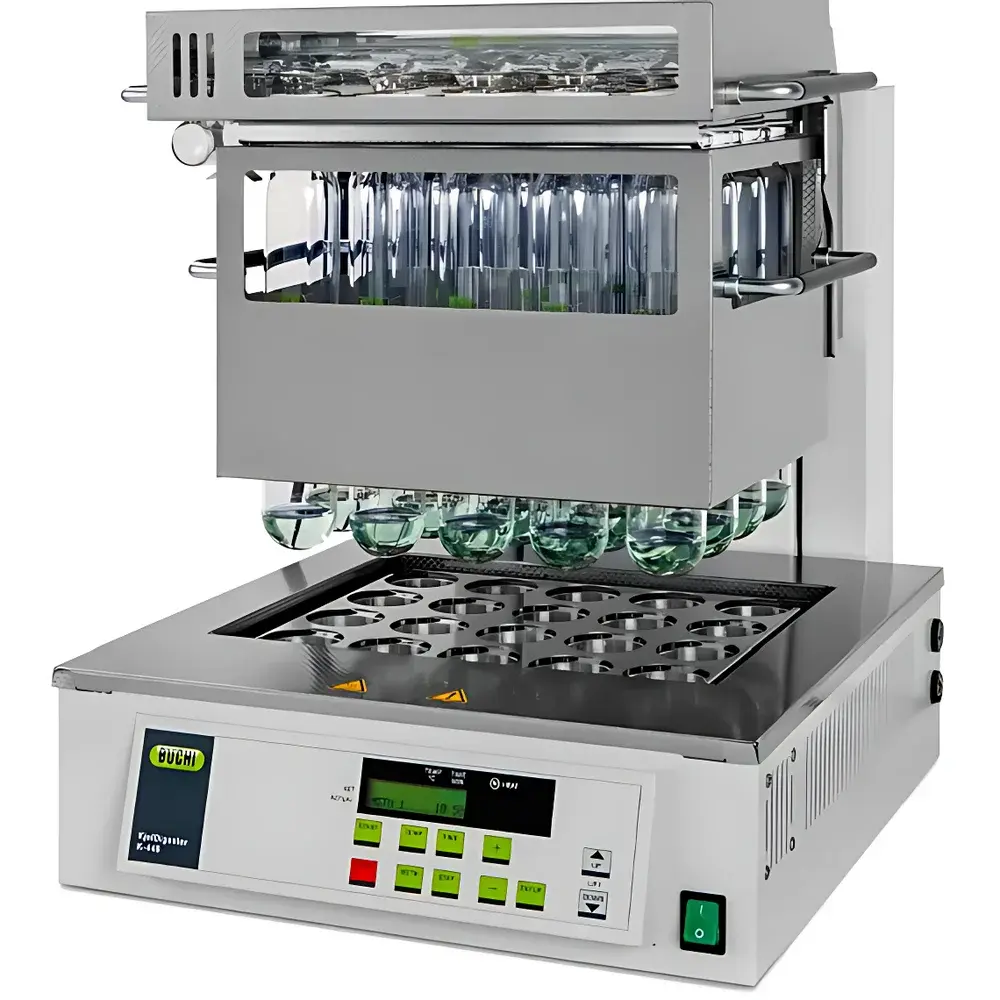
BUCHI K-449 Automated Kjeldahl Digestion System
| Brand | BUCHI |
|---|---|
| Origin | Switzerland |
| Manufacturer | BUCHI AG |
| Product Type | Electric Heating Digestion Instrument |
| Automation Level | Fully Automatic |
| Sample Capacity | 20 positions |
| Max. Heating Temperature | 420 °C |
| Temperature Control Accuracy | ±1 °C |
| Heating Block Material | Aluminum Alloy Block |
| Reagent Channels | 20 |
| Compliance | AOAC, ISO 8585, EN 13656, ISO 14891 |
| Power Supply | 220–240 VAC, 50/60 Hz |
| Max. Power Consumption | 2300 W |
| Dimensions (W × H × D) | 435 × 558 × 764 mm |
| Net Weight | 25.8 kg |
| Temperature Range | 30–450 °C |
| Temp. Uniformity | ≤±7 °C at 420 °C |
| Sample Tube Format | 300 mL digestion tubes |
Overview
The BUCHI K-449 Automated Kjeldahl Digestion System is an engineered solution for high-throughput, reproducible, and operator-safe sample mineralization in nitrogen determination workflows. Based on classical wet-chemical acid digestion—using concentrated sulfuric acid under controlled thermal conditions—the K-449 implements precise aluminum-block heating to decompose organic matrices (e.g., food, feed, environmental, and agricultural samples) into ammonium sulfate. Its design adheres to the fundamental principles of Kjeldahl methodology as codified in AOAC Official Method 984.13, ISO 8585:2020, EN 13656:2002, and ISO 14891:2013. Unlike open-heating or ceramic-block systems, the K-449’s monolithic aluminum heating block ensures rapid thermal response, uniform heat distribution across all 20 positions, and minimal thermal lag—critical for method robustness and inter-laboratory comparability.
Key Features
- Fully automated digestion sequence with programmable time/temperature ramps, hold steps, and post-digestion cooling profiles—enabling unattended operation overnight or over weekends.
- Integrated sample lift mechanism: motor-driven vertical translation of the entire 20-position sample rack eliminates manual handling of hot digestion tubes, reducing burn risk and improving ergonomics.
- Dedicated reagent delivery module with 20 independent channels for synchronized, metered addition of catalysts (e.g., selenium or copper sulfate) and oxidizing agents—ensuring stoichiometric consistency across all samples.
- Optimized gas management interface: direct compatibility with the BUCHI K-415 Absorption Unit for real-time neutralization of SO2, NOx, and HBr fumes via alkaline trapping; sealed transfer path minimizes operator exposure and lab contamination.
- Aluminum heating block with active temperature feedback control (±1 °C setpoint accuracy) and validated uniformity (≤±7 °C deviation at 420 °C), meeting GLP traceability requirements for thermal validation.
- Modular mechanical architecture: magnetic mounting system for quick attachment/detachment of the absorption manifold and drip tray—designed to extend service life of core components and simplify preventive maintenance.
Sample Compatibility & Compliance
The K-449 accommodates standard 300 mL Kjeldahl digestion tubes (borosilicate glass, ASTM E438 Type I, Class A) and supports a broad range of sample types—including dairy products, cereals, meat, soil extracts, and wastewater sludge—within defined matrix mass limits (typically 0.5–5 g dry weight). All operational parameters—including ramp rates, hold durations, and final digestion temperatures—are configurable to align with method-specific requirements from AOAC, ISO, and national food safety authorities. The system’s firmware supports audit-trail logging (user ID, timestamp, parameter changes) compliant with FDA 21 CFR Part 11 when integrated with BUCHI’s LabX software platform. Routine performance verification can be conducted using NIST-traceable reference materials (e.g., BCR-185R skim milk powder) to confirm recovery accuracy and digestion completeness.
Software & Data Management
The K-449 operates standalone or integrates seamlessly with BUCHI LabX LIMS-ready software for centralized method deployment, instrument monitoring, and electronic record retention. LabX provides role-based access control, digital signature support, and automatic generation of PDF reports containing full digestion logs (temperature vs. time curves, reagent volumes dispensed, lift activation events). All data are stored in encrypted SQLite databases with immutable timestamps, satisfying ALCOA+ (Attributable, Legible, Contemporaneous, Original, Accurate) data integrity criteria. Optional OPC UA connectivity enables bidirectional communication with enterprise MES or ERP systems for production batch traceability in regulated food and feed manufacturing environments.
Applications
- Quantitative total nitrogen analysis in compliance with ISO 14891 for infant formula and dietary supplements.
- Routine protein content determination in animal feed per AOAC 992.15 and EN 13656.
- Environmental monitoring of organic nitrogen in sewage sludge and compost under ISO 11261.
- Quality control of fertilizers and agrochemicals per ISO 5983-1 and DIN 15952.
- Research-scale method development for novel digestion protocols involving mixed-acid systems (e.g., H2SO4/H2O2) requiring precise thermal profiling.
FAQ
Does the K-449 require external ventilation or fume hood integration?
No—the system is designed for closed-loop gas handling when paired with the K-415 absorption unit; however, installation in a certified chemical fume hood is recommended for initial setup, maintenance, or non-standard digestion chemistries.
Can the K-449 be validated for GMP environments?
Yes—its temperature calibration traceability (to NIST standards), electronic audit trail, and LabX qualification packages (IQ/OQ/PQ documentation templates) support validation under EU Annex 11 and FDA guidance.
What maintenance intervals are recommended for the aluminum heating block?
Visual inspection and cleaning of the block surface after every 200 digestions; full recalibration of temperature sensors every 12 months or per internal SOP.
Is method transfer from older BUCHI models (e.g., K-375) straightforward?
Yes—K-449 retains identical tube geometry, heating profile logic, and reagent dosing mechanics; existing SOPs require only minor updates to reflect enhanced automation features and improved thermal stability.



