
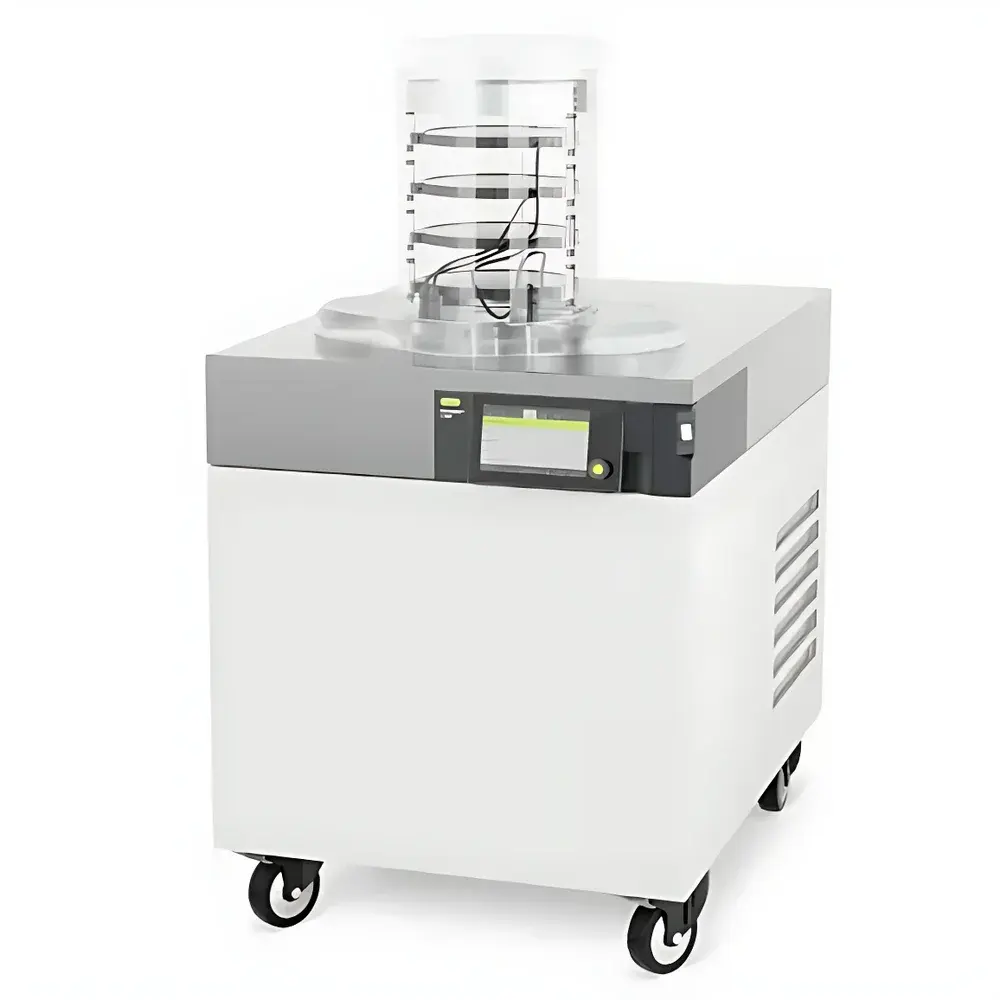
BUCHI Lyovapor L-300 Laboratory Freeze Dryer
| Brand | BUCHI |
|---|---|
| Origin | Switzerland |
| Manufacturer Type | Original Equipment Manufacturer (OEM) |
| Product Origin | Imported |
| Model | Lyovapor L-300 |
| Pricing | Available upon Request |
Overview
The BUCHI Lyovapor L-300 is a high-performance laboratory freeze dryer engineered for continuous, scalable lyophilization of heat-sensitive biologicals, pharmaceuticals, and analytical standards. It operates on the fundamental principles of sublimation under deep vacuum—where ice transitions directly from solid to vapor without passing through the liquid phase—enabling preservation of structural integrity, bioactivity, and chemical stability in delicate samples. Unlike conventional batch-mode systems, the Lyovapor L-300 integrates BUCHI’s proprietary Infinite-Technology™ architecture, which employs two independently controlled condensers operating in alternating cycles. This design eliminates downtime between batches and sustains uninterrupted operation at ultra-low condensation temperatures down to –105 °C—critical for efficient trapping of both water vapor and low-volatility organic solvents (e.g., tert-butanol, acetonitrile, ethyl acetate) commonly used in formulation development.
Key Features
- Dual-Condenser Infinite-Technology™ System: Two stainless-steel condensers alternate between active condensation and automatic defrosting/cleaning cycles, ensuring zero process interruption and maintaining consistent vacuum integrity throughout extended runs.
- –105 °C Condensation Capability: Achieved via a cascade refrigeration system with environmentally compliant refrigerants, enabling reliable capture of volatile organic solvents beyond aqueous matrices—essential for non-aqueous lyophilization protocols.
- Infinite-Control™ Touch Interface: A 7-inch capacitive touchscreen with intuitive workflow navigation supports real-time monitoring and adjustment of shelf temperature (–50 °C to +70 °C), chamber pressure (0.001–1.0 mbar), condenser temperature, and cycle phase timing.
- Mobile Remote Access: Secure web-based interface accessible via iOS or Android devices allows remote supervision, alarm acknowledgment, and parameter override—fully compatible with institutional IT security policies and TLS 1.2 encryption.
- Robust Vacuum Architecture: Integrated oil-free diaphragm vacuum pump with integrated pressure regulation and optional helium leak detection port for validation-grade vacuum integrity verification.
- GMP-Ready Design: All wetted parts comply with ASTM F86 surface finish standards (Ra ≤ 0.4 µm); chamber and condenser are electropolished AISI 316L stainless steel; full traceability of materials of construction per EN 10204 3.1 certification.
Sample Compatibility & Compliance
The Lyovapor L-300 accommodates vials (2–50 mL), serum bottles, flasks (up to 2 L), and custom trays—compatible with stoppering modules for terminal sterilization workflows. Its operational envelope supports formulations containing proteins, monoclonal antibodies, plasmid DNA, vaccines, and small-molecule APIs across ICH Q5C stability classifications. The system meets key regulatory expectations for equipment qualification: it supports IQ/OQ/PQ documentation packages aligned with ISO 9001, ISO 13485, and FDA 21 CFR Part 11 requirements—including electronic signature enforcement, audit trail logging (retention ≥ 3 years), and user role-based access control (admin/operator/technician tiers). Optional validation support includes thermocouple mapping per ASTM E2297 and chamber leak rate testing per ISO 13485 Annex C.
Software & Data Management
Lyovapor Control Software (v4.2+) provides deterministic cycle scripting with up to 99 steps per program, including ramp/soak profiles, pressure-controlled primary drying, and dynamic annealing. All process data—including time-stamped shelf temperature, chamber pressure, condenser load, and vacuum pump current—are recorded at configurable intervals (1–60 seconds) and exported in CSV or PDF format compliant with ALCOA+ principles. The software supports direct integration with LIMS platforms via OPC UA protocol and includes built-in deviation alerting with SMS/email escalation (via SMTP or Microsoft Graph API). Audit trails are immutable and timestamped to UTC, satisfying GLP/GMP data integrity requirements for QC laboratories undergoing MHRA, EMA, or PMDA inspections.
Applications
- Stabilization of biologics during pre-formulation screening and clinical trial material manufacturing
- Lyophilization of reference standards for HPLC, GC-MS, and ICP-MS calibration
- Preparation of sterile powders for inhalation (DPI) and injectables under aseptic processing conditions
- Solvent removal from nanomaterial dispersions and liposomal suspensions without aggregation
- Dehydration of microbial cultures and enzymatic preparations for long-term archival storage
- Method development for continuous freeze-drying processes aligned with Quality by Design (QbD) frameworks
FAQ
Does the Lyovapor L-300 support validation for GMP environments?
Yes—it ships with a comprehensive DQ/IQ/OQ documentation package and supports PQ execution with third-party qualified sensors. Full 21 CFR Part 11 compliance is enabled via optional software license.
Can the system handle solvent mixtures containing ethanol or acetone?
Yes—the –105 °C condenser enables efficient capture of ethanol, acetone, methanol, and other low-boiling solvents when used within defined concentration limits and under appropriate pressure control.
Is remote monitoring possible without installing additional server infrastructure?
Yes—Infinite-Control™ uses embedded HTTPS server functionality; no local server or cloud subscription is required for basic remote viewing and control.
What maintenance intervals are recommended for the vacuum pump and refrigeration system?
Diaphragm pump membranes require replacement every 6,000 operating hours; cascade refrigerant levels and oil integrity are verified annually by BUCHI-certified service engineers.
How is cleaning-in-place (CIP) performed on the dual condenser system?
Automated CIP is executed via programmable hot nitrogen purge and controlled condensate drainage; validation of residue removal follows USP guidelines for analytical instrument qualification.



