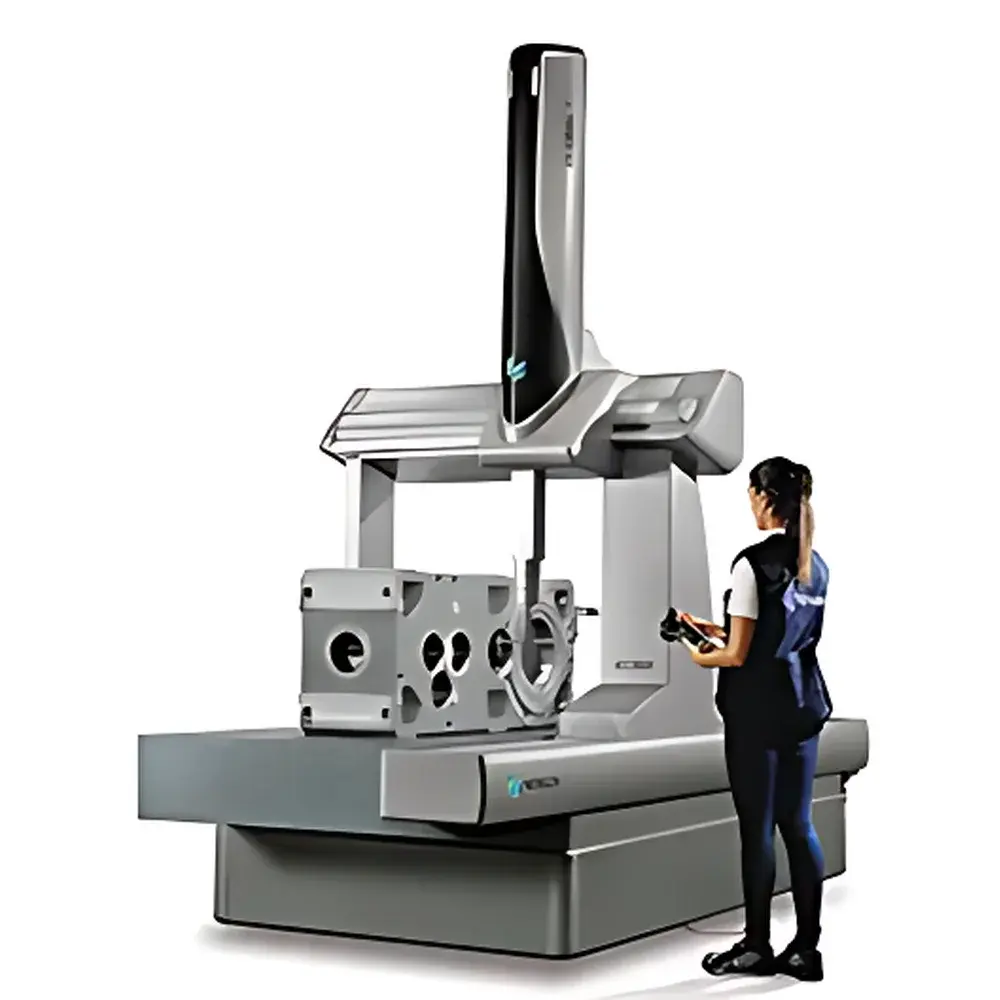
Hexagon GLOBAL S Bridge Coordinate Measuring Machine
| Brand | Hexagon |
|---|---|
| Origin | Shandong, China |
| Manufacturer Type | Authorized Distributor |
| Origin Category | Domestic |
| Model | GLOBAL S |
| Configuration Type | Bridge-type |
| Operation Mode | Fully Automatic |
| Instrument Orientation | Vertical |
| Measurement Method | Hybrid Contact & Non-contact |
| Measurement Volume Range | 500×700×500 mm to 2000×5000×1500 mm |
| Standard Operating Temperature | 15–30 °C |
| Primary Application Sectors | Automotive, Precision Manufacturing, Aerospace |
Overview
The Hexagon GLOBAL S is a high-performance bridge-type coordinate measuring machine (CMM) engineered for precision geometric metrology across demanding industrial environments. Built upon Hexagon’s proven GLOBAL platform, it integrates advanced mechanical architecture with multi-sensor modularity to deliver traceable, repeatable, and ISO/IEC 17025-aligned dimensional measurements. Its core measurement principle relies on three-axis orthogonal motion guided by high-stiffness granite base and precision air-bearing guideways, coupled with high-resolution optical encoders (certified by PTB for thermal expansion coefficient). The system supports both tactile probing (trigger and scanning) and non-contact sensing (confocal white light, laser line scanning), enabling full-geometry acquisition—from GD&T-compliant feature inspection to freeform surface digitization—within a single metrology platform. Designed for integration into production-critical workflows, the GLOBAL S operates reliably within extended environmental conditions (15–30 °C), minimizing dependency on climate-controlled metrology labs while maintaining compliance with ISO 10360 and VDI/VDE 2617 standards.
Key Features
- Monolithic granite base with integrated dovetail guideways ensures long-term structural stability and volumetric accuracy consistency across the entire measurement envelope.
- Precision triangular beam design delivers superior stiffness-to-mass ratio, enabling high-dynamic-speed operation without compromising measurement uncertainty.
- Preloaded air bearings on all axes provide frictionless, low-wear motion, sustaining sub-micron positioning repeatability even at maximum traverse speeds.
- Real-time thermal compensation system—leveraging encoder-integrated temperature sensors and workpiece-mounted thermistors—dynamically corrects for thermal drift per ISO 230-3.
- PULSE environmental monitoring module continuously logs ambient temperature, humidity, and vibration, supporting GLP/GMP audit trails and predictive maintenance scheduling.
- Integrated safety system with laser-based area monitoring automatically decelerates axis motion upon intrusion detection, compliant with ISO 13857 and EN 61496-1.
- Modular sensor interface supports automatic tool-changing between tactile probes (PH10M, PH20), scanning heads (LP-S2), confocal white-light sensors (LW400), and HP-L series laser scanners—all within a single measurement program.
- Message Light status indicator enables remote visual verification of machine state (e.g., idle, measuring, error), optimizing operator workflow in large-scale shop-floor deployments.
- Low-maintenance belt drive system utilizing synchronous flat and V-belts minimizes mechanical vibration and ensures smooth, quiet axis translation.
- High-resolution linear encoders with 0.005 µm resolution and PTB-certified thermal behavior ensure metrological traceability to national standards.
Sample Compatibility & Compliance
The GLOBAL S accommodates parts ranging from small precision components (e.g., fuel injector nozzles, surgical implants) to large aerospace assemblies (e.g., wing ribs, fuselage panels), with maximum part weight support up to 3,000 kg depending on configuration. Its hybrid measurement capability allows seamless transition between contact-based GD&T evaluation (per ASME Y14.5 and ISO 1101) and non-contact surface characterization (e.g., roughness, waviness, transparency-sensitive features). The system meets ISO 9001:2015 requirements for measurement process control and supports FDA 21 CFR Part 11 compliance when deployed with PC-DMIS Enterprise software and validated electronic signature workflows. All configurations are designed to satisfy ASTM E1379 (standard practice for CMM verification) and are compatible with NIST-traceable calibration artifacts.
Software & Data Management
PC-DMIS—the industry-standard metrology software suite—is fully integrated with the GLOBAL S, offering parametric programming, CAD-based alignment, statistical process control (SPC) reporting, and automated report generation (PDF, Excel, XML). Version-controlled measurement programs include full audit logging, change history, and user-access permissions aligned with ISO/IEC 17025 clause 7.7. Data export conforms to Q-DAS QDB, DMIS 3.7, and STEP AP242 formats for interoperability with PLM systems (e.g., Teamcenter, Windchill). Optional modules include GD&T Advisor for real-time tolerance stack-up analysis and AutoRun for unattended batch inspection with barcode-triggered job loading.
Applications
- Automotive: Engine block cylinder bore cylindricity, transmission gear tooth profile, EV battery housing flatness and positional tolerancing.
- Aerospace: Turbine blade airfoil deviation, composite wing skin contour fidelity, landing gear component concentricity under thermal load simulation.
- Precision Manufacturing: Micro-machined medical device dimensions (stents, catheter hubs), optical lens mount runout, semiconductor wafer stage flatness verification.
- Reverse Engineering: Full-part laser scanning of legacy components for CAD reconstruction, mold cavity digitization, and tool wear analysis.
- Quality Gate Inspection: In-line or near-line verification of first-article and periodic production samples against APQP-defined control plans.
FAQ
What is the maximum permissible environmental temperature fluctuation during operation?
The GLOBAL S maintains specified volumetric accuracy within ±0.5 °C/hour drift; continuous operation is validated across 15–30 °C with active thermal compensation.
Can the system be integrated into an Industry 4.0 manufacturing execution system (MES)?
Yes—via OPC UA server interface and RESTful API, enabling real-time measurement data exchange with MES/SCADA platforms including Siemens Opcenter, Rockwell FactoryTalk, and SAP ME.
Is calibration certification included with delivery?
Each unit ships with factory-issued ISO 17025-accredited calibration certificate covering all axes and standard probe configurations; on-site acceptance testing follows VDI/VDE 2617 Part 2.5.
How does the automatic sensor changer maintain measurement traceability after tool exchange?
All sensor modules undergo individual calibration using certified reference standards; the system applies dynamic correction matrices based on calibrated offset vectors and orientation parameters stored in the probe library.
What level of operator training is required for routine programming?
PC-DMIS offers role-based training paths: basic operation (2 days), GD&T programming (5 days), and automation scripting (3 days); Hexagon-certified instructors deliver on-site or virtual sessions.