
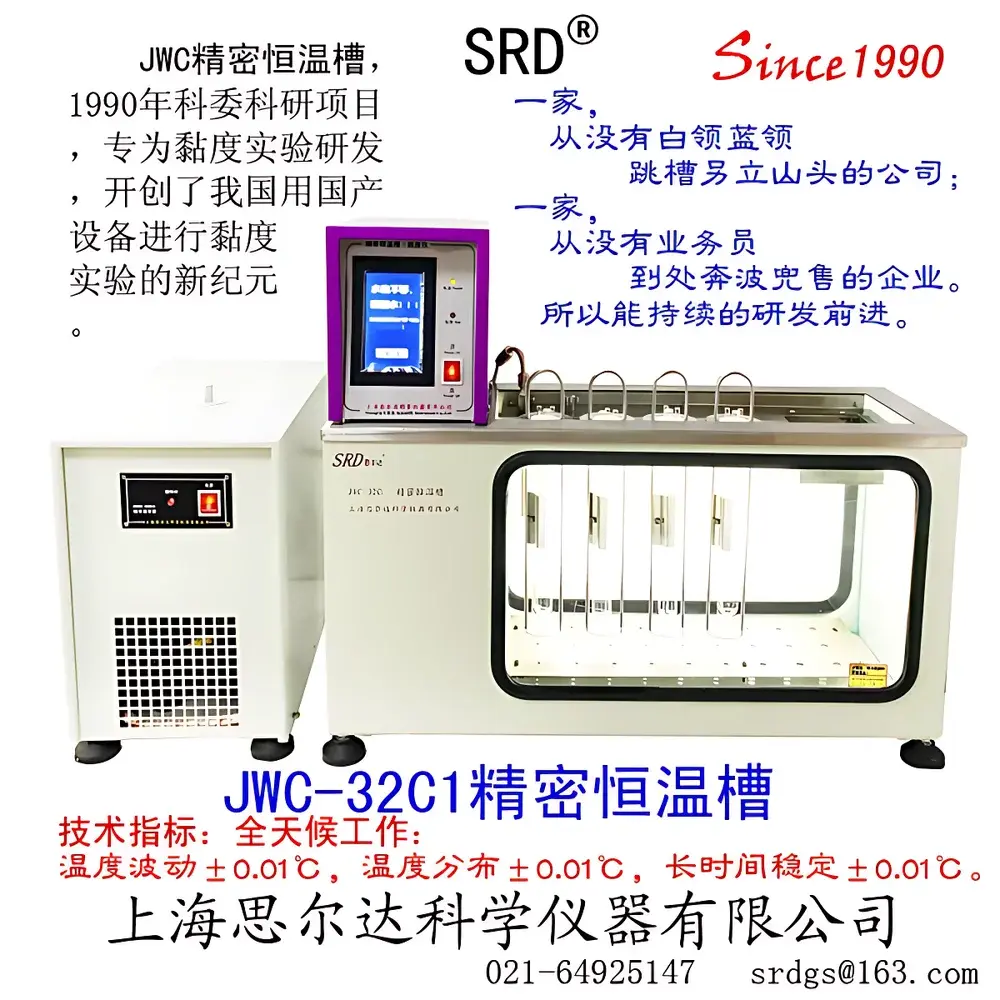
JWC Constant Temperature Bath (SRD NCY Kinematic Viscosity Tester)
| Brand | SRD |
|---|---|
| Origin | Shanghai, China |
| Model | SRD NCY |
| Application | Manual & Automated Kinematic Viscosity Testing with Ubbelohde, Ostwald, and Cannon-Fenske Viscometers |
| Compliance | Designed for ASTM D445, ISO 3104, GB/T 265, and USP <911> viscosity measurement protocols |
| Temperature Control Range | 20–100 °C (±0.01 °C stability) |
| Bath Capacity | 20 L stainless steel reservoir |
| Heating/Cooling | Peltier-assisted dual-mode thermal regulation |
| Interface | Analog manual timing inputs + optional digital timer integration |
Overview
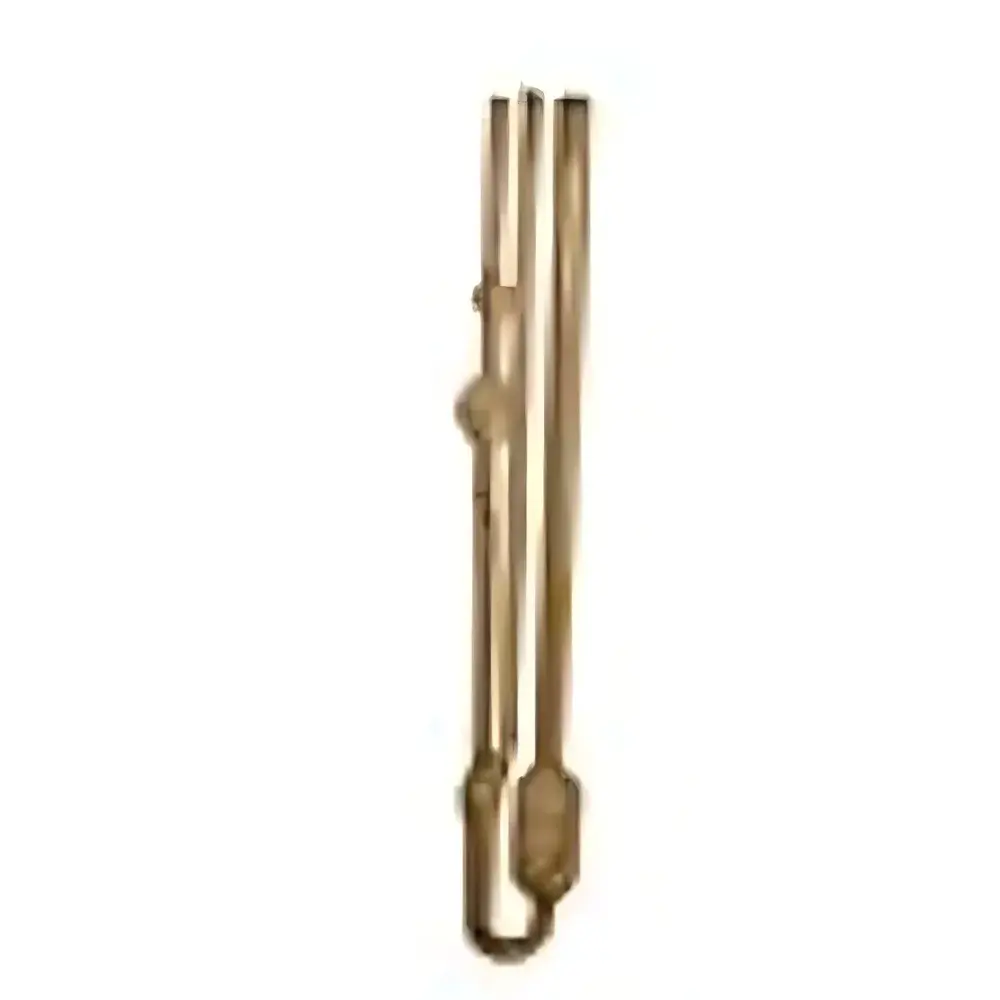
The JWC Constant Temperature Bath (SRD NCY) is an engineered thermal platform specifically designed to support standardized kinematic viscosity measurements in petroleum, polymer, and synthetic fiber laboratories. It operates on the principle of precise thermostatic immersion—maintaining a uniform, stable bath temperature across the entire viscometer capillary during flow-time measurement. This stability is critical for achieving reproducible results per ASTM D445 (Standard Test Method for Kinematic Viscosity of Transparent and Opaque Liquids), ISO 3104 (Petroleum Products — Determination of Kinematic Viscosity and Calculation of Dynamic Viscosity), and GB/T 265 (Petroleum Products — Determination of Kinematic Viscosity). The bath accommodates standard gravity-driven glass capillary viscometers—including Ubbelohde (dilution-type), Ostwald (simple capillary), and Cannon-Fenske (reverse-flow)—ensuring compatibility with both manual stopwatch-based analysis and semi-automated timing systems.
Key Features
- High-stability temperature control (±0.01 °C) over a 20–100 °C operating range, achieved via Peltier-based heating and cooling modules coupled with PID feedback regulation.
- 20-liter corrosion-resistant stainless steel bath tank with optimized fluid dynamics to minimize thermal stratification and ensure uniform heat distribution around immersed viscometers.
- Dual-mode operation: supports traditional manual timing workflows as well as integration-ready analog trigger inputs for external digital timers or data acquisition systems.
- Front-panel digital display with independent setpoint and real-time bath temperature readout; intuitive rotary encoder for precise parameter adjustment.
- Over-temperature and low-level liquid protection circuits ensure operational safety and prevent heater dry-run damage.
- Compliant mechanical design allows direct mounting of viscometer holders (e.g., SRD VHM-2 or equivalent) without modification, facilitating rapid setup and alignment per ISO 3104 Annex A.
Sample Compatibility & Compliance
The SRD NCY bath is validated for use with transparent and opaque Newtonian and mildly non-Newtonian liquids within the kinematic viscosity range of 0.2–300,000 mm²/s (cSt), consistent with the scope of ASTM D445 and ISO 3104. It accommodates all standard capillary viscometer geometries—Ubbelohde (with/without dilution bulbs), Ostwald (standard and suspended-level variants), and Cannon-Fenske (normal and suspended-level). The bath’s thermal uniformity profile meets the ≤0.02 °C axial and radial gradient requirement specified in ASTM D445 Section 7.2 for viscometer immersion depth compliance. Its construction adheres to IEC 61010-1 safety standards for laboratory equipment, and its operational protocol supports GLP documentation requirements when paired with calibrated timers and traceable thermometers.
Software & Data Management
While the SRD NCY operates as a standalone thermostatic platform, its analog timing interface enables seamless integration into regulated environments requiring audit trails. When connected to a validated digital timer (e.g., SRD VT-300 or third-party NIST-traceable units), elapsed flow times can be logged directly into LIMS or Excel-based reporting templates. The system supports 21 CFR Part 11-compliant workflows when deployed with electronic signature-enabled software platforms—though no proprietary firmware or embedded OS is included. All calibration records (temperature sensor, timing device) and maintenance logs must be retained per ISO/IEC 17025 Clause 7.7 to maintain measurement traceability.
Applications
- Petroleum refining: Routine determination of kinematic viscosity for base oils, lubricants, diesel fuels, and residual fuels per ASTM D445 and IP 71.
- Synthetic fiber manufacturing: Measurement of intrinsic viscosity and limiting viscosity number (LVN) of PET, nylon, and acrylic polymer solutions using Ubbelohde viscometers.
- Plastics quality control: Monitoring molecular weight distribution trends via relative viscosity and viscosity number (VN) calculations per ISO 1628-1 and GB/T 1632.1.
- Pharmaceutical excipients: Viscosity assessment of cellulose derivatives (e.g., HPMC, MC) in aqueous solutions under USP conditions.
- Academic research: Fundamental rheological characterization of dilute polymer solutions where shear rate independence and thermal history control are essential.
FAQ
What capillary viscometers are compatible with the SRD NCY bath?
Ubbelohde, Ostwald, and Cannon-Fenske viscometers—across all standard calibrations (e.g., Cannon 50, 100, 300, 400 series)—are fully supported when mounted using industry-standard holders.
Does the bath include built-in timing functionality?
No—the SRD NCY is a thermostatic platform only. Timing is performed externally using manual stopwatches or integrated digital timers connected via the analog trigger port.
Is the temperature sensor calibrated and traceable?
The internal Pt100 sensor is factory-calibrated; users must perform periodic verification against a NIST-traceable reference thermometer per ASTM E77 or ISO 17025 requirements.
Can the bath be used for dynamic viscosity calculations?
Yes—when kinematic viscosity (ν) is measured and fluid density (ρ) is known at the test temperature, dynamic viscosity (η = ν × ρ) is calculated per ISO 3104 Section 10.
What maintenance is required for long-term stability?
Monthly inspection of bath fluid level and cleanliness, annual verification of temperature uniformity profile, and biannual calibration of the control sensor using a certified reference standard.
Related Products





