
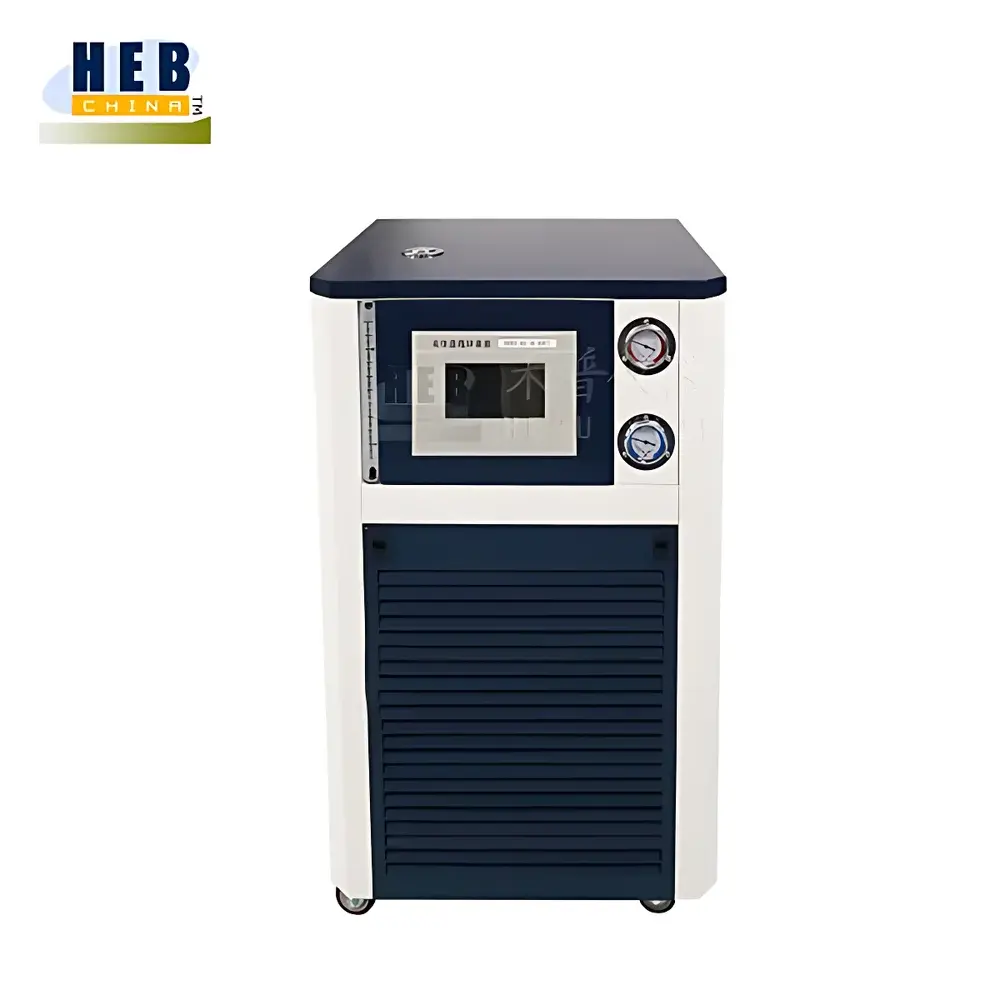
Hebei Jihepu GDSZ-50/-20+200 High-Low Temperature Circulating Chiller
| Brand | Jihepu (Jihepu) |
|---|---|
| Origin | Shandong, China |
| Model | GDSZ-50/-20+200 |
| Temperature Range | −20 °C to +200 °C |
| Ambient Operating Conditions | 5–35 °C, ≤70% RH |
| Power Supply | 3-phase 380 V / 50 Hz |
| Control Accuracy | ±0.1 °C |
| Heating Power | 6000 W |
| Compressor | 3 HP, R22 refrigerant, 2205 W, 6972 W cooling capacity |
| Circulation Pump | 250 W, 30 L/min flow rate, 15 m head, ≤0.2 MPa pressure |
| Heat Exchanger | Plate-type, 1.46 m² surface area |
| Display | LCD with keypad interface |
| Safety Protections | Delay start, overcurrent, overheat, overtemperature, phase sequence & phase loss detection |
| Enclosure Material | Powder-coated cold-rolled steel |
| External Port | 3/4″ BSP (6-point) female threads ×2 |
| Recommended Fluid | Premium-grade silicone oil |
| Dimensions (W×D×H) | 695×720×1100 mm |
| Net Weight | 144 kg |
| Shipping Volume | 0.76 m³ |
| Gross Weight | 173 kg |
Overview
The Hebei Jihepu GDSZ-50/-20+200 High-Low Temperature Circulating Chiller is a dual-mode thermal management system engineered for precise, stable temperature control of external process equipment—particularly jacketed reactors, calorimeters, and analytical instrumentation requiring dynamic thermal cycling between −20 °C and +200 °C. Its operation integrates vapor-compression refrigeration and resistive electric heating within a single closed-loop architecture. The refrigeration circuit employs a hermetically sealed 3 HP compressor, air-cooled condenser, thermostatic expansion valve, high-efficiency plate heat exchanger (1.46 m²), and R22 refrigerant—optimized for consistent sub-zero performance and rapid thermal recovery. Simultaneously, a 6000 W immersion heater maintains accurate high-temperature setpoints without thermal overshoot. Internal circulation is driven by a corrosion-resistant centrifugal pump (30 L/min, 15 m head), delivering conditioned silicone oil through dual 3/4″ BSP ports to external jackets or heat exchange manifolds. This design enables indirect, non-invasive thermal regulation—preserving sample integrity while meeting the stringent thermal stability demands of synthetic chemistry, polymerization kinetics, and material characterization workflows.
Key Features
- Dual-range thermal control: Stable operation from −20 °C to +200 °C with ±0.1 °C setpoint accuracy, verified via calibrated PT100 sensor feedback
- Integrated safety architecture: Comprehensive protection including compressor delay start, overcurrent cutoff, dual-stage overtemperature shutdown, phase sequence monitoring, and phase loss detection
- High-capacity thermal delivery: 6972 W nominal cooling capacity and 6000 W heating power support large-volume reactors (up to 100 L) and high-thermal-load applications
- Robust fluid handling: Stainless-steel wetted components, 30 L/min flow rate, and 0.2 MPa max pressure rating ensure compatibility with standard jacketed vessel interfaces
- Industrial-grade enclosure: Powder-coated cold-rolled steel chassis with vibration-damped mounting and IP20-rated electrical compartment
- Intuitive local operation: Backlit LCD display with membrane keypad interface; real-time monitoring of bath temperature, setpoint, pump status, and fault codes
Sample Compatibility & Compliance
This chiller is designed for use with thermally stable, non-reactive heat transfer fluids—primarily premium-grade methylphenyl silicone oils meeting ASTM D4672 specifications. It is compatible with glass, stainless-steel, and Hastelloy-jacketed reactors, calorimetric cells, and spectroscopic sample holders requiring external thermal conditioning. While not certified to UL/CSA or CE for standalone medical or explosive environments, its electrical design complies with IEC 61000-6-2 (immunity) and IEC 61000-6-4 (emissions) standards. All safety interlocks meet requirements for general laboratory use under ISO/IEC 17025-accredited facilities. For GLP/GMP-regulated processes, users must validate temperature uniformity, ramp rate reproducibility, and system response time per internal SOPs—no factory-provided 21 CFR Part 11 audit trail functionality is included.
Software & Data Management
The GDSZ-50/-20+200 operates as a standalone unit with no embedded Ethernet, USB, or RS-485 communication ports. Temperature logging, remote setpoint adjustment, or integration into SCADA or LIMS platforms requires external data acquisition hardware (e.g., third-party PLC or DAQ module) interfaced via analog 4–20 mA or 0–10 V output signals (available upon request with optional I/O module). The onboard controller stores no historical data; all operational parameters—including runtime hours, alarm history, and last 10 fault events—are viewable in real time on the LCD but are not retained after power cycle. Users implementing electronic records must employ validated external recording systems compliant with ALCOA+ principles for traceability and retention.
Applications
- Exothermic/endothermic reaction control in pilot-scale batch synthesis (e.g., Grignard additions, nitration, hydrogenation)
- Temperature-programmed polymerization studies requiring precise ramping between −10 °C and +180 °C
- Calibration and thermal validation of DSC, TGA, and rheometry instrumentation
- Stability testing of pharmaceutical intermediates under ICH Q1A-relevant stress conditions
- Cooling of high-power laser diodes or IR detectors requiring sub-ambient stabilization
- Pre-conditioning of composite materials prior to mechanical testing per ASTM D638 or ISO 527
FAQ
What heat transfer fluid is recommended for operation across the full −20 °C to +200 °C range?
Premium methylphenyl silicone oil (e.g., Dow Corning DC-704 or equivalent), with pour point ≤−40 °C and flash point ≥300 °C, is required. Water-glycol mixtures are incompatible below 0 °C and degrade above 120 °C.
Can this unit maintain temperature stability during rapid ramping cycles?
Yes—its 6000 W heater and 6972 W chiller enable typical ramp rates of 1.5–2.0 °C/min between −20 °C and +200 °C in a 50 L jacketed reactor, with steady-state stability maintained within ±0.1 °C under constant load.
Is external cooling water required for the condenser?
No—the unit uses an air-cooled condenser with axial fans; adequate ambient ventilation (≥0.5 m³/s free airflow) at 5–35 °C is mandatory for rated performance.
What maintenance intervals are recommended for long-term reliability?
Compressor oil and refrigerant charge require verification every 24 months; plate heat exchanger should be inspected annually for fouling; silicone oil replacement is advised every 18–24 months depending on thermal cycling frequency and peak temperature exposure.



