
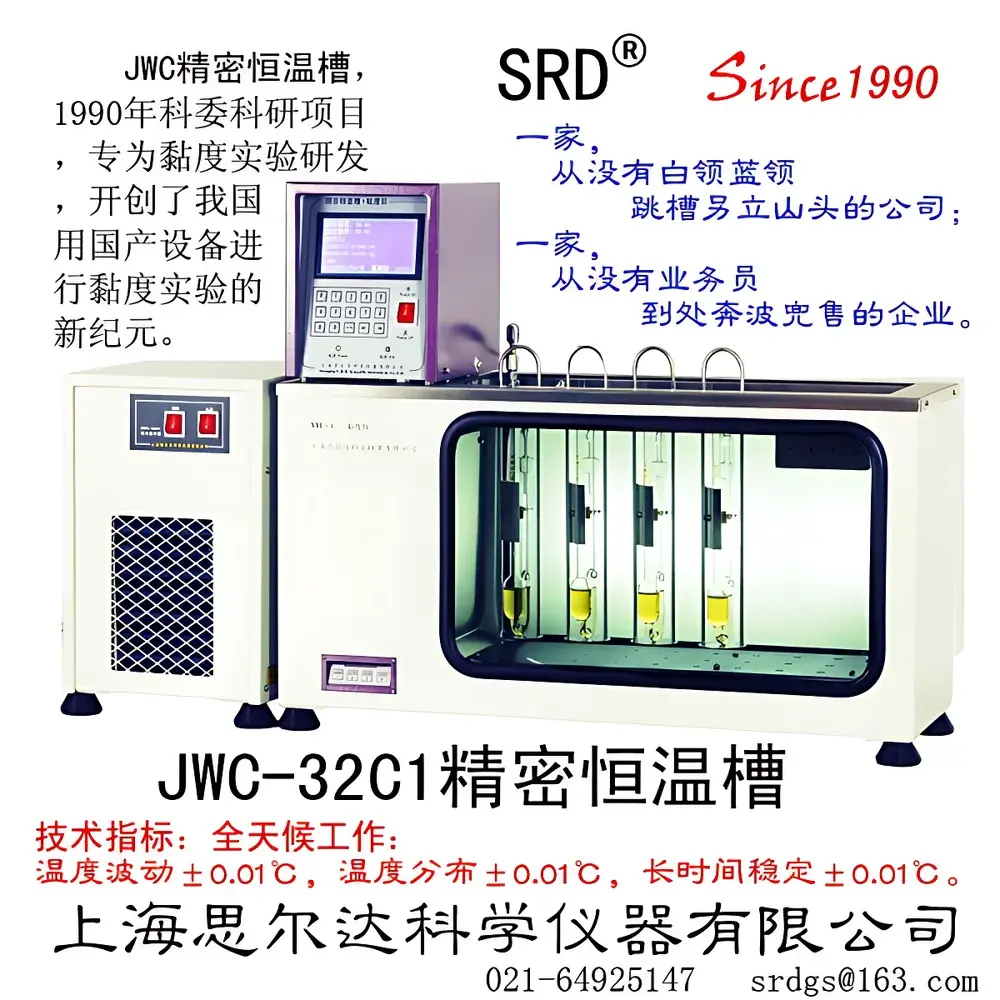
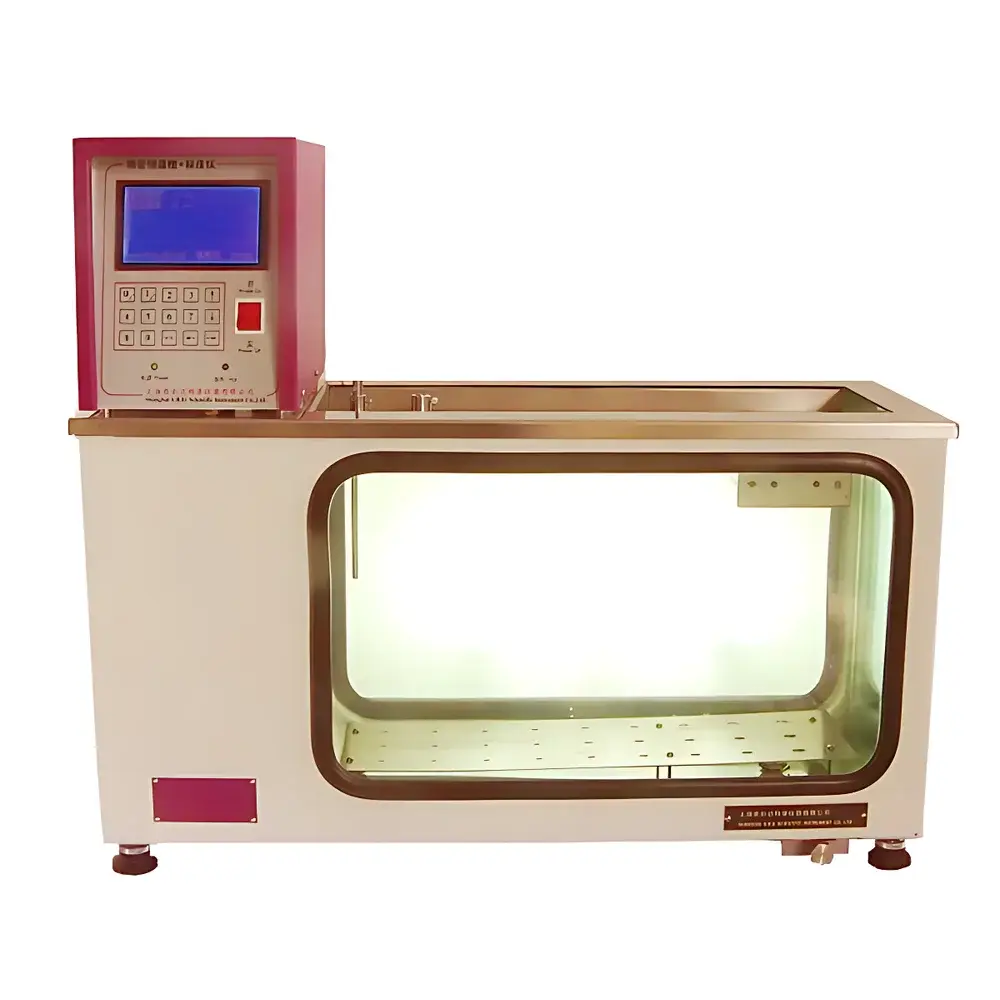
SRD JWC-32C1 Precision Circulating Constant-Temperature Bath
| Brand | SRD |
|---|---|
| Origin | Shanghai, China |
| Manufacturer Type | Authorized Distributor |
| Country of Origin | China |
| Model | JWC-32C1 |
| Instrument Type | Circulating Constant-Temperature Bath |
| Circulation Mode | External Circulation |
| Temperature Control | Refrigeration & Heating |
| Bath Volume | 42 L |
| Temperature Range | 0–80 °C |
| Temperature Stability | ±0.01 °C |
| Temperature Resolution | 0.01 °C |
| Heating Power | 1 kW |
| Cooling Capacity | 220 kcal/h |
| Cold Source Output Temp (short-circuit) | –15 °C |
| Input Voltage | 220 V AC, 50 Hz |
| Dimensions (Bath Unit) | 75 × 26/38 (with/without backlight box) × 61 cm (L×W×H) |
| Internal Chamber | 64 × 19.5 × 34 cm (L×W×H) |
| Viewing Window | 47.5 × 27 cm (L×H) |
Overview
The SRD JWC-32C1 Precision Circulating Constant-Temperature Bath is an engineered thermal control system designed for high-stability applications in physical property testing, particularly capillary viscometry and routine physicochemical analysis. It operates on a dual-mode thermoregulation principle—combining closed-cycle refrigeration with PID-controlled resistive heating—to maintain precise setpoint temperatures across its full operational range of 0 °C to 80 °C. Unlike Peltier-based systems, the JWC-32C1 employs a dedicated external cold source unit equipped with a hermetically sealed compressor and insulated coolant reservoir, eliminating dependency on ambient cooling water and ensuring long-term reliability under continuous operation. The bath’s thermal architecture delivers exceptional uniformity (±0.01 °C spatial distribution) and stability (±0.01 °C over time), verified via calibrated platinum resistance thermometers traceable to national standards. Its 42 L working volume and optimized fluid dynamics—enabled by directional flow guides and a low-turbulence circulation pump—support reproducible thermal equilibration for multi-sample configurations.
Key Features
- Dual independent thermal modules: Integrated refrigeration unit (–15 °C output capability) and 1 kW PID-regulated heating system enable seamless transition between sub-ambient and elevated temperature operation.
- Optimized optical access: Front and rear large-area transparent viewing windows (47.5 × 27 cm) with integrated rear backlighting facilitate real-time visual monitoring of capillary viscometers—including Ubbelohde, Ostwald, and Cannon-Fenske types—under standardized lighting conditions.
- Viscometry-optimized mechanical interface: Dedicated front-panel viscosity test rack accommodates up to six vertically aligned capillary tubes; built-in leveling mechanism ensures automatic gravitational alignment post-installation.
- External circulation porting: Standardized quick-connect fittings support integration with auxiliary equipment such as rheometers, spectrophotometer cells, or reaction jackets requiring remote temperature control.
- Robust thermal insulation: High-density polyurethane foam enclosure minimizes heat exchange with ambient environment, contributing to energy efficiency and reduced thermal drift during extended runs.
Sample Compatibility & Compliance
The JWC-32C1 is routinely deployed in laboratories conducting ASTM D445, ISO 3104, and GB/T 265-compliant kinematic viscosity measurements. Its temperature uniformity and stability meet the stringent requirements of GLP environments for method validation and QC release testing in petrochemical, polymer, and pharmaceutical manufacturing. The stainless-steel bath chamber and chemically resistant coolant circuit are compatible with aqueous solutions, ethylene glycol–water mixtures, and silicone oils (viscosity ≤ 500 cSt). All electrical components conform to IEC 61010-1 safety standards for laboratory equipment. While the instrument itself does not include built-in audit trail or electronic signature functionality, its analog/digital temperature readout and manual calibration records support documentation practices required under FDA 21 CFR Part 11 when used within validated workflows.
Software & Data Management
The JWC-32C1 operates via an embedded digital controller with LED display, offering direct setpoint entry, real-time temperature readout (0.01 °C resolution), and status indicators for refrigeration/heating activation. No proprietary software is required for basic operation; however, optional RS-232 or 4–20 mA analog outputs (available upon request) permit integration into SCADA or LIMS platforms for centralized monitoring. Users may log temperature data manually or via third-party DAQ systems interfaced through standard industrial protocols. Calibration certificates—traceable to CNAS-accredited reference standards—are provided with each unit, including as-found/as-left verification at three points across the operating range (0 °C, 40 °C, and 80 °C).
Applications
- Kinematic viscosity determination per ASTM D445 and ISO 3104 using gravity-driven capillary viscometers.
- Thermal conditioning of samples prior to FTIR, UV-Vis, or HPLC analysis where temperature-dependent spectral shifts must be minimized.
- Temperature stabilization of optical cells, refractometers, and density meters requiring stable thermal baselines.
- Supporting cold-source applications: The detachable refrigeration module can independently supply chilled fluid to calorimeters, condensers, or other benchtop instruments requiring sub-ambient cooling.
- Material science studies involving thermal expansion coefficient measurement, phase transition observation, or polymer solution behavior analysis.
FAQ
What is the minimum achievable temperature with the cold source unit?
The refrigeration module delivers a nominal output temperature of –15 °C under short-circuit conditions; actual bath temperature depends on load, ambient conditions, and circulation rate.
Can the JWC-32C1 operate without the external cold source?
Yes—the heating function remains fully operational up to 80 °C; however, sub-ambient temperature control requires the cold source unit.
Is the bath compatible with organic solvents?
The stainless-steel tank and fluorocarbon-compatible seals tolerate common solvents (e.g., toluene, chloroform, acetone); prolonged exposure to strong oxidizers or halogenated hydrocarbons is not recommended.
How is temperature uniformity verified across the bath chamber?
Uniformity is characterized using a 9-point grid mapping protocol per ISO/IEC 17025 guidelines, with deviations consistently maintained within ±0.01 °C at steady state.
Does the unit support external temperature probe input for cascade control?
Standard configuration uses internal Pt100 sensing only; optional retrofit kits for external probe integration are available through SRD technical support.



