
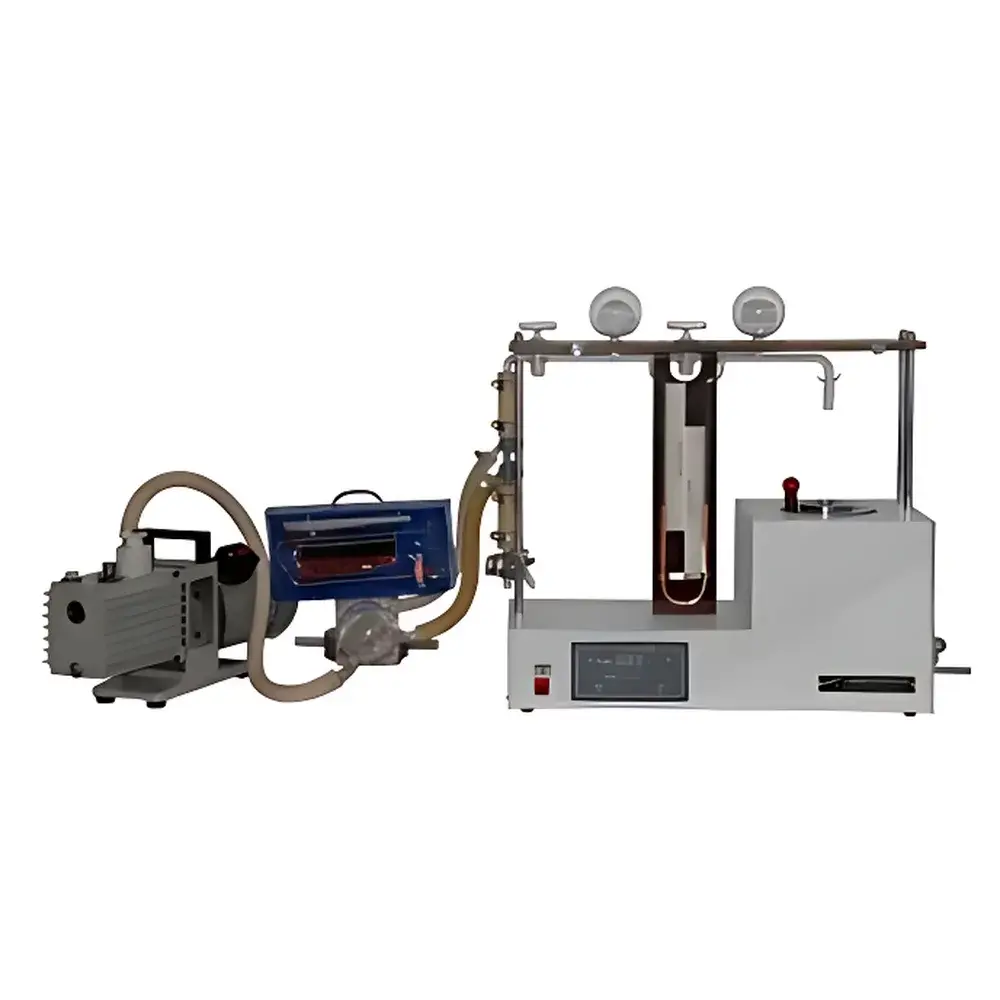
Shanghai SRD SF-1 Differential Pressure Moisture Analyzer
| Brand | SRD |
|---|---|
| Origin | Shanghai, China |
| Model | SF-1 |
| Measurement Principle | Differential Pressure (Manometric) Method |
| Temperature Control Range | Ambient to 250 °C |
| Temperature Stability | ±2.0 °C |
| Vacuum Level | ≤100 Pa |
| Moisture Detection Range | 5–3000 ppm (sample mass: 0.5–10 g) |
| Power Supply | 220 V AC, 2 A |
| Compliance | ISO 6188:1980 (Plastics — Poly(ethylene terephthalate) granules — Determination of water content) |
Overview
The Shanghai SRD SF-1 Differential Pressure Moisture Analyzer is a dedicated laboratory instrument engineered for precise, trace-level moisture quantification in hygroscopic polymer granules—specifically polyethylene terephthalate (PET) chips and nylon 6 pellets—prior to melt spinning. It operates on the differential pressure (manometric) principle: a sealed sample chamber is heated under high vacuum, driving off bound and adsorbed water vapor; the resulting pressure increase in a calibrated reference volume is directly proportional to the mass of evolved water, enabling calculation of moisture content in parts per million (ppm). Unlike coulometric or volumetric Karl Fischer titration—which require reagent handling, electrode maintenance, and solvent disposal—the SF-1 eliminates consumables beyond desiccant (sodium molybdate), delivering consistent baseline performance with minimal operator intervention. Its design aligns with ISO 6188:1980, the internationally recognized standard for PET granule moisture determination, making it suitable for quality control laboratories operating under GLP-compliant workflows or pre-production validation protocols in synthetic fiber manufacturing.
Key Features
- Integrated manometric measurement system with calibrated expansion volume and high-stability vacuum transducer (≤100 Pa ultimate vacuum)
- Precise digital temperature controller with ramp-and-hold capability (ambient to 250 °C, ±2.0 °C stability over 30 min)
- Automated vertical alignment mechanism ensuring reproducible thermal coupling between heater block and sample tube
- Pre-assembled, factory-aligned glass manifold—including differential pressure U-tube, sample reservoir, and vacuum isolation valves—eliminating user calibration or component sourcing
- Comprehensive accessory kit supplied: sodium molybdate desiccant, silicone oil, vacuum grease, mercury manometer fluid, calibrated syringes, Viton® vacuum tubing, and pump interface adapters
- Robust mechanical architecture with corrosion-resistant stainless steel heating block and borosilicate glass components rated for repeated thermal cycling
Sample Compatibility & Compliance
The SF-1 is optimized for solid, granular polymer samples with low equilibrium moisture content (<0.3 wt%) and high thermal stability up to 250 °C. Validated applications include PET chips (post-drying), nylon 6 pellets, polycarbonate granules, and other engineering thermoplastics where residual moisture induces hydrolytic degradation during extrusion or spinning. Sample mass flexibility (0.5–10 g) accommodates both high-precision low-moisture measurements (5–50 ppm) and broader-range screening (up to 3000 ppm). The instrument satisfies the procedural requirements of ISO 6188:1980, including specified heating duration, vacuum level, and pressure equilibration time. While not certified to ISO/IEC 17025, its documented repeatability (RSD <2.5% at 20 ppm, n=6) supports internal method validation under ASTM E203 or USP <921> guidelines for loss-on-drying alternatives.
Software & Data Management
The SF-1 is a benchtop analog-digital hybrid instrument with no embedded microprocessor or proprietary software. All operational parameters—temperature setpoint, vacuum dwell time, and pressure rise recording—are manually logged via external lab notebooks or LIMS-integrated spreadsheets. This architecture ensures full audit trail transparency: raw pressure readings (mmHg or Pa), temperature profiles, and sample identifiers are entered directly by the analyst without algorithmic interpolation or auto-correction—critical for FDA 21 CFR Part 11–aligned environments where data integrity hinges on attributable, legible, contemporaneous records. Optional integration with third-party data acquisition systems (e.g., LabVIEW or MATLAB via analog voltage output from vacuum transducer) enables automated trend analysis across production batches.
Applications
- Quality assurance of PET chip moisture prior to continuous filament spinning (target: ≤25 ppm to prevent molecular weight reduction)
- Validation of dryer performance in nylon 6 pellet conditioning lines
- Comparative moisture stability testing of polymer blends exposed to controlled humidity chambers
- Root cause analysis of melt fracture or die swell anomalies traced to inconsistent feedstock dryness
- Educational use in polymer science laboratories for teaching gravimetric vs. manometric moisture principles
FAQ
What is the primary advantage of the differential pressure method over Karl Fischer titration for PET moisture analysis?
The differential pressure method avoids reagent consumption, electrode fouling, and solvent waste—reducing cost-per-test and analytical downtime. It also provides direct physical measurement of evolved water vapor, eliminating stoichiometric assumptions inherent in KF chemistry.
Can the SF-1 measure moisture in liquid or paste samples?
No. The instrument is designed exclusively for free-flowing, thermally stable solids. Liquids would volatilize non-aqueous components under vacuum and heat, invalidating the pressure-based water quantification model.
Is mercury handling required during routine operation?
Yes—the included mercury manometer serves as the primary pressure reference for calibration verification. Users must follow local occupational safety regulations (e.g., OSHA 29 CFR 1910.1200) for mercury storage, spill response, and disposal.
How often must the sodium molybdate desiccant be replaced?
Replacement frequency depends on ambient humidity and usage intensity; typical service life is 3–6 months under controlled lab conditions. A color-change indicator (blue → pink) signals saturation.
Does the SF-1 support automated data export to LIMS?
Not natively—but its analog vacuum transducer output (0–10 V DC) can be interfaced with commercial DAQ hardware and configured for CSV or XML export compatible with most LIMS platforms.
Related Products






