
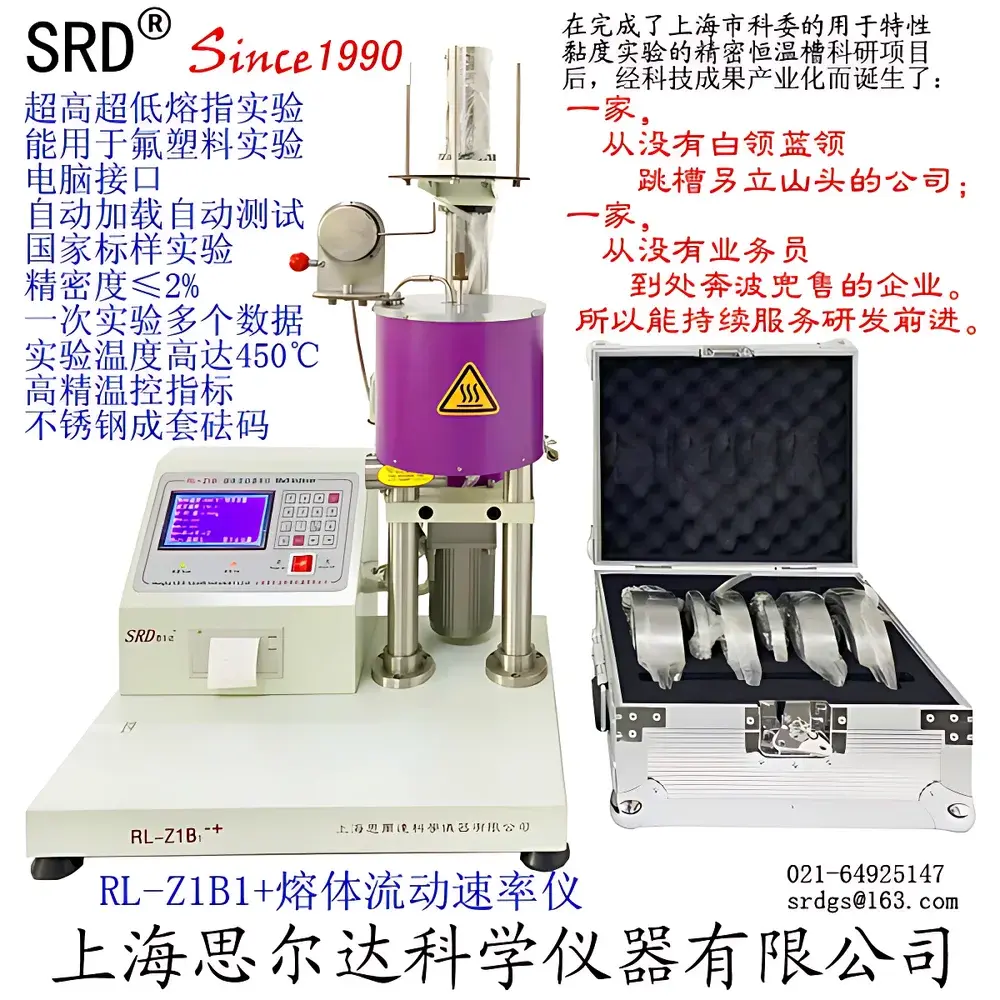
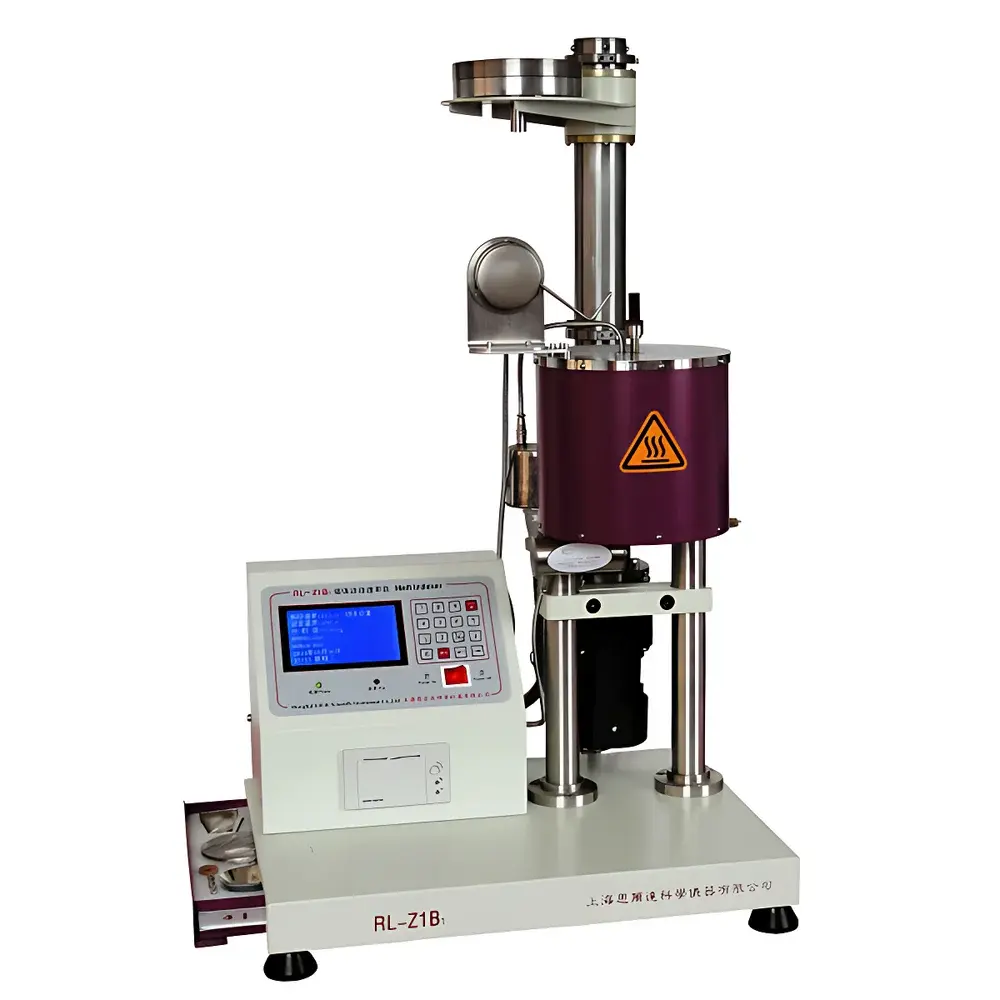
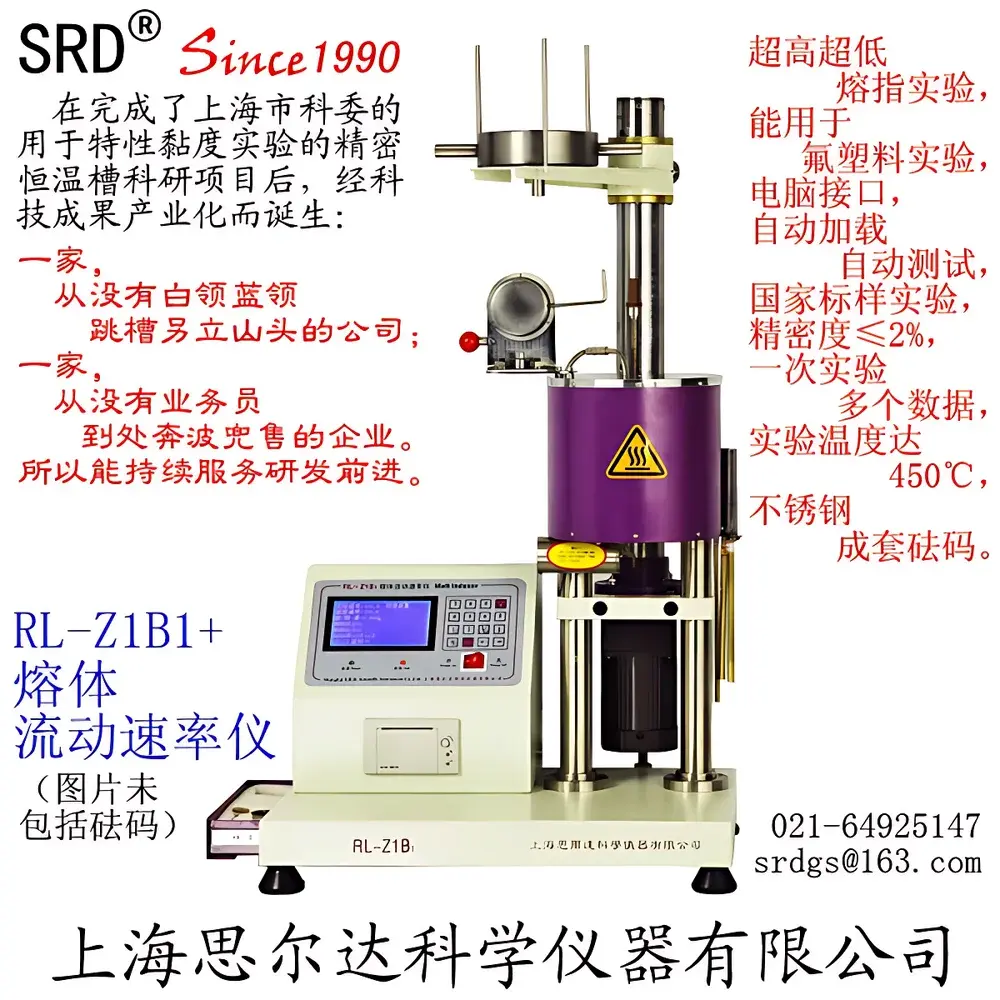
SRD RL-Z1B1+ Melt Flow Indexer (MFI) / Melt Mass Flow Rate (MFR) Tester
| Brand | SRD |
|---|---|
| Origin | Shanghai, China |
| Model | RL-Z1B1+ |
| Temperature Range | 100–400 °C |
| Temp. Accuracy | ±0.2 °C (125–300 °C) |
| Temp. Stability | ≤±0.1 °C (8-h drift ≤0.1 °C) |
| Barrel ID | 9.550 ±0.020 mm |
| Die ID | 2.095 ±0.005 mm |
| Load Accuracy | ±0.5% |
| Standard Loads | 325 g to 21,600 g |
| MFR Range | 0.02–2000 g/10 min |
| MVR Range | 0.03–50000 cm³/10 min |
| Timing Resolution | 0.001 s |
| Auto-Cut Interval | 0–999 s |
| Compliance | ISO 1133:1997(E), ASTM D1238-95, GB/T 3682-2000, JJG 878, JIS K 7210 |
Overview
The SRD RL-Z1B1+ Melt Flow Indexer is a precision laboratory instrument engineered for the standardized determination of melt mass flow rate (MFR) and melt volume flow rate (MVR) of thermoplastic polymers under controlled temperature and load conditions. Based on the capillary rheometry principle—where molten polymer is extruded through a standardized die under gravimetric loading—the instrument quantifies material viscosity in the molten state. This measurement serves as a critical quality control parameter across polymer synthesis, compounding, extrusion, and injection molding processes. The RL-Z1B1+ implements a robust thermal architecture with nitrogen-hardened steel barrel and piston components (HV ≥ 600–700), ensuring dimensional stability, minimal thermal deformation, and long-term repeatability. Its temperature control system meets stringent international tolerances: ±0.2 °C accuracy between 125 °C and 300 °C (per ASTM D1238 and JIS K 7210), with thermal uniformity ≤0.5 °C across the barrel zone and 8-hour drift limited to ≤0.1 °C—exceeding the requirements of JJG 878 and ISO 1133:1997(E).
Key Features
- High-stability temperature control system with PID regulation and dual-sensor feedback, achieving ±0.2 °C accuracy (125–300 °C) and ≤±0.1 °C short-term fluctuation
- Nitrided tool-steel construction for barrel, piston rod, and die—HV ≥ 700 for barrel/die, HV ≥ 600 for piston—ensuring wear resistance, thermal stability, and dimensional fidelity over thousands of test cycles
- Full ISO/ASTM-compliant load set: eight calibrated masses (325 g, 1200 g, 2160 g, 3800 g, 5000 g, 10,000 g, 12,500 g, 21,600 g), traceable to national metrological standards with ±0.5% load accuracy
- Precision-machined die (Φ2.095 ±0.005 mm) and barrel (Φ9.550 ±0.020 mm) manufactured to ISO 1133 geometric tolerances
- Dual-mode operation: automated timed cutting (0–999 s adjustable, 0.001 s resolution) and manual blade cutting for method flexibility and validation cross-checking
- Integrated thermal recovery protocol: ≤4 minutes to re-stabilize setpoint after sample loading, minimizing throughput delay without compromising thermal equilibrium
- Comprehensive timing system with triple-range digital chronometer (0–9.999 s / 0–999.9 s / 0–9999 s) and millisecond-level resolution for high-precision MFR/MVR calculation
Sample Compatibility & Compliance
The RL-Z1B1+ is validated for routine testing of polyolefins (PP, PE), engineering thermoplastics (PS, ABS, PC, PA), fluoropolymers (including FEP and PFA), and filled compounds. Its standard configuration (RL-Z1B1+) supports general-purpose polymer evaluation per ISO 1133, ASTM D1238, GB/T 3682-2000, and JIS K 7210. For aggressive media—including halogenated polymers and high-purity fluororesins—a corrosion-resistant variant (RL-Z1B1−) is available, featuring aerospace-grade alloy components for extended service life in chemically demanding applications. All units undergo factory calibration against certified reference materials (e.g., NIST-traceable PE standards) and comply with metrological requirements defined in JJG 878 (China National Verification Regulation) and JB/T 5456 (Mechanical Industry Standard). Temperature uniformity, load accuracy, and dimensional conformity are documented in the出厂 calibration certificate supplied with each instrument.
Software & Data Management
While the RL-Z1B1+ operates as a standalone hardware platform, its measurement workflow aligns with GLP/GMP data integrity principles. All test parameters—including temperature setpoint, applied load, cut interval, operator ID, and ambient conditions—are manually recorded or entered into LIMS-compatible spreadsheets. The instrument’s deterministic mechanical design ensures full auditability: piston displacement is referenced to two engraved 30-mm-spaced marks; die geometry and barrel dimensions are permanently certified; and thermal profiles are verifiable via external calibrated thermocouples. For laboratories requiring electronic records, the RL-Z1B1+ can be integrated with third-party data acquisition systems via RS-232 or analog voltage output (optional). All test reports generated externally may include compliance statements referencing ISO/IEC 17025:2017 clause 7.7 (results reporting) and FDA 21 CFR Part 11 when paired with validated software environments.
Applications
- Quality assurance of virgin and recycled polyethylene (LDPE, HDPE, LLDPE) and polypropylene resins in production and incoming inspection
- Batch-to-batch consistency verification during polymerization process development and catalyst screening
- Correlation of MFR with molecular weight distribution (MWD) and shear-thinning behavior in R&D labs
- Validation of thermal stability and degradation onset during multiple extrusion passes (e.g., regrind assessment)
- Specification conformance testing for automotive, medical, and packaging-grade thermoplastics per ISO 527, ASTM D638, and UL 94 requirements
- Support of regulatory submissions requiring documented melt rheology data (e.g., FDA device master records, EU MDR technical files)
FAQ
What standards does the RL-Z1B1+ comply with?
It conforms to ISO 1133:1997(E), ASTM D1238-95, GB/T 3682-2000, JJG 878, JIS K 7210, and JB/T 5456. Full compliance documentation, including dimensional certification and temperature uniformity test reports, is provided with shipment.
Can it measure both MFR and MVR?
Yes. The instrument supports both melt mass flow rate (g/10 min) and melt volume flow rate (cm³/10 min) calculations. MVR requires optional volumetric collection accessories (e.g., calibrated cylinder and digital caliper), while MFR uses standard gravimetric weighing.
Is calibration traceable to national standards?
All load masses are calibrated against CMA-certified weights (Class M1); temperature sensors are verified using NIST-traceable dry-block calibrators. A factory calibration certificate listing uncertainties per ISO/IEC 17025 is included.
What maintenance is required for long-term accuracy?
Recommended quarterly verification includes die bore inspection (with optical comparator), piston/barrel clearance check, load mass recalibration, and thermal mapping using a calibrated miniature thermocouple array. Nitrided surfaces require no lubrication but must be cleaned with acetone after each test to prevent carbon buildup.
Related Products




