
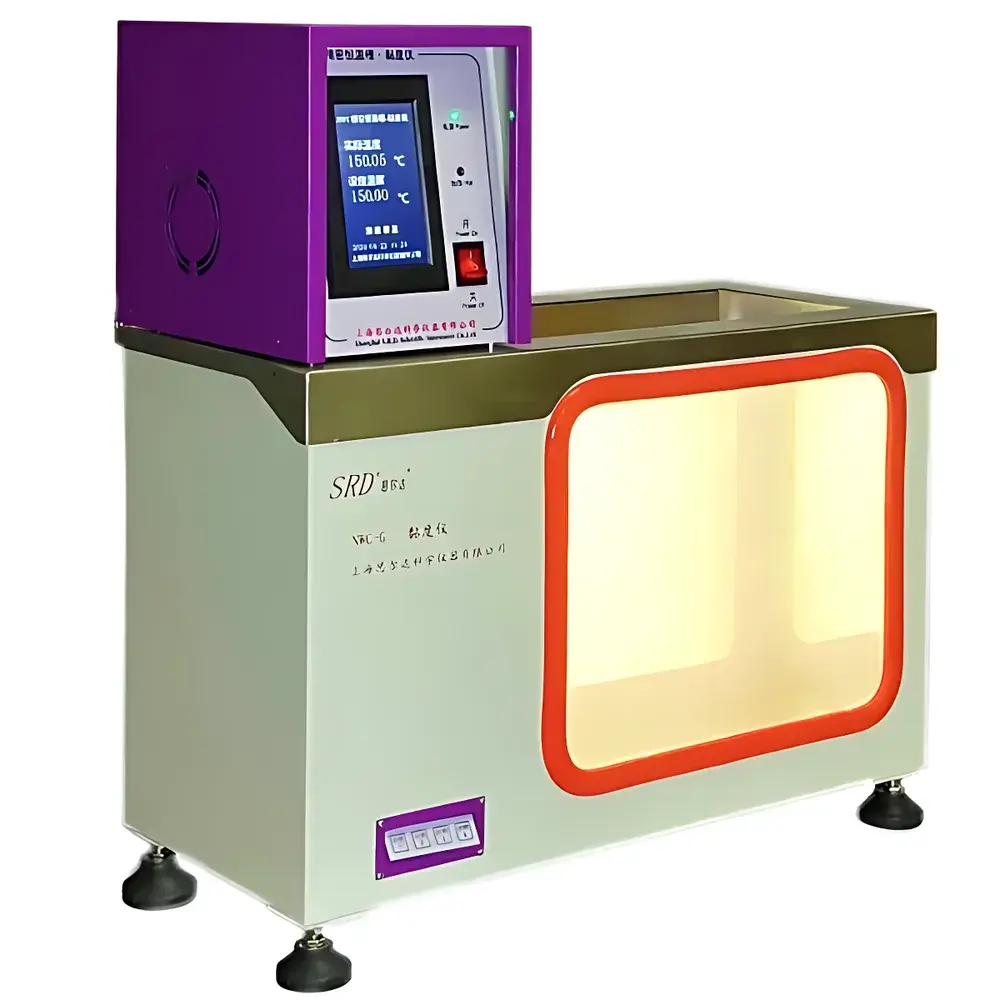
SRD NWC-G High-Temperature Precision Thermostatic Bath & Capillary Viscometer
| Brand | SRD |
|---|---|
| Origin | Shanghai, China |
| Model | NWC-G |
| Instrument Type | Fixed-Station Capillary Viscometer with Integrated Thermostatic Bath |
| Temperature Range | 50–150 °C |
| Temperature Resolution | 0.01 °C |
| Temperature Stability | ±0.01–±0.03 °C (medium-dependent) |
| Compliance | ASTM D445, ISO 3104, JIS K 2283, GB/T 265 |
Overview
The SRD NWC-G High-Temperature Precision Thermostatic Bath & Capillary Viscometer is a purpose-engineered laboratory system designed for precise kinematic viscosity measurement of thermally stable liquids—particularly polymer melts and high-molecular-weight solutions such as polypropylene (PP), polyethylene (PE), and polystyrene (PS) in xylene or decalin solvents. It integrates a high-stability thermostatic bath with a dedicated capillary viscometer mounting and timing station, operating on the fundamental principle of Poiseuille flow: viscosity is derived from the time required for a fixed volume of liquid to gravitationally flow through a calibrated capillary under controlled thermal conditions. Unlike rotational rheometers or digital viscometers, the NWC-G delivers traceable, standard-compliant kinematic viscosity (ν, mm²/s) data essential for intrinsic viscosity (IV) and molecular weight correlation per ASTM D1243 and ISO 1628-1. Its design prioritizes long-term thermal equilibrium—achieving < ±0.03 °C stability over 7+ days—without external air conditioning or vibration isolation, making it suitable for routine QC labs and academic polymer characterization facilities.
Key Features
- Integrated thermostatic bath with dual-zone temperature control: independent heating and PID-regulated cooling circuit ensure uniform thermal distribution across the entire bath volume (≥12 L working capacity)
- High-resolution capacitive touchscreen interface (7-inch, 800×480) enabling real-time monitoring of actual bath temperature, setpoint, and stability deviation (display resolution: 0.01 °C)
- Dedicated capillary viscometer holder with micrometer-adjustable vertical alignment mechanism—ensures ≤0.1° deviation from true vertical, critical for ASTM D445 compliance
- Multi-channel electronic timing station with tactile push-button activation per viscometer position; timestamps synchronized to internal RTC with µs-level precision
- Front- and rear-mounted optical observation windows with diffused LED backlighting (5600 K CCT, 90+ CRI) for unobstructed visual verification of meniscus movement and flow termination
- Corrosion-resistant 304 stainless steel bath interior and powder-coated steel chassis; modular top-mount sample rack (customizable geometry and load capacity upon request)
Sample Compatibility & Compliance
The NWC-G accommodates standard Ubbelohde, Cannon-Fenske, and Ostwald-type capillaries (diameters 0.4–1.2 mm) as specified in ASTM D445 Annex A1 and ISO 3104 Clause 6. It supports solvent systems including xylene, tetralin, chlorobenzene, and phenol/1,1,2,2-tetrachloroethane mixtures—commonly used for PP, PE, PET, and PA dissolution at elevated temperatures. Thermal stability validation follows ISO/IEC 17025:2017 clause 7.8.3, with documented uncertainty budgets for temperature (k=2, U = ±0.015 °C) and timing (k=2, U = ±0.05 s). The system meets the environmental robustness requirements of GLP Annex 11 (EU) and FDA 21 CFR Part 11 for audit-trail-enabled timing and parameter logging when paired with optional SRD-VIS software.
Software & Data Management
Optional SRD-VIS v3.2 software (Windows 10/11, 64-bit) provides automated calculation of kinematic viscosity (ν), dynamic viscosity (η), and intrinsic viscosity ([η]) using user-defined calibration constants and Huggins/Martin equation fitting. All raw timing events, temperature logs, and operator annotations are stored in encrypted SQLite databases with SHA-256 hash integrity verification. Audit trails record timestamped entries for parameter changes, user logins, and report generation—fully compliant with 21 CFR Part 11 electronic signature requirements. Export formats include CSV (for LIMS integration), PDF (with embedded digital signature), and XML (ASTM E1382-compliant test data schema).
Applications
- Quality control of polyolefin resins: IV determination per ASTM D1243 for batch release in extrusion-grade PP/PE production
- Research-scale polymer degradation studies: monitoring molecular weight shifts during thermal aging or shear history experiments
- Development of high-temperature lubricants and heat-transfer fluids requiring viscosity profiling between 50–150 °C
- Educational laboratories: hands-on instruction in capillary flow theory, Newtonian/non-Newtonian fluid behavior, and standard method validation
- Contract testing labs serving automotive, packaging, and medical device industries requiring ISO/IEC 17025-accredited viscosity reporting
FAQ
What capillary viscometer standards does the NWC-G support?
It fully complies with ASTM D445, ISO 3104, JIS K 2283, and GB/T 265 for kinematic viscosity measurement using suspended-level capillaries.
Can the bath accommodate multiple viscometers simultaneously?
Yes—the standard configuration supports up to four independently timed capillary positions; custom configurations with six or eight stations are available upon engineering review.
Is external chiller connection required for operation at 50 °C?
No—the integrated Peltier-based cooling module maintains stability at 50 °C without auxiliary chillers; external cooling is only recommended for extended operation below 45 °C.
How is temperature uniformity validated across the bath volume?
SRD performs three-point spatial mapping (center, front-left, rear-right) using NIST-traceable Pt100 probes prior to shipment; full validation reports are included with each unit.
Does the system support automatic viscosity calculation without PC connectivity?
Basic kinematic viscosity calculation (ν = C × t) is performed onboard via firmware; advanced analysis (e.g., [η] extrapolation) requires SRD-VIS software.
Related Products



