
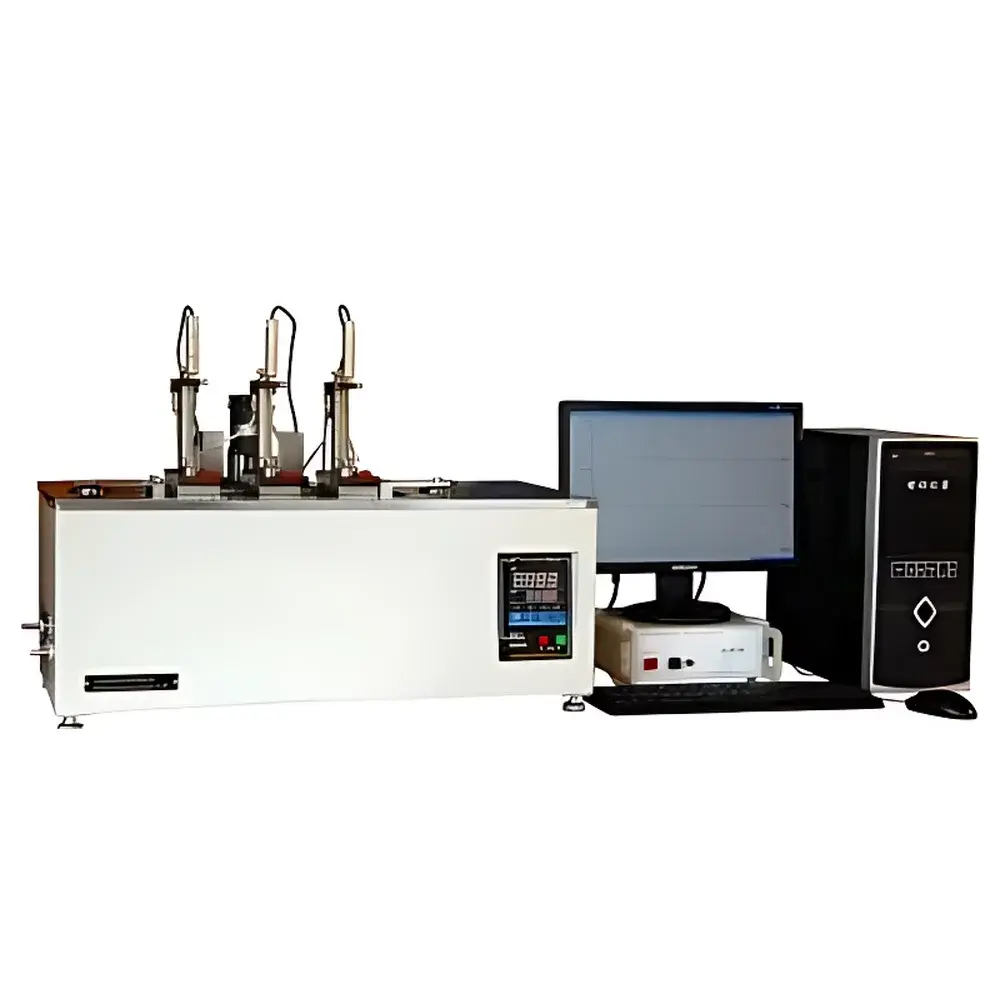
SRD SWB-300C Vicat Softening Point & Heat Deflection Temperature Tester
| Brand | SRD |
|---|---|
| Origin | Shanghai, China |
| Model | SWB-300C |
| Temperature Range | Ambient to 300 °C |
| Heating Rate | 5 ± 0.5 °C/6 min or 12 ± 1.0 °C/6 min |
| Temperature Accuracy | ±0.5 °C |
| Temperature Uniformity | ±0.5 °C across 3 sensing points |
| Bath Volume | 25 L |
| Test Stations | 3 |
| Displacement Resolution | 0.01 mm |
| Vicat Needle Cross-Section | 1.000 ± 0.015 mm² (d = 1.128 ± 0.0085 mm) |
| HDT Probe Radius | R = 3.0 ± 0.2 mm |
| HDT Support Span | 100 ± 0.5 mm |
| Load Rod Mass | 88.35 g |
| Max. Thermal Expansion of Fixture | ≤0.01 mm (automatically compensated) |
| Heating Power | 4 kW |
| Power Supply | 220 VAC, 20 A |
| Dimensions (L×W×H) | 830 × 500 × 540 mm |
| Net Weight (C-type) | 58 kg (excl. heat transfer oil) |
Overview
The SRD SWB-300C Vicat Softening Point & Heat Deflection Temperature (HDT) Tester is a precision-engineered instrument designed for standardized thermal performance evaluation of thermoplastic and thermosetting polymers. It operates on two internationally recognized test principles: the Vicat softening temperature (VST), defined as the temperature at which a flat-ended needle penetrates 1 mm into a loaded polymer specimen under specified load and heating rate; and the heat deflection temperature (HDT), determined as the temperature at which a standard test bar deflects 0.25 mm under a specified flexural stress while subjected to a controlled linear heating profile. Both methods are governed by ISO 306, ASTM D1525 (VST), ASTM D648 (HDT), and Chinese national standards GB/T 1633 and GB/T 1634. The SWB-300C implements a dual-mode measurement architecture—switchable via interchangeable probe assemblies—enabling full compliance with both VST and HDT protocols within a single platform. Its thermostatic bath employs high-stability silicone oil as the heat transfer medium, maintained via PID-controlled 4 kW heating and calibrated three-point temperature monitoring to ensure spatial uniformity (±0.5 °C) and temporal accuracy (±0.5 °C).
Key Features
- Triple independent test stations for parallel, statistically robust sample evaluation—reducing inter-test variability and accelerating throughput in QC laboratories.
- High-resolution linear displacement sensor (0.01 mm resolution) coupled with real-time temperature–displacement acquisition, enabling full curve-based analysis beyond endpoint detection.
- Automated thermal expansion compensation: fixture deformation (≤0.01 mm) is measured and algorithmically subtracted from raw displacement data, preserving measurement integrity across extended temperature ranges.
- Configurable heating profiles compliant with both ISO-specified rates: 50 °C/h (5 ± 0.5 °C/6 min) for VST and 120 °C/h (12 ± 1.0 °C/6 min) for HDT—each validated per ASTM E220 calibration traceability requirements.
- Included certified reference materials: NIST-traceable standard rods and blocks for daily system verification and periodic recalibration, supporting GLP/GMP documentation workflows.
- Modular mechanical design with rigid aluminum alloy frame and oil-immersed thermal isolation—minimizing external vibration coupling and ambient thermal drift during long-duration tests.
Sample Compatibility & Compliance
The SWB-300C accommodates standard rectangular test bars (80 × 10 × 4 mm for HDT; cylindrical or slab specimens for VST) per ISO 306 and ASTM D1525/D648 geometries. Specimen preparation follows strict dimensional tolerances: HDT support span fixed at 100 ± 0.5 mm; Vicat needle diameter precisely 1.128 ± 0.0085 mm (1.000 ± 0.015 mm² cross-section); HDT probe radius 3.0 ± 0.2 mm. All mechanical loading components—including the 88.35 g load rod—are manufactured to metrological grade tolerances and verified against SI-traceable mass standards. The instrument meets electromagnetic compatibility (EMC) requirements per IEC 61326-1 and safety specifications per IEC 61010-1. Data acquisition complies with FDA 21 CFR Part 11 readiness when operated with validated software configurations, including electronic signature support, audit trail logging, and user access control.
Software & Data Management
Bundled Windows-based acquisition software provides synchronized multi-channel recording of temperature, displacement, and time. Raw data is stored in ASCII-compatible .csv format with embedded metadata (operator ID, sample ID, test method, calibration date). The software generates overlayable temperature–deflection curves, automatically identifies VST/HDT endpoints using derivative-based inflection algorithms, and exports reports in PDF or printer-ready formats. Calibration records—including sensor offset verification, bath uniformity mapping, and load verification logs—are archived with timestamped digital signatures. Audit trails capture all user actions (e.g., parameter edits, curve reprocessing, report generation) with immutable timestamps—fully aligned with ISO/IEC 17025 documentation requirements for accredited testing laboratories.
Applications
- Quality control of injection-molded polypropylene (PP), acrylonitrile butadiene styrene (ABS), polycarbonate (PC), and polyethylene terephthalate (PET) components in automotive and consumer electronics manufacturing.
- R&D screening of polymer blends and filled composites (e.g., glass-fiber-reinforced PA6) to quantify thermal stability improvements post-additive incorporation.
- Regulatory submission support for medical device housings (ISO 10993-12) and food-contact packaging (FDA 21 CFR 177), where VST serves as a key thermal safety indicator.
- Failure analysis of thermally degraded parts—correlating VST depression or HDT hysteresis with oxidative aging history or processing-induced chain scission.
- Supplier qualification audits requiring third-party verification of material datasheet claims under standardized thermal load conditions.
FAQ
What standards does the SWB-300C comply with?
It fully supports ISO 306, ASTM D1525, ASTM D648, GB/T 1633, and GB/T 1634, with hardware and software configured to enforce prescribed loads, heating rates, and dimensional tolerances.
Can the instrument be used for both VST and HDT testing without hardware modification?
Yes—interchangeable probe assemblies (Vicat needle vs. HDT probe) and automatic load configuration switching enable seamless transition between test modes.
Is the displacement sensor calibrated traceably to national standards?
Yes—the linear variable differential transformer (LVDT) sensor is supplied with a factory calibration certificate traceable to CNAS-accredited metrology institutes, and includes on-site verification tools.
How is thermal drift of the test fixture addressed during long-duration runs?
The system continuously monitors fixture thermal expansion via reference measurements and applies real-time correction to displacement readings, ensuring <0.01 mm residual error across the full 300 °C range.
Does the software support 21 CFR Part 11 compliance for regulated environments?
When deployed with validated user authentication, electronic signatures, and immutable audit trails enabled, the software meets core technical requirements for Part 11 compliance in pharmaceutical and medical device QA/QC settings.
Related Products





