
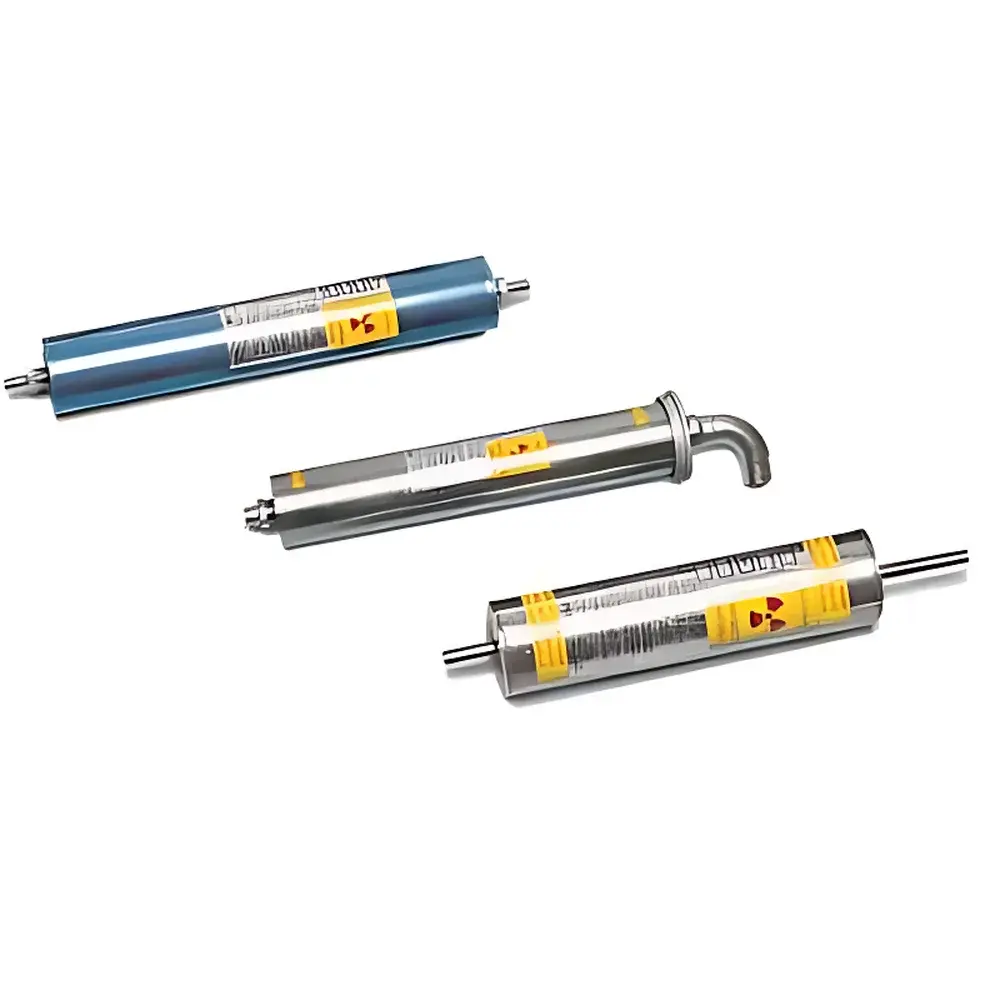
TSI Model 3012/3054/3077 Aerosol Neutralizers
| Origin | USA |
|---|---|
| Manufacturer Type | Authorized Distributor |
| Origin Category | Imported |
| Model Numbers | 3012, 3012A, 3054, 3054A, 3077, 3077A |
| Pricing | Available Upon Request |
Overview
TSI Aerosol Neutralizers (Models 3012, 3054, and 3077 series) are precision-engineered devices designed to eliminate electrostatic charge from airborne particles prior to measurement or sampling. These neutralizers operate on the principle of controlled radioactive ionization—utilizing 85Kr (krypton-85) or 210Po (polonium-210) sources—to generate balanced concentrations of positive and negative ions in the aerosol stream. When charged particles pass through this ion-rich environment, they undergo charge exchange until reaching a statistically stable, near-Boltzmann equilibrium charge distribution. This process is essential for achieving metrologically traceable particle sizing, counting, and filtration efficiency testing, as unneutralized charge introduces significant bias in diffusion loss, electrostatic deposition, and electrometer-based detection.
Key Features
- Radioisotope-based ion generation with certified activity levels compliant with IAEA and NRC regulatory limits for sealed source devices
- Stainless steel construction with electropolished internal surfaces to minimize particle adhesion and contamination carryover
- Compact, modular design enabling integration upstream of SMPS systems, CPCs, ELPI+, filter test rigs, and cascade impactors
- Multiple flow rate configurations: Model 3012 supports up to 1 L/min; Model 3054 up to 10 L/min; Model 3077 supports high-flow applications up to 30 L/min
- Low-pressure drop architecture (< 2 kPa at rated flow), preserving laminar flow conditions in downstream instrumentation
- A-type variants (e.g., 3012A, 3054A, 3077A) include integrated flow straighteners and calibrated pressure taps for ISO 14644-3-compliant installation verification
Sample Compatibility & Compliance
TSI neutralizers accommodate polydisperse aerosols across a broad size range—from sub-3 nm nucleation-mode particles to supermicron droplets—without altering particle morphology or inducing coagulation under standard operating conditions. They are validated for use with both liquid and solid aerosols generated by atomizers, fluidized beds, thermal generators, and combustion sources. All models meet requirements specified in ISO 27891:2019 (Aerosol science — Requirements for neutralizers used in particle size distribution measurements), ASTM F328–22 (Standard Practice for Calibration of Aerosol Neutralizers), and EN 1822-3:2022 (High-efficiency air filters — Part 3: Determination of the most penetrating particle size). Radioactive source licensing documentation, decay correction tables, and leak-test certificates are provided per shipment in accordance with national regulatory frameworks.
Software & Data Management
While TSI aerosol neutralizers operate as passive, source-driven hardware components without embedded firmware or digital interfaces, their performance is fully characterized and documented within TSI’s instrument calibration ecosystem. Each unit ships with a Certificate of Conformance including source activity verification, ion balance ratio (±5% tolerance at 1 L/min), and half-life-corrected operational lifetime data. Integration into automated test platforms (e.g., TSI’s FMPS or Scanning Mobility Particle Sizer™ systems) is supported via analog flow monitoring signals and mechanical mounting templates compatible with ISO-KF and Swagelok® 1/4″ VCR fittings. Audit trails for source replacement, recalibration, and maintenance events align with GLP and GMP documentation standards when used in regulated environments such as pharmaceutical cleanroom validation or EPA Method 202-compliant emission testing.
Applications
- Pre-conditioning aerosols prior to differential mobility analysis (DMA) and condensation particle counting (CPC)
- Ensuring charge neutrality during HEPA/ULPA filter efficiency testing per ISO 16890 and EN 1822
- Calibrating and validating aerosol charging state in laboratory studies of nanoparticle transport and deposition
- Supporting ambient air quality monitoring networks requiring reproducible PM2.5/PM10 reference measurements
- Enabling accurate aerosol mass concentration determination using beta attenuation or TEOM methodologies
- Facilitating standardized inhalation toxicology exposure systems per OECD TG 412 and ISO 10993-12
FAQ
Do TSI aerosol neutralizers require electrical power or external gas supply?
No—they operate passively using sealed radioisotope sources and require no electricity, compressed gas, or consumables beyond periodic source replacement per half-life expiration.
What is the typical service life of the radioactive source?
85Kr sources (used in Models 3054/3077) have a half-life of 10.76 years; 210Po sources (used in Model 3012) have a half-life of 138.4 days—source replacement intervals are specified in the Certificate of Conformance.
Can these neutralizers be used in explosive or hazardous area environments?
Yes—models are rated for Class I, Division 2 / ATEX Zone 2 operation when installed per TSI’s mechanical grounding and shielding guidelines.
Is regulatory approval required to install and operate these devices?
Yes—users must comply with national radiation safety regulations (e.g., NRC 10 CFR Part 30 in the U.S., IR(ME)R in the UK); TSI provides full technical support for license application documentation.
How is ion balance verified during routine operation?
Using a Faraday cup electrometer and bipolar aerosol charger in tandem, following the procedure outlined in ISO/TR 21506:2021 for neutralizer performance assessment.







