
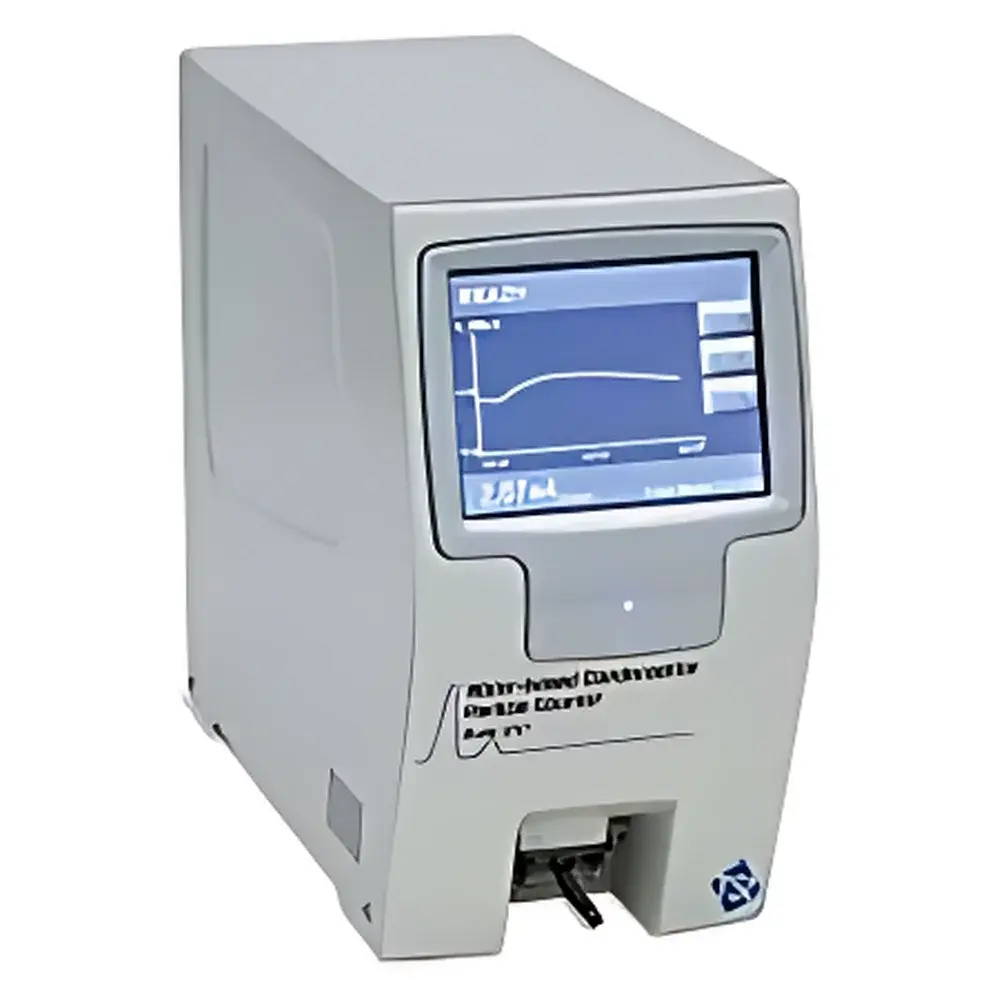
TSI Model 3787/3788 Water-based Condensation Particle Counter (WCPC)
| Origin | USA |
|---|---|
| Manufacturer Type | Authorized Distributor |
| Origin Category | Imported |
| Model | 3787 / 3788 |
| Instrument Type | Aerosol Detector |
| Minimum Detectable Particle Size (D₅₀) | 5 nm |
| Maximum Counting Concentration | 250,000 cm⁻³ |
| Aerosol Flow Rate | 0.6 ± 0.06 L/min |
| High-Flow Mode | 1.5 ± 0.15 L/min |
| Response Time (10–90%) | < 300 ms |
| Time Constant | ~130 ms |
| Background Count | < 0.01 cm⁻³ (hourly average) |
| Operating Temperature | 10–35 °C |
| Relative Humidity | 0–90% RH (non-condensing) |
| Working Fluid | Deionized or Ultrapure Water |
| Water Reservoir | External 1 L (3-day operation) or optional 4 L (12-day operation) |
| Water Consumption | ~300 mL/day |
| Vacuum Source | Integrated diaphragm pump |
| Compliance | Manufactured per ISO 9001 |
Overview
The TSI Model 3787 and 3788 Water-based Condensation Particle Counters (WCPCs) are research-grade aerosol instruments engineered for high-fidelity, real-time detection of ultrafine particles down to 5 nm (D₅₀) using a laminar-flow, water-based condensation growth mechanism. Unlike alcohol-based CPCs, these instruments employ deionized or ultrapure water as the working fluid—eliminating flammability hazards, reducing operational complexity, and enhancing environmental compatibility. The core measurement principle relies on controlled thermodynamic supersaturation: sampled aerosol is first saturated with water vapor, then introduced into a precisely temperature-regulated condensation chamber where thermal gradients induce homogeneous nucleation and growth of nanoparticles into micron-sized droplets. These enlarged droplets scatter laser light, generating discrete optical pulses that are detected, amplified, and counted at the single-particle level. Designed for both laboratory and field-deployable applications, the 3787/3788 WCPC delivers sub-second temporal resolution, robust linearity up to 250,000 cm⁻³, and intrinsic compatibility with Scanning Mobility Particle Sizers (SMPS™) for full size distribution analysis across 5 nm – 1 µm.
Key Features
- Ultra-low detection limit of 5 nm (D₅₀), verified via DMA calibration with NIST-traceable aerosol standards
- Sub-300 ms 10–90% rise time and ~130 ms time constant—enabling dynamic tracking of rapidly varying particle concentrations
- Dual-flow operation: standard 0.6 L/min aerosol flow for high-sensitivity measurements; high-flow mode at 1.5 L/min for improved counting statistics in low-concentration environments
- Integrated laminar-flow condenser with active dew-point control, heated core wall, and precision thermal management to minimize diffusion losses and maximize growth repeatability
- Patented pulse-height analysis (PHA) system for continuous in-situ diagnostics of supersaturation stability and instrument health—pulse amplitude thresholds trigger real-time alerts when deviation exceeds specification
- 6-inch color touchscreen interface with intuitive navigation, onboard Ethernet connectivity, USB data export, and internal storage for audit-ready logging
- Modular optical assembly and field-replaceable core unit—designed for rapid maintenance without factory recalibration
- Comprehensive self-diagnostic suite including laser reference monitoring, nozzle pressure sensing, inlet pressure verification, and optical alignment validation
Sample Compatibility & Compliance
The 3787/3788 WCPC is validated for use with ambient air, chamber-generated aerosols (e.g., diesel exhaust, secondary organic aerosol, salt nuclei), and inhalation exposure systems. It meets stringent requirements for GLP-compliant aerosol research and supports regulatory-aligned workflows under ISO 27427 (aerosol instrumentation), ASTM D6243 (ultrafine particle measurement), and USP (subvisible particle testing) when integrated into validated SMPS configurations. All units are manufactured under ISO 9001 quality management systems and calibrated using NIST-traceable protocols. No hazardous solvents or pressurized gas cylinders are required—only deionized water and standard line power (100–240 VAC). The instrument operates reliably within ambient conditions of 10–35 °C and ≤90% RH (non-condensing), with built-in dew-point monitoring ensuring consistent saturation performance.
Software & Data Management
The WCPC operates natively with TSI’s Aerosol Instrument Manager (AIM) software, providing synchronized control, real-time visualization, statistical post-processing, and automated file management. AIM supports 21 CFR Part 11-compliant audit trails—including user login history, parameter change logs, and timestamped calibration records—making it suitable for regulated QC/QA environments. Data output formats include CSV, HDF5, and TSI binary (.tsi) for seamless integration with Python, MATLAB, or LabVIEW-based analysis pipelines. The system implements automatic power-loss recovery: upon restart, it resumes counting from the last known stable state and reconstructs missing timestamps using internal clock synchronization. Remote monitoring is enabled via Ethernet or optional Wi-Fi module, allowing status checks, firmware updates, and diagnostic reporting without physical access.
Applications
- Indoor air quality assessment—monitoring nanoparticle emissions from printers, cooking, and cleaning products
- Outdoor ambient monitoring networks—tracking nucleation-mode particle formation events in urban and rural settings
- Controlled exposure studies—quantifying dose-response relationships in inhalation toxicology chambers
- Filter and mask efficiency testing—measuring penetration of sub-10 nm particles through filtration media
- Engine and combustion aerosol characterization—coupled with dilution tunnels and volatility tandem differential mobility analyzers (V-TDMA)
- Nanomaterial safety evaluation—real-time release monitoring during synthesis, handling, and disposal
- Atmospheric science field campaigns—deployed aboard mobile laboratories and stationary observatories for long-term trend analysis
FAQ
What is the difference between the Model 3787 and 3788?
The 3788 is an enhanced variant featuring upgraded optical module accessibility, refined thermal isolation of the condenser core, and expanded diagnostic telemetry—optimized for extended unattended operation in remote or harsh environments.
Can the WCPC be used without an SMPS system?
Yes—the 3787/3788 functions as a standalone total particle counter with full analog/digital output, real-time display, and local data logging. SMPS integration is optional for size-resolved measurements.
Is tap water acceptable for operation?
No—only deionized or ultrapure water (resistivity ≥18.2 MΩ·cm) is recommended. Tap water introduces ionic contaminants that cause nozzle clogging, inconsistent condensation, and elevated background counts.
How often does the water reservoir require refilling?
With the standard 1 L external bottle, replenishment is needed approximately every 72 hours at nominal flow; the optional 4 L reservoir extends this to ~12 days under continuous operation.
Does the instrument comply with FDA or EPA regulatory requirements?
While not pre-certified for specific regulatory submissions, its NIST-traceable calibration, ISO 9001 manufacturing, and 21 CFR Part 11–ready software architecture support validation under FDA GMP, EPA Method PS-1, and EU REACH frameworks when deployed in qualified laboratory environments.
Related Products







