
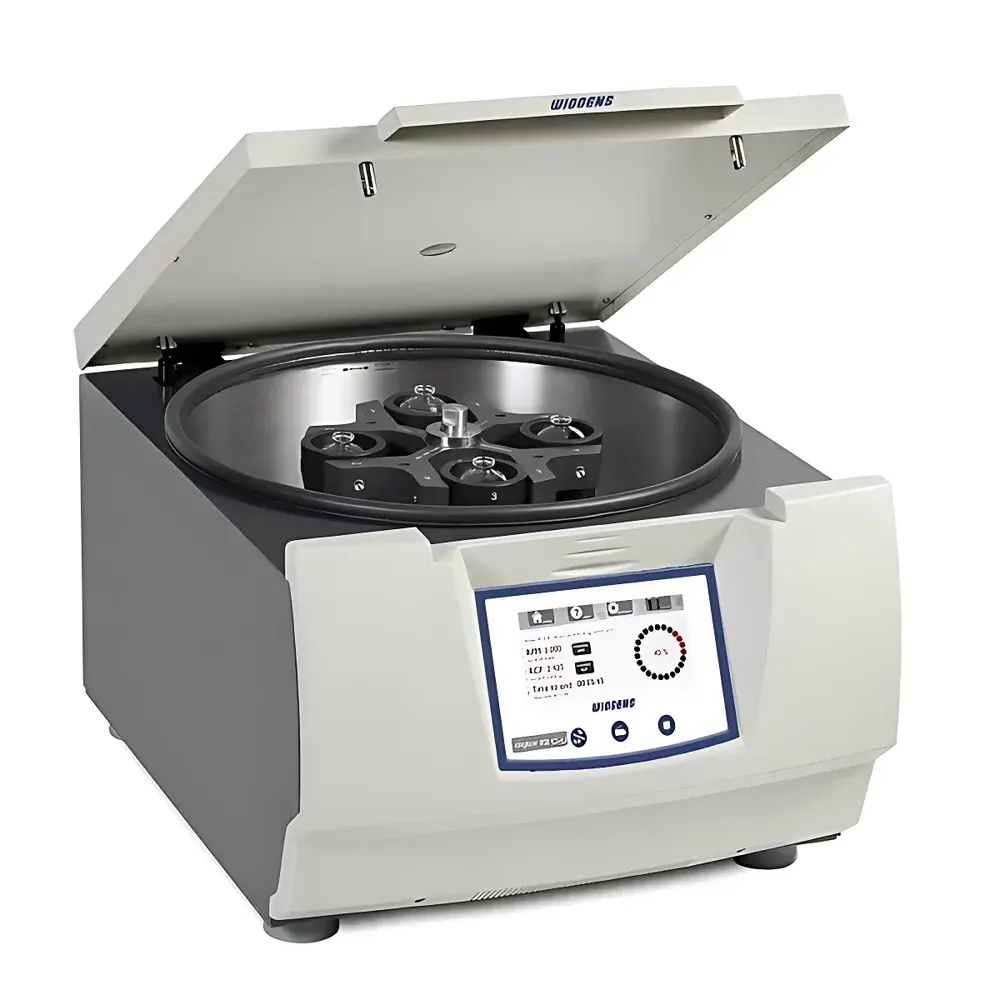
ChemTron Digtor 22 C-U Oil Water and Sediment Analyzer
| Brand | ChemTron |
|---|---|
| Origin | Germany |
| Model | Digtor 22 C-U |
| Instrument Type | Benchtop Centrifuge |
| Max Speed | 3000 rpm |
| Max RCF | 2425 × g |
| Capacity | 4 × 100 mL (6" or 8" tubes) |
| Dimensions | 540 × 650 × 400 mm |
| Weight | 77 kg |
| Power Supply | 220–230 V, 50–60 Hz |
| Power Consumption | 400 W |
| Noise Level | < 60 dB(A) |
| Compliance | ASTM D91, D96, D893, D1796, D2273, D2709, D2711, D4007, D5546 |
| Safety Standards | EN 61010-1, EN 61010-2-020, EN 61326-1, EN 61326-2-6, EN 61010-2-010 |
| CE Directives | 2011/65/EU (RoHS), 2012/19/EU (WEEE), 2014/30/EU (EMC), 2014/35/EU (LVD), 98/79/EC (IVDR) |
Overview
The ChemTron Digtor 22 C-U is a purpose-engineered benchtop centrifuge designed specifically for standardized quantitative determination of water and sediment content in petroleum-based liquids—including crude oil, fuel oils, lubricants, and hydraulic fluids. It operates on the principle of gravity-assisted sedimentation under controlled centrifugal acceleration, enabling precise phase separation of immiscible components based on density differentials. Unlike general-purpose centrifuges, the Digtor 22 C-U integrates mechanical, thermal, and safety architectures optimized for ASTM, ISO, IP, and API test methods—most notably ASTM D96 (Standard Test Method for Water and Sediment in Fuel Oils by Centrifuge), ASTM D2709 (Water and Sediment in Aviation Turbine Fuels), and ISO 9030 (Petroleum Products — Determination of Water and Sediment). Its fixed-angle rotor geometry, calibrated RCF delivery, and non-heated chamber ensure reproducible stratification without thermal-induced emulsion breakdown or viscosity drift—critical for compliance with regulatory chain-of-custody requirements in refinery QC, third-party testing labs, and aviation fuel certification facilities.
Key Features
- Microprocessor-controlled operation with TFT color display (visible up to 3 m), showing real-time RPM, RCF, elapsed time, acceleration/deceleration profiles, and unbalance localization (ULS)
- Automatic rotor identification and overspeed protection; memory function for up to 40 user-defined programs with password protection
- Brushless DC motor with maintenance-free operation, stepwise speed control (10 rpm / 10 × g increments), and in-run RPM/RCF adjustment
- Integrated safety architecture: dual mechanical lid lock, emergency manual unlock, anti-drop lid mechanism, optical observation window, and automatic shutdown upon imbalance detection
- Stainless-steel centrifuge chamber (AISI 304) with thermal insulation layer between chamber and housing; forced-air cooling system minimizes temperature rise during extended runs
- Compatibility with multiple tube formats: 6″ and 8″ cylindrical tubes, pear-shaped tubes, and 12.5 mL conical tubes; rotor and adapters autoclavable (121 °C, 20 min)
- Programmable timer (1 min – 99 h, 1 s resolution), forward/reverse countdown, RPM/RCF attainment-triggered timing, and multi-step program sequencing
- PCBS (Progressive Control Braking System) with 175 selectable acceleration/deceleration slopes to prevent post-separation remixing of sediment layers
- Energy-saving mode with auto-power-off after idle timeout; acoustic and visual status alerts throughout operation
Sample Compatibility & Compliance
The Digtor 22 C-U accommodates standard test vessels specified in major international standards—including ASTM D96’s 100 mL calibrated centrifuge tubes (6″ or 8″), ISO 9030’s pear-shaped tubes, and IP 75’s graduated cylinders. Its 4 × 100 mL capacity supports parallel analysis while maintaining strict adherence to volumetric loading tolerances required by method protocols. The absence of heating elements eliminates thermal artifacts that could compromise sediment morphology or interfacial tension integrity—ensuring conformity with GLP-aligned documentation practices. All operational parameters—including RCF calculation, dwell time, and deceleration profile—are traceable and auditable, supporting 21 CFR Part 11–compliant data integrity frameworks when paired with ChemTron’s optional LIMS-integrated software module.
Software & Data Management
While the Digtor 22 C-U operates as a standalone instrument, its embedded firmware supports full parameter logging (start/stop timestamps, actual RCF achieved, rotor ID, imbalance events) stored in non-volatile memory. Optional USB export enables transfer of run logs for external validation or QA review. Firmware complies with EN 61326-1 and EN 61326-2-6 for electromagnetic compatibility in laboratory environments, and all electronic controls meet IEC 61000-4 immunity requirements. Audit trails are retained for ≥10,000 cycles, and firmware updates are delivered via encrypted USB key—maintaining configuration stability across GxP-regulated workflows.
Applications
- Quantitative water and sediment (W&S) analysis per ASTM D96, D2709, D4007, and ISO 9030 in refinery feedstocks and finished fuels
- Determination of insoluble contaminants in turbine oils (ASTM D893, D2273) and hydraulic fluids (ISO 4406 particle count pre-screening)
- Sediment and sludge evaluation in lubricating oils (ASTM D1796, D2711) and biodiesel blends (ASTM D5546)
- Field-deployable verification of fuel cleanliness prior to aircraft refueling (API RP 2542, DEF STAN 91-91)
- Supporting API MPMS Chapter 10.8 (Manual of Petroleum Measurement Standards) for custody transfer verification
FAQ
Does the Digtor 22 C-U comply with ASTM D96 for water and sediment testing?
Yes—the instrument meets all mechanical, rotational, and timing specifications defined in ASTM D96, including RCF accuracy, tube geometry support, and non-heated operation.
Can the rotor be sterilized?
Yes—both the aluminum rotor and polymer adapters are rated for autoclaving at 121 °C for 20 minutes, supporting bio-contamination control in cross-sample applications.
Is remote monitoring or network connectivity available?
No native Ethernet or Wi-Fi interface is included; however, USB data export and optional ChemTron LabLink software enable local PC-based log aggregation and report generation.
What safety certifications does the unit hold?
It carries full CE marking under Low Voltage Directive (2014/35/EU), EMC Directive (2014/30/EU), RoHS (2011/65/EU), WEEE (2012/19/EU), and IVDR (98/79/EC); certified to EN 61010-1 and EN 61010-2-020 for laboratory equipment safety.
How is unbalance detected and managed during operation?
The ULS (Unbalance Localization System) identifies the angular position of mass asymmetry and displays the affected rotor bucket number on-screen, triggering immediate deceleration and shutdown if thresholds exceed ±5 g tolerance.



