
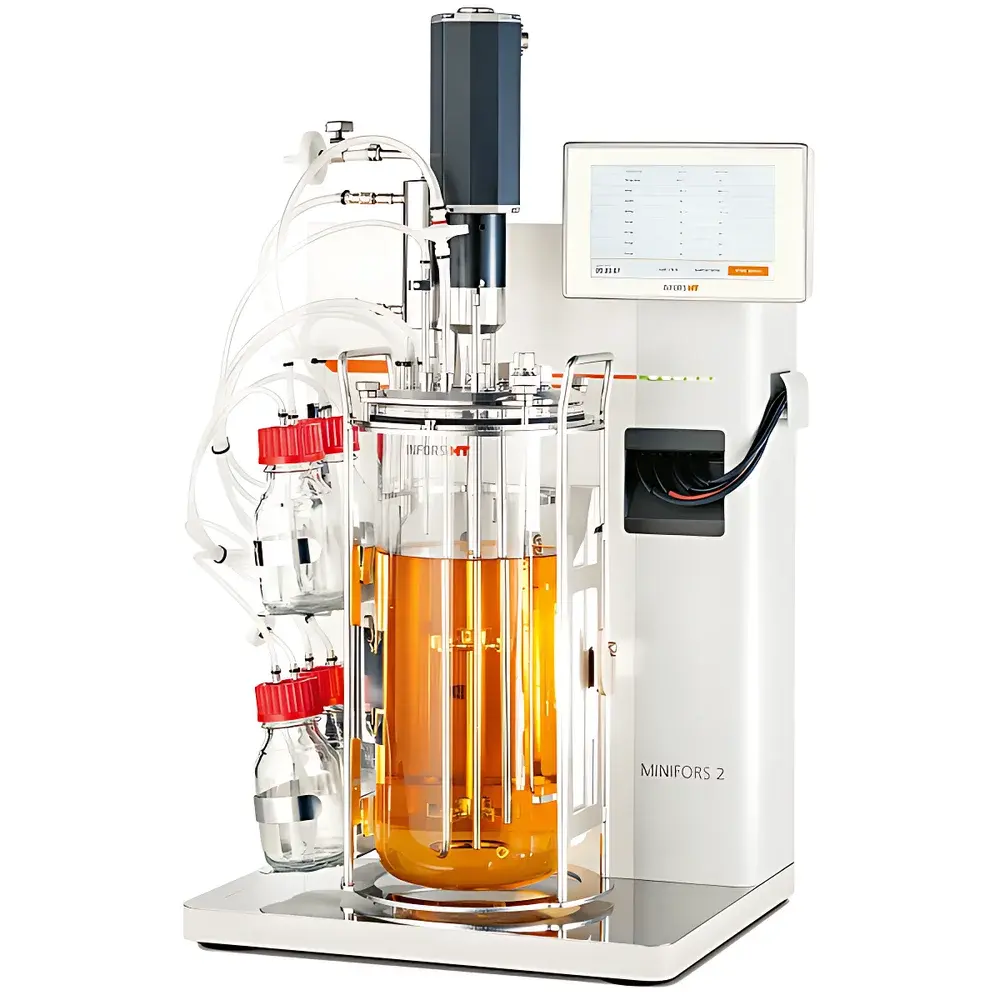
INFORS Minifors 2 Standard Benchtop Bioreactor
| Brand | INFORS |
|---|---|
| Origin | Switzerland |
| Model | Minifors 2 |
| Vessel Options | 5 L / 3.5 L working volume or 2.5 L / 1.2 L working volume |
| Temperature Control Range | +5 °C to 60 °C (cooling medium dependent) |
| Agitation | 100–1250 rpm, ±1 rpm accuracy |
| pH Range | 1.0–14.0, ±0.1 pH |
| Dissolved Oxygen (pO₂) | 0–100 %, ±0.1 % |
| Sterilization | Integrated off-line autoclavable design |
| Peristaltic Pumps | 2 standard (expandable to 4), max. 3.7 mL/min each, 0–100 % controllable |
| Foaming Control | Intelligent capacitive foam electrode with automatic detection |
| Gas Control | Central air flow regulation |
| Sensor Compatibility | Sterilizable pH and pO₂ electrodes, integrated level and temperature sensors |
Overview
The INFORS Minifors 2 Standard Benchtop Bioreactor is an engineered solution for laboratory-scale microbial and mammalian cell culture under controlled, reproducible conditions. Designed on the foundation of over four decades of bioprocess engineering expertise, the Minifors 2 implements classic Couette-type stirred-tank bioreactor principles—featuring Rushton turbine agitation, sparged gas delivery, and jacketed thermal management—to ensure consistent mass transfer, oxygenation, and heat exchange across small working volumes (0.6–3.5 L). Its compact footprint (≤400 × 400 mm base) and modular architecture make it ideal for academic labs, QC/QA units, and early-stage process development where space efficiency, operational flexibility, and regulatory traceability are critical. The system adheres to fundamental bioreactor design criteria defined in ISO 20951:2020 (Biotechnology — General requirements for bioreactors) and supports alignment with GLP-compliant workflows through deterministic control logic and audit-ready data logging.
Key Features
- Modular Off-Line Sterilization: Fully detachable glass vessel and stainless-steel headplate enable rapid assembly/disassembly for autoclaving at 121–134 °C; all wetted components—including pH/pO₂ sensors, tubing manifolds, and peristaltic pump heads—are validated for repeated steam sterilization without recalibration.
- Optimized Fluidics Architecture: Reduced internal tubing length (30–50 % shorter vs. conventional benchtop systems) minimizes hold-up volume, dead-leg risk, and contamination potential—critical for aseptic operation and low-biomass cultures.
- Precision Actuation & Sensing: High-resolution DC motor drive delivers ±1 rpm agitation control; sterilizable Pt100 temperature probe, glass-body pH electrode with stainless-steel pressure sleeve, and Clark-type polarographic pO₂ sensor provide stable, drift-compensated measurements under dynamic culture conditions.
- Expandable Parameter Control: Base configuration manages temperature, agitation, pH, pO₂, antifoam addition, and liquid level; optional modules support feed rate profiling, gas blending (Air/O₂/N₂/CO₂), and cascade control loops (e.g., pO₂ → agitation or O₂ flow).
- IRIS Control Software Integration: Single-host IRIS v5.x platform enables synchronized monitoring and scripting across up to four Minifors 2 units; supports time-based parameter scheduling, alarm-triggered actions (e.g., stop feed on pH excursion), and full export of timestamped CSV/Excel datasets compliant with 21 CFR Part 11 Annex 11 requirements.
Sample Compatibility & Compliance
The Minifors 2 accommodates diverse biological systems including aerobic bacteria (e.g., E. coli, Bacillus spp.), yeasts (S. cerevisiae), filamentous fungi, and anchorage-dependent or suspension-adapted mammalian cells (CHO, HEK293). Its borosilicate glass vessels (DIN 28120 compliant) and electropolished 316L stainless-steel headplates meet USP Class VI biocompatibility standards. All fluid paths utilize USP Class VI-certified silicone or EPDM tubing. The system supports validation protocols aligned with ASTM E2500-13 (Standard Guide for Specification, Design, and Verification of Pharmaceutical and Biopharmaceutical Manufacturing Systems) and facilitates IQ/OQ documentation packages. Optional GMP-grade IRIS software licenses include electronic signatures, user role-based access control, and immutable audit trails for regulated environments.
Software & Data Management
IRIS software operates on Windows-based host PCs and provides real-time visualization of all process variables via customizable dashboards with multi-axis trend plots. It natively records raw sensor outputs (mV, Ω, mA) alongside calculated values (e.g., DO saturation %, derived growth rate μ), enabling post-hoc recalibration and uncertainty analysis. Data files are stored in encrypted SQLite databases with SHA-256 hash integrity verification. Export functions generate PDF reports with embedded metadata (operator ID, batch number, calibration timestamps) and support LIMS integration via OPC UA or RESTful API endpoints. Batch replay functionality allows exact re-execution of historical control sequences—essential for troubleshooting, training, and comparative studies. Remote access is supported via secure TLS 1.2 tunnels with two-factor authentication.
Applications
- Strain screening and media optimization for recombinant protein expression
- Kinetic modeling of microbial growth, substrate consumption, and metabolite formation
- Process characterization under varying shear stress (via rpm/pO₂ coupling) and nutrient gradients
- Scale-down model development for tech-transfer to pilot- or production-scale bioreactors (e.g., Techfors, Labfors 5)
- Teaching bioprocess fundamentals—including Monod kinetics, oxygen transfer coefficient (kLa) determination, and feedback control theory—in undergraduate and graduate curricula
- Regulatory filing support: generation of PK/PD-relevant data under documented, repeatable conditions meeting ICH Q5D and Q5A expectations
FAQ
Is the Minifors 2 suitable for anaerobic cultivation?
Yes. The system supports N₂ or CO₂ sparging via optional gas mixing modules, and its sealed headplate design maintains strict redox control when paired with anaerobic sensors and catalyst-based O₂ scrubbers.
Can pH and pO₂ be controlled simultaneously using cascade logic?
Yes. IRIS enables hierarchical control strategies—for example, maintaining pO₂ setpoint by modulating agitation speed first, then O₂ fraction, and finally air flow rate—following user-defined priority rules.
What validation documentation is provided with the system?
INFORS supplies Factory Acceptance Test (FAT) reports, sensor calibration certificates (NIST-traceable), material compliance declarations (RoHS, REACH), and optional IQ/OQ protocol templates compatible with ISO 13485 and FDA 21 CFR Part 820 frameworks.
How is sterility assurance verified after repeated autoclave cycles?
Each vessel/headplate assembly undergoes helium leak testing (≤1 × 10⁻⁹ mbar·L/s) prior to shipment; users may perform periodic integrity checks using pressure-hold or bubble-point methods per ASTM F838-22.
Does the system support integration with exhaust gas analyzers (e.g., for CER/OUR calculation)?
While the Minifors 2 does not include built-in off-gas analysis, its analog/digital I/O ports and IRIS API allow seamless connection to third-party mass spectrometers or paramagnetic O₂/NDIR CO₂ analyzers for real-time respiratory quotient (RQ) and volumetric oxygen uptake rate (OUR) derivation.




