
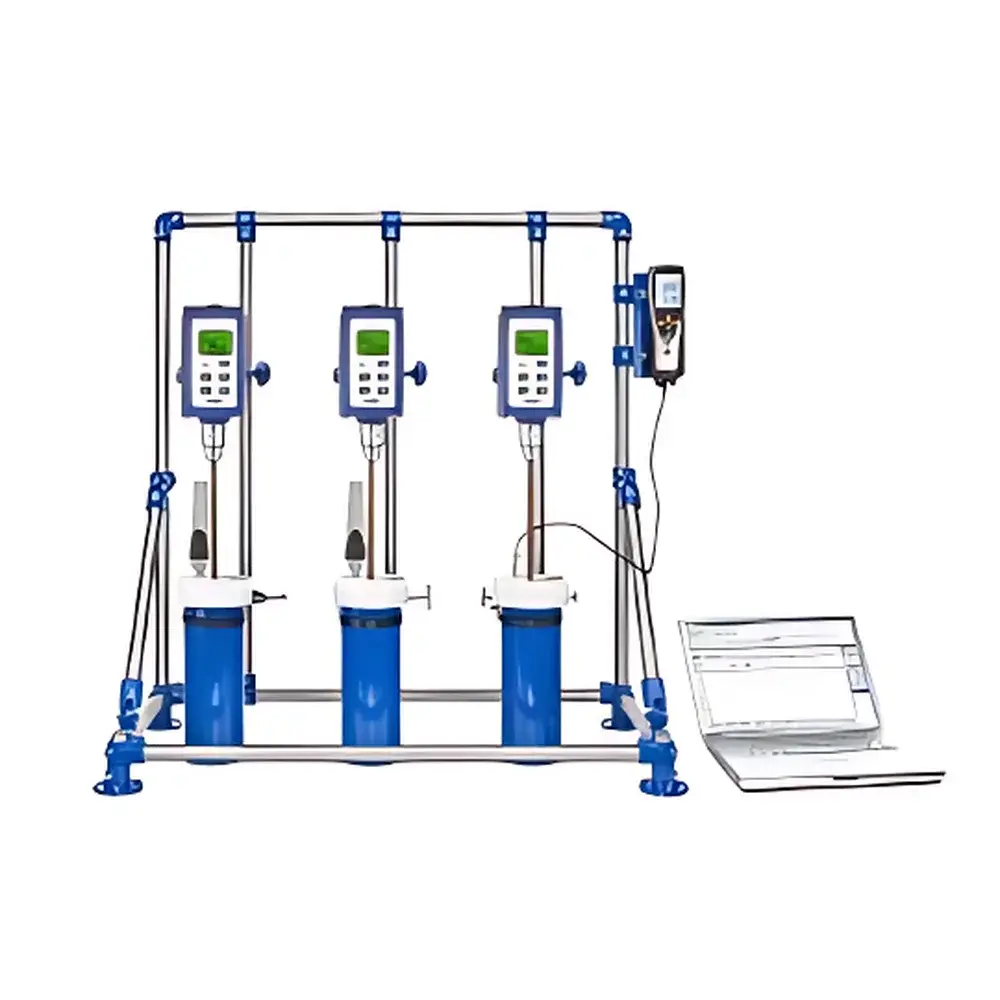
ChemTron NLK Lime Performance Testing System
| Brand | ChemTron |
|---|---|
| Origin | Germany |
| Model | NLK |
| Compliance | DIN EN 459-2 |
| Measurement Principle | Calorimetric monitoring of heat evolution during lime slaking (wet digestion) |
| Data Acquisition | Dual/multi-point temperature sensing via calibrated thermistors or Pt100 sensors |
| Thermal Isolation | Vacuum-insulated Dewar vessels |
| Output Format | CSV export |
| LIS/LIMS Integration | Yes |
| Calibration | Two-point or multi-point temperature sensor calibration |
| Reporting Parameters | T₀, tₘₐₓ, Tₘₐₓ, T′ₘₐₓ, tᵤ₈₀, Tᵤ₈₀, T₆₀, T₁₀, T₄₀, R-value, max rotational speed |
Overview
The ChemTron NLK Lime Performance Testing System is a precision calorimetric instrument engineered for the quantitative assessment of quicklime (CaO) and hydrated lime (Ca(OH)₂) reactivity in industrial lime processing and flue gas desulfurization (FGD) applications. Unlike empirical or visual ash fusion methods, the NLK system operates on the fundamental principle of exothermic reaction calorimetry: it continuously monitors the rate and magnitude of heat release during controlled wet slaking—where CaO reacts with water to form Ca(OH)₂. This real-time thermal profile directly correlates with lime quality parameters including particle size distribution, calcination degree, crystallinity, and presence of inert impurities. The system conforms strictly to DIN EN 459-2:2021, the harmonized European standard governing the determination of lime reactivity through slaking behavior. Its design prioritizes metrological integrity—thermal isolation via double-walled vacuum Dewar vessels minimizes ambient heat exchange, while high-stability temperature sensors ensure traceable, reproducible data acquisition under ISO/IEC 17025-aligned laboratory conditions.
Key Features
- Calorimetric measurement architecture compliant with DIN EN 459-2 for standardized lime reactivity evaluation
- Dual or multi-point temperature sensing using calibrated Pt100 or NTC thermistors, supporting two-point or multi-point in-situ calibration
- Vacuum-insulated Dewar vessel configuration to suppress convective and conductive thermal losses—critical for accurate enthalpy-of-reaction quantification
- Full parametric output set: T₀ (initial slaking onset), tₘₐₓ (time to peak exotherm), Tₘₐₓ (maximum temperature), T′ₘₐₓ (derivative-based inflection point), tᵤ₈₀/Tᵤ₈₀ (time/temperature at 80% of total heat release), T₆₀, T₁₀, T₄₀ (characteristic temperatures at defined cumulative heat fractions), R-value (reactivity index), and maximum rotational speed (if integrated stirring control is used)
- CSV-compatible data interface enabling bidirectional import/export for statistical process control (SPC) and historical trend analysis
- Natively supports integration with Laboratory Information Management Systems (LIMS) and Laboratory Information Systems (LIS) via standardized communication protocols
- Modular hardware configuration: Available in A, AL, B, BL, C2, C3, and C4 kit variants—differing in sensor type (wired/wireless), number of Dewar assemblies, and inclusion of NLK-specific stirrers and caps
Sample Compatibility & Compliance
The NLK system is validated for use with commercial quicklime, hydrated lime, and dolomitic lime samples within the mass range of 0.5–5.0 g per test cycle. It accommodates both powdered and granular feedstocks typical of coal-fired power plant FGD systems and steelmaking slag conditioning processes. All operational procedures, calibration routines, and reporting templates align with DIN EN 459-2 Annex A (slaking calorimetry method). While not an ash fusion tester per se, its application domain overlaps with coal combustion residue characterization—particularly when evaluating lime reactivity as a proxy for sorbent efficiency in sulfur capture. The system’s temperature sensors are traceably calibrated against NIST-traceable reference standards, and raw data files retain full audit trails required under GLP and GMP environments. No ASTM or ISO ash fusion standards (e.g., ASTM D1857, ISO 540) apply directly; however, thermal profiling data may be correlated to fusibility indices in cross-validation studies.
Software & Data Management
Data acquisition and reporting are managed through a dedicated Windows-based application supporting configurable test protocols, user-defined pass/fail thresholds, and automated report generation in PDF and CSV formats. Each test record includes timestamped sensor readings, metadata (operator ID, sample ID, batch number), and digital signatures where enabled. Audit trail functionality logs all parameter modifications, calibration events, and report exports—meeting documentation requirements under FDA 21 CFR Part 11 for electronic records and signatures. Database functionality enables long-term storage of ≥10,000 test records with SQL-backed indexing for rapid retrieval by sample attribute, date range, or performance metric. Raw CSV outputs integrate seamlessly with JMP, Minitab, or Python-based analytics pipelines for multivariate regression modeling of lime reactivity against kiln operating parameters.
Applications
- Quality control of lime feedstock in flue gas desulfurization (FGD) scrubber systems
- Optimization of lime slurry preparation in wastewater neutralization plants
- Supplier qualification and incoming material inspection per EN 459-1 specifications
- Research into calcination severity effects on lime hydration kinetics
- Correlation studies between lime reactivity profiles and downstream gypsum purity in forced oxidation FGD
- Supporting technical due diligence in coal-to-power asset acquisitions where limestone/lime procurement strategy impacts OPEX
FAQ
Does the NLK system measure ash fusion temperature?
No. The NLK is a lime reactivity calorimeter—not an ash fusion tester. It evaluates CaO hydration kinetics, not the softening, hemisphere, or flow temperatures of coal ash. For ash fusion analysis, refer to dedicated instruments complying with ASTM D1857 or ISO 540.
Is stirring speed controlled automatically by the NLK system?
No. Stirring is performed externally using optional OHS.2 or OHS.4 digital stirrers (sold separately); the NLK system acquires temperature data only and does not regulate motor speed.
Can the NLK system be used for dolomitic lime?
Yes—provided the sample contains ≥60% CaO equivalent and exhibits measurable exothermic slaking behavior. Reaction profiles may differ quantitatively due to MgO contribution; users should establish internal reference curves.
What is the minimum required sample mass?
0.5 g is the validated lower limit for reliable signal-to-noise ratio under standard Dewar geometry; below this, thermal inertia effects dominate and reduce parametric resolution.
Are calibration certificates included with temperature sensors?
Calibration certificates traceable to national standards (e.g., PTB or UKAS) are available upon request at additional cost; factory calibration is performed pre-shipment but not certified unless specified.






