
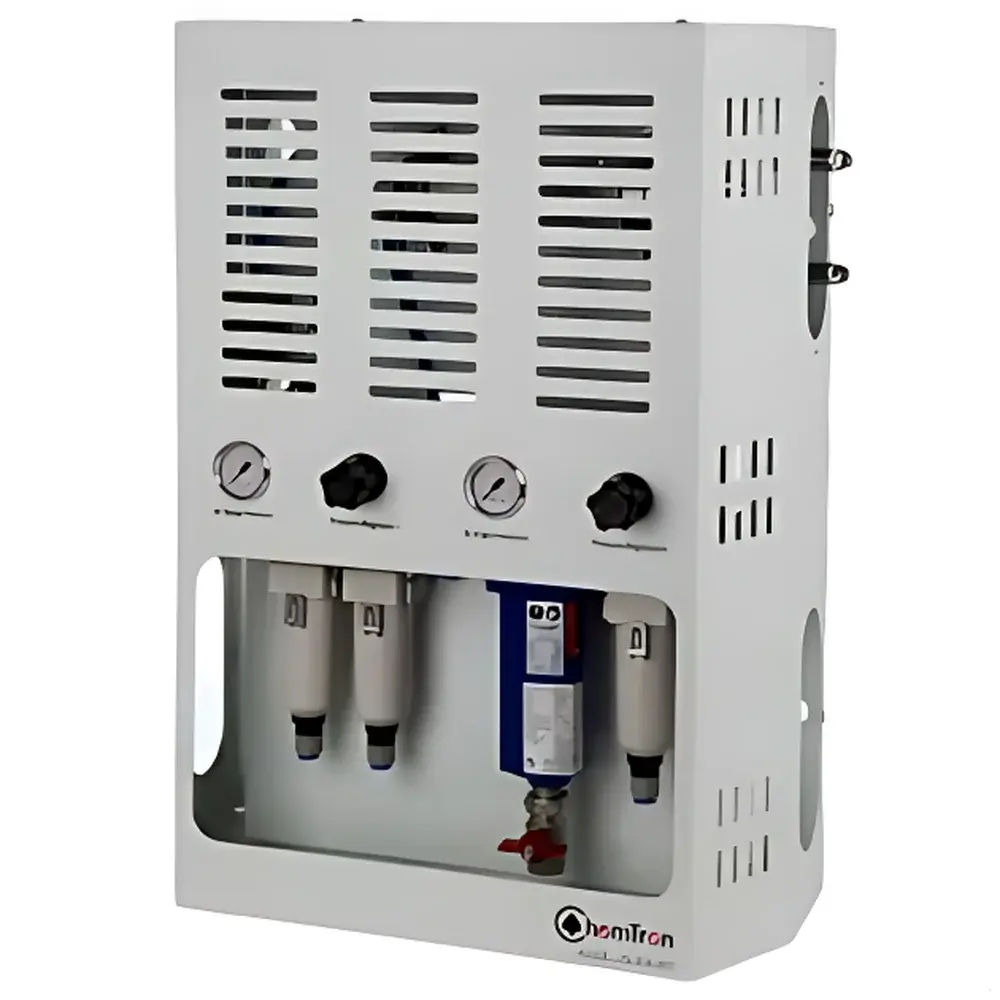
ChemTron AEOLUS ZA30/Z A60 Modular Zero-Air Generator
| Brand | ChemTron |
|---|---|
| Origin | Germany |
| Model | AEOLUS ZA30 / AEOLUS ZA60 |
| Output Flow | 30 L/min or 60 L/min |
| Output Pressure | 7.6 bar / 108 psi |
| Compressed Air Input Requirement | 8.5–10 bar, oil-free and dry (pressure dew point ≤ −20 °C, ISO 8573-1 Class 1.3.1) |
| Noise Level | < 58 dB(A) |
| Ambient Temperature Range | 15–35 °C |
| Dimensions (L×W×H) | 490×220×625 mm (ZA30), 490×240×625 mm (ZA60) |
| Weight | 25 kg (ZA30), 27 kg (ZA60) |
| Compressed Air Inlet | OD 10 mm or G1/4" |
| Zero-Air Outlet | OD 6 mm or G1/4" |
Overview
The ChemTron AEOLUS ZA30 and ZA60 are modular, passive zero-air generators engineered for laboratories and industrial analytical environments requiring ultra-pure, hydrocarbon-free, oil-free, and moisture-free compressed air. Unlike conventional electrically driven air purification systems, the AEOLUS series operates without power—leveraging pressure-swing adsorption (PSA) technology with carbon molecular sieve (CMS) beds to selectively remove hydrocarbons, CO, NOx, SO2, ozone, and other trace contaminants from instrument-grade compressed air. This passive design eliminates electromagnetic interference, thermal drift, and electrical background noise—critical for sensitive applications such as gas chromatography (GC), GC–MS, flame ionization detection (FID), nitrogen oxide analyzers, and ambient air monitoring systems compliant with EPA Method TO-14/TO-15 and EN 14662.
Key Features
- Passive operation: No electricity required—ensures zero EMI/RFI interference and intrinsic safety in explosion-hazard zones (ATEX-compliant when installed per local regulations)
- Modular architecture: ZA30 (30 L/min zero-air output at 7.6 bar) and ZA60 (60 L/min at 7.6 bar) modules can be paralleled to scale total output linearly—e.g., two ZA60 units deliver up to 120 L/min
- Dual-output configuration: Simultaneous delivery of zero-air (hydrocarbon < 0.1 ppb, THC < 0.05 ppm) and oil-/water-free instrument air (ISO 8573-1 Class 1.3.1 compliant) from a single compressed air feed
- Flexible integration: Supports both high-flow continuous compressor sources (≥120 L/min at 10 bar) and low-flow intermittent sources with buffer tanks via dual-mode inlet regulation
- Low-footprint deployment: Compact vertical form factor enables benchtop use or wall-mounting (hardware included); vibration- and noise-free operation (<58 dB(A)) preserves acoustic integrity in shared lab spaces
- Robust mechanical construction: Stainless steel CMS housings, brass manifold blocks, and elastomer-free sealing materials ensure long-term stability under cyclic pressure loading and prevent outgassing
Sample Compatibility & Compliance
The AEOLUS generator is validated for use with gas-phase analytical instrumentation where baseline stability and contaminant-free carrier/combustion/support gases are non-negotiable. It meets the zero-air purity specifications defined in ASTM D6163 (for hydrocarbon analysis), EPA Method IO-3.2 (ambient air quality monitoring), and ISO 8573-1:2010 Class 1.3.1 for particulate, water, and oil content. All wetted materials comply with USP for extractables profiling. The system requires incoming compressed air meeting ISO 8573-1 Class 1.3.1 (oil content ≤ 0.01 mg/m³, pressure dew point ≤ −20 °C, particles ≤ 0.1 µm). No calibration or routine consumable replacement is needed—CMS lifetime exceeds 20,000 operating hours under specified inlet conditions.
Software & Data Management
As a fully passive, analog-only device, the AEOLUS ZA30/Z A60 does not incorporate embedded firmware, digital interfaces, or data logging capabilities. This architecture aligns with GLP/GMP environments where deterministic behavior, absence of software validation burden, and immunity to cybersecurity threats are prioritized. System performance verification is conducted externally using certified gas analyzers (e.g., photoacoustic spectroscopy for THC, chemiluminescence for NOx). Maintenance records—including inlet air quality logs, pressure drop monitoring, and CMS service intervals—are maintained manually per laboratory SOPs and support FDA 21 CFR Part 11 audit readiness when integrated into validated instrument platforms.
Applications
- Carrier and detector gases for GC and GC–MS systems requiring ultra-low hydrocarbon backgrounds
- Combustion air for FID, NPD, and PFPD detectors
- Zero-air dilution and calibration standards generation in environmental air quality labs (e.g., for O3, NOx, VOC analyzers)
- Supply gas for FTIR, cavity ring-down spectroscopy (CRDS), and laser-based trace gas sensors
- Instrument air for pneumatic actuators, auto-samplers, and valve manifolds in regulated QC/QA workflows
- Backup or primary zero-air source in mobile labs and field-deployable monitoring stations
FAQ
Does the AEOLUS require electricity to operate?
No—it functions entirely passively using only inlet compressed air pressure; no power supply, cooling, or control electronics are involved.
What compressed air quality is mandatory for optimal performance?
Inlet air must be oil-free and dry, with a pressure dew point ≤ −20 °C and particulate contamination conforming to ISO 8573-1 Class 1.3.1. Oil-lubricated compressors must be paired with coalescing + desiccant + activated carbon pre-filters.
Can multiple AEOLUS modules be connected in parallel?
Yes—modules are designed for direct parallel manifold connection using standardized G1/4″ or OD 10 mm tubing. Flow scales linearly; pressure drop remains within specification if total inlet flow and pressure meet combined demand.
Is certification available for regulatory submissions?
ChemTron provides Factory Acceptance Test (FAT) reports documenting zero-air purity (THC, CO, NOx, SO2) per batch, along with material compliance declarations (RoHS, REACH, USP ). Site-specific IQ/OQ protocols are supported by application engineers.
How often does the carbon molecular sieve require replacement?
Under specified inlet conditions, CMS service life exceeds 20,000 hours. Replacement is indicated only when measured outlet THC rises above 0.05 ppm or pressure drop across the module exceeds 1.5 bar—typically every 3–5 years in continuous operation.



