
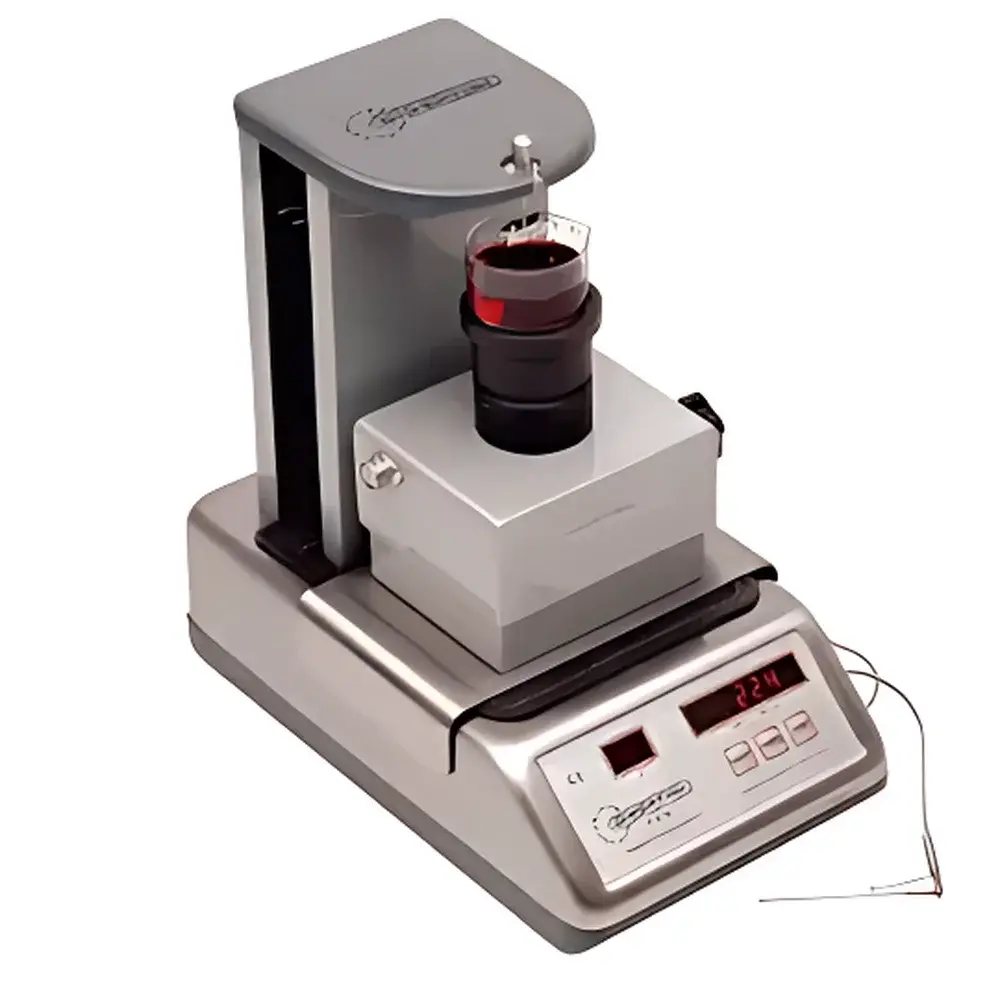
ChemTron TDS Digital Tensiometer
| Brand | ChemTron |
|---|---|
| Origin | Germany |
| Model | TDS |
| Measurement Principle | Wilhelmy Plate & Du Noüy Ring Methods |
| Max Force Range | 60 g |
| Surface Tension Accuracy | ±0.2 mN/m |
| Units | mN/m (equivalent to dyne/cm) |
| Standard Accessories | Custom Glass Plate (24×24×0.15 mm), Plate Suspension System, Borosilicate Glass Sample Cup, Manual Height-Adjustable Stand |
| Optional Accessories | PT100 1/3 DIN Temperature Sensor (10–30 °C, ±0.05 °C accuracy, 0.1 °C resolution), Wilhelmy Platinum Plate, Double-Wall Jacketed Thermostatted Cell, Du Noüy Platinum Ring (requires density measurement via sinker and jacketed cell) |
Overview
The ChemTron TDS Digital Tensiometer is a precision-engineered, semi-automated instrument designed for the accurate and reproducible determination of surface tension and interfacial tension using the classical Wilhelmy plate and Du Noüy ring methods. Based on the principle of measuring the force exerted on a solid probe—either a vertically immersed platinum or glass plate or a calibrated platinum ring—as it contacts or detaches from a liquid interface, the TDS delivers traceable, ISO-compliant measurements in accordance with ASTM D971, ISO 6295, and ISO 1409. Its robust mechanical architecture integrates a high-resolution load cell (60 g full-scale capacity) with temperature-stable electronics and an ergonomic manual vertical positioning system, enabling stable operation in routine QC laboratories and research environments where long-term repeatability and method consistency are critical.
Key Features
- Two standardized measurement modes: Wilhelmy plate (Wihelmy method) and Du Noüy ring (ring detachment method), both compliant with international standards for surface and interfacial tension testing
- High-precision force transduction with ±0.2 mN/m accuracy and resolution down to 0.01 mN/m, ensuring compliance with GLP/GMP documentation requirements
- Modular probe compatibility: includes custom borosilicate glass plate (24 × 24 × 0.15 mm) as standard; optional Wilhelmy platinum plate and Du Noüy platinum ring available for enhanced reproducibility and low-surface-tension applications
- Manual height-adjustable stand with fine-thread micrometer control enables precise immersion depth regulation and consistent meniscus formation
- Internal automatic calibration routine ensures measurement integrity without external weights—reducing operator dependency and drift-related uncertainty
- Designed for ambient and controlled-temperature operation; compatible with thermostatted double-wall cells and PT100 1/3 DIN temperature sensors (±0.05 °C accuracy, 0.1 °C resolution) for thermodynamic surface tension studies
Sample Compatibility & Compliance
The TDS supports aqueous and non-aqueous systems—including surfactant solutions, polymer melts, emulsions, microemulsions, and biological fluids—across a wide range of viscosities and surface activity profiles. When used with the Du Noüy ring configuration, density determination is required per ASTM D1250 and ISO 12185; this is achieved using a calibrated sinker and jacketed measurement cell. All wetted parts are chemically inert (borosilicate glass, platinum, PTFE), minimizing adsorption artifacts and enabling trace-level analysis in pharmaceutical excipient characterization and formulation development. The instrument meets essential regulatory expectations for audit-ready documentation under FDA 21 CFR Part 11 when integrated with compliant data acquisition software (see Software & Data Management).
Software & Data Management
While the TDS operates as a standalone benchtop instrument with direct digital readout, it is fully compatible with ChemTron’s optional TensioSoft™ PC-based acquisition suite. This software provides real-time force curve visualization, automated peak detection for ring detachment, dynamic surface tension calculation (via time-resolved Wilhelmy plate immersion), statistical reporting (mean, SD, RSD), and export to CSV or PDF formats. Audit trails, user access levels, electronic signatures, and raw-data archiving align with ALCOA+ principles and support 21 CFR Part 11 compliance in regulated environments such as pharmaceutical QC labs and contract research organizations.
Applications
- Surfactant efficacy evaluation: quantifying critical micelle concentration (CMC) and adsorption kinetics in detergent formulations
- Coating and adhesion science: assessing wettability and spreading coefficients of paints, inks, adhesives, and functional coatings on porous or polymeric substrates
- Pharmaceutical development: characterizing drug-excipient interfacial behavior, emulsion stability, and liposome membrane interactions
- Biomedical research: studying protein-surfactant interactions, lung surfactant analogs, and biomembrane model systems
- Environmental chemistry: monitoring surfactant persistence in wastewater effluents and soil leachates
- Materials science: evaluating nanofluid stability, nanoparticle dispersion quality, and functionalized surface energy
- Foam and emulsion engineering: correlating surface rheology with bulk phase stability in food, cosmetic, and agrochemical products
FAQ
What measurement methods does the ChemTron TDS support?
The TDS supports both the Wilhelmy plate method (using glass or platinum plates) and the Du Noüy ring method (with optional platinum ring), each governed by distinct correction protocols defined in ISO 1409 and ASTM D971.
Is density measurement required for all test configurations?
Density correction is mandatory only when using the Du Noüy ring method; it is not required for Wilhelmy plate measurements, which rely on geometric calibration and direct force-to-tension conversion.
Can the TDS be used for interfacial tension between two immiscible liquids?
Yes—the instrument is validated for both air–liquid and liquid–liquid interfacial tension measurements, provided the lower-phase density is known or measured separately using the sinker method.
Does the TDS comply with regulatory data integrity standards?
When paired with TensioSoft™ and configured with user authentication, audit trail logging, and electronic signature capability, the system satisfies core elements of FDA 21 CFR Part 11 and EU Annex 11 for computerized systems in GxP environments.
What temperature control options are available?
The base system operates at ambient temperature; optional accessories include a PT100 1/3 DIN sensor (10–30 °C) and double-wall jacketed cells for active thermostatic control—enabling temperature-dependent surface tension profiling per ISO 1409 Annex A.
Related Products







