
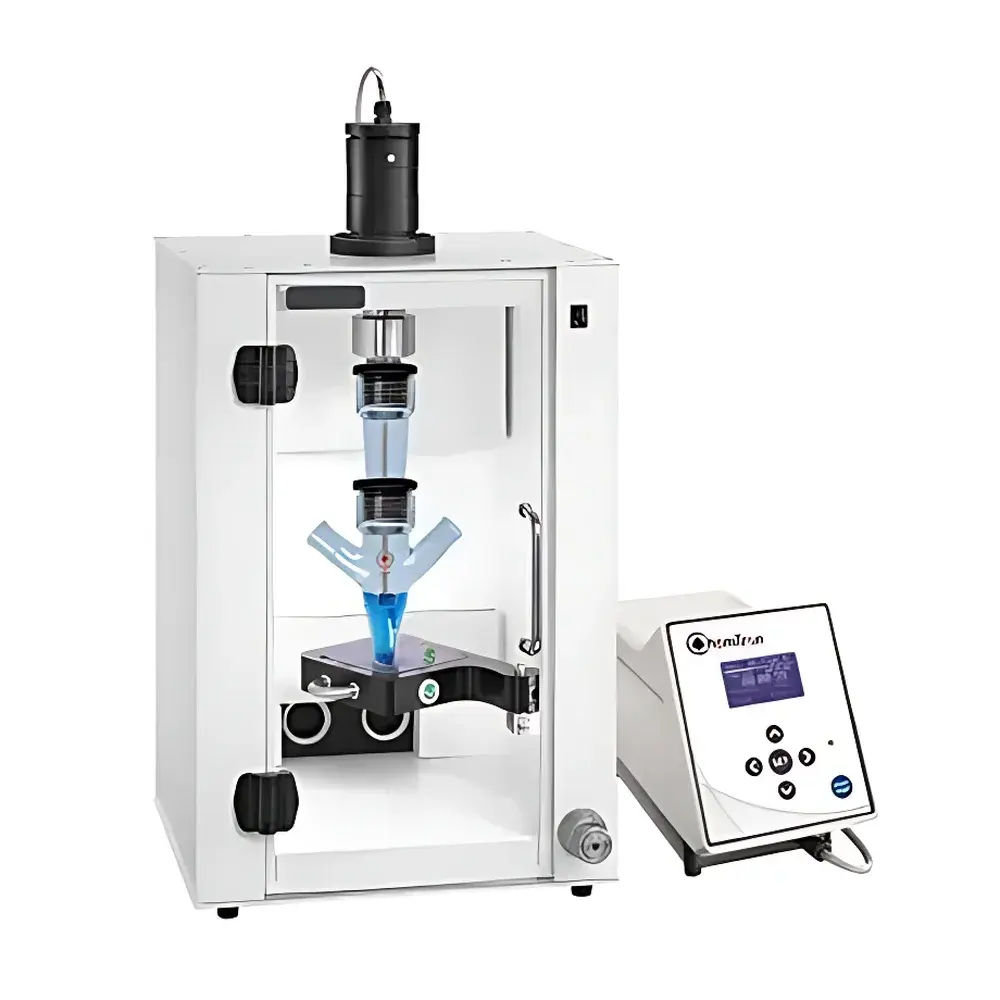
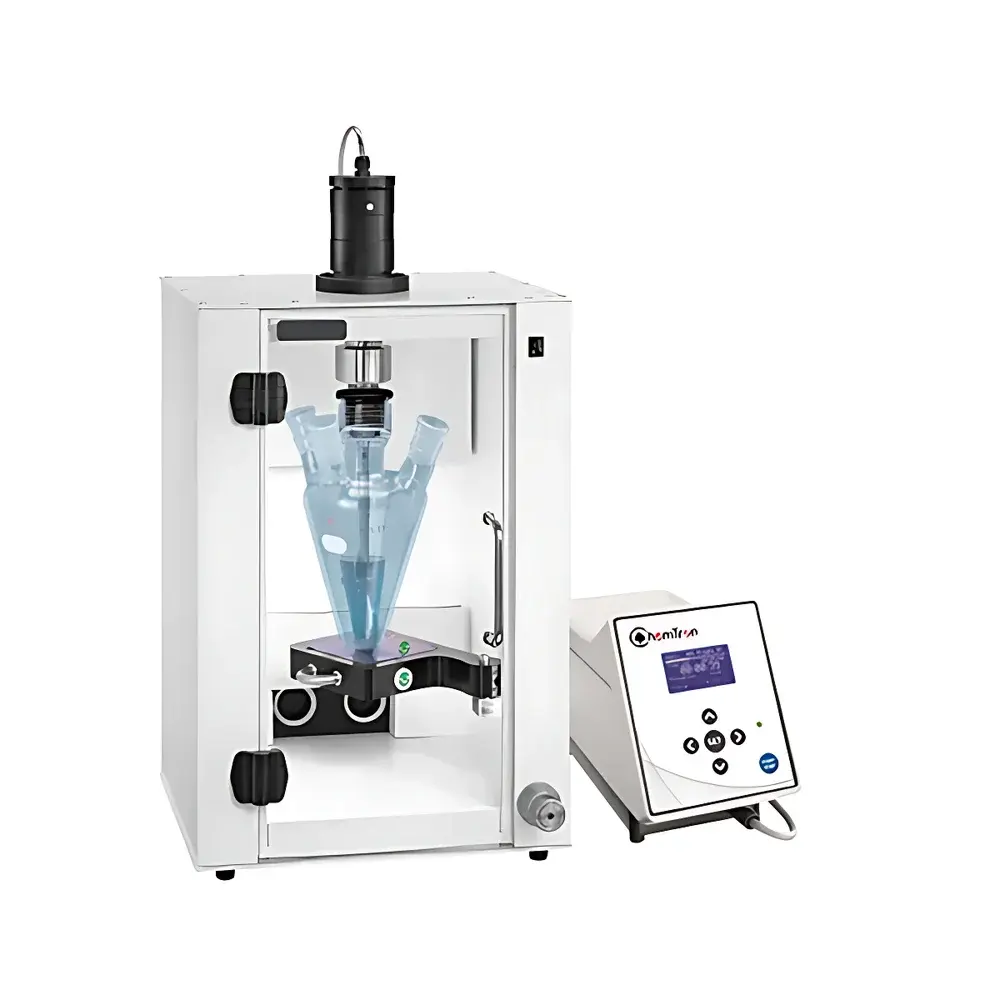
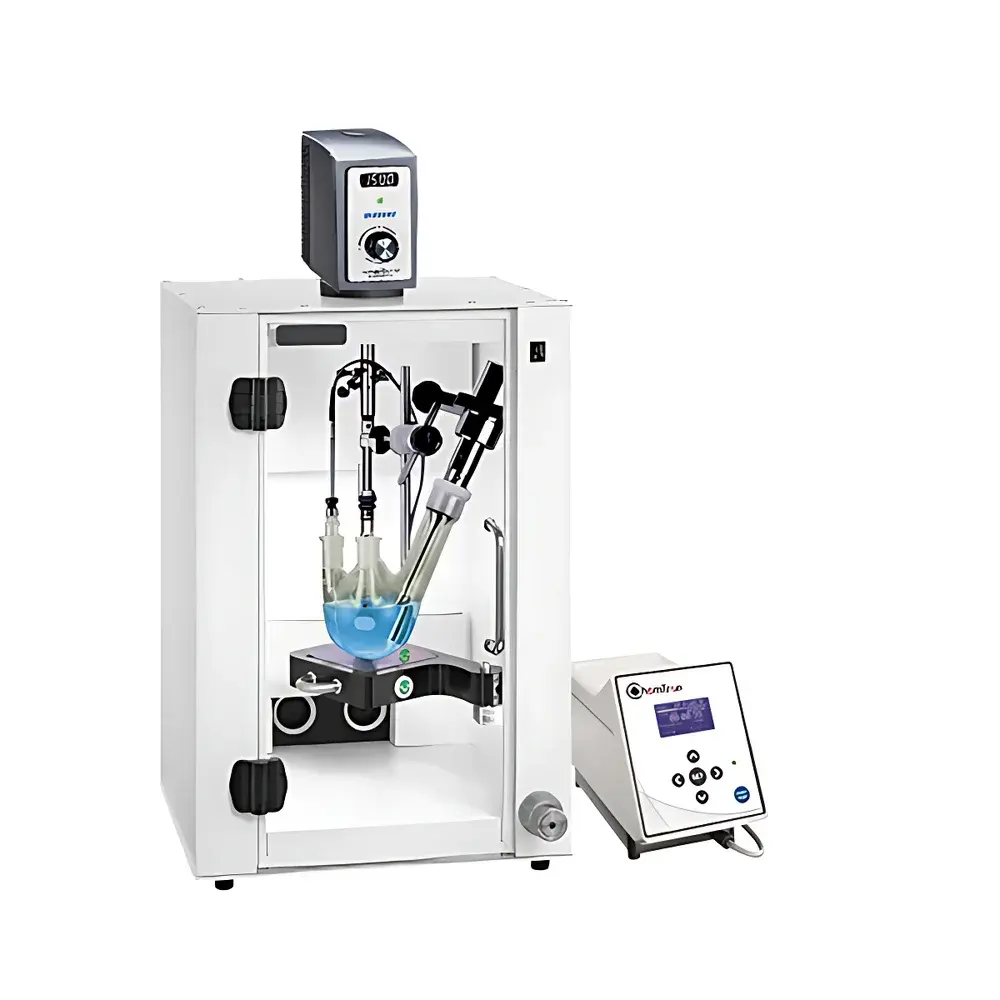
ChemTron UR Series Ultrasonic Chemical Reactor
| Brand | ChemTron |
|---|---|
| Origin | Germany |
| Model | UR-1 / UR-2 / UR-3 / UR-4 |
| Reaction Volume | 3–2000 mL |
| Number of Reactor Units | 3 |
| Max. Ultrasonic Output Power | 200 W (UR-1/UR-2) / 400 W (UR-3/UR-4) |
| Transducer Type | UW200 (UR-1/UR-2) / UW400 (UR-3/UR-4) |
| Horn Diameter | 6 mm (UR-1/UR-2) / 19 mm (UR-3/UR-4) |
| Horn Length | 128 mm (UR-1/UR-2) / 132 mm (UR-3/UR-4) |
| Generator Model | GM4200 (UR-1/UR-2) / GM4400 (UR-3/UR-4) |
| Reactor Construction | Single-layer or jacketed borosilicate glass |
| Acoustic Enclosure | Integrated sound-dampening chamber with 20 dB(A) noise reduction |
| Stirring | Top-mounted mechanical stirrer (UR-4 only, 40–2000 rpm) |
| Optional Temperature Control | External recirculating chiller (–25 to +100 °C) |
Overview
The ChemTron UR Series Ultrasonic Chemical Reactor is an engineered platform for controlled sonochemical synthesis and process intensification in research and development laboratories. It leverages high-intensity ultrasonic cavitation—generated via piezoelectric transducers operating at 20 kHz—to deliver localized energy input directly into reaction media. This physical mechanism induces transient microcavitation: rapid formation and adiabatic collapse of vacuum bubbles in liquid phase, producing localized hotspots exceeding 5000 K and transient pressures above 1000 bar, with thermal gradients exceeding 1010 K/s. Unlike conventional thermal activation, this non-equilibrium energy transfer enables acceleration of kinetically hindered reactions, enhanced mass transfer across phase boundaries, selective bond cleavage, and access to alternative reaction pathways—particularly valuable in nanoparticle synthesis, catalytic activation, pharmaceutical intermediate preparation, and green chemistry workflows. The UR system integrates reactor geometry, acoustic coupling, temperature management, and real-time operational safety into a modular, ISO-compliant benchtop architecture.
Key Features
- Modular reactor configurations: UR-1 and UR-2 support small-volume reactions (3–250 mL) using conical flasks with #25 center opening and dual 14/20 side ports; UR-3 accommodates 500 mL and 2000 mL conical reactors with #36 center port and triple 24/40 side ports; UR-4 features a 2000 mL round-bottom flask with integrated top-mounted mechanical stirring (40–2000 rpm).
- Dual-power ultrasonic generators: GM4200 (200 W output, UR-1/UR-2) and GM4400 (400 W output, UR-3/UR-4), both compliant with IEC 61000-6-3 EMC standards and equipped with digital amplitude control (0–100%), pulse mode, and real-time power monitoring.
- Optimized acoustic delivery: Titanium alloy sonotrodes (TS106: Ø6 mm × 128 mm; TS419: Ø19 mm × 132 mm) coupled with precision-machined gain horns (SH200G/SH400G) ensure efficient energy transfer and minimize harmonic distortion.
- Acoustically shielded operation: Integrated 20 dB(A) sound-dampening enclosure includes vibration-isolating support base, anti-slip matting, adjustable mounting rods, and quick-clamp vessel holders—meeting OSHA 29 CFR 1910.95 workplace noise exposure guidelines.
- Material compatibility: All wetted parts constructed from ASTM E438 Type I, Class A borosilicate 3.3 glass; PTFE-coated stainless steel stirrers and nickel-plated brass fittings ensure chemical resistance across pH 0–14 and common organic solvents.
Sample Compatibility & Compliance
The UR Series supports heterogeneous, multiphase, and viscous reaction systems—including suspensions, emulsions, colloids, organometallic precursors, and biological matrices (e.g., cell lysates, tissue homogenates). Reactor vessels conform to DIN 12331 (conical flasks) and DIN 12337 (round-bottom flasks); all ground-glass joints meet ISO 3807 tolerances. System design aligns with GLP requirements for traceable parameter logging and operator intervention records. Optional recirculating chiller (JRS-9620025, –25 to +100 °C) enables precise temperature control per ASTM E2847 for calorimetric consistency. Full documentation package—including Declaration of Conformity (CE), RoHS compliance statement, and electrical safety certification per EN 61010-1—is provided with each unit.
Software & Data Management
While the UR Series operates via intuitive front-panel controls (no proprietary software required), generator firmware logs operational parameters—including cumulative sonication time, average power output, amplitude setting, and fault codes—for audit-ready recordkeeping. All UR models support external TTL-triggered data acquisition via RS-232 interface (optional USB-to-serial adapter), enabling integration into LIMS environments or custom Python/Matlab scripts for time-series correlation of acoustic duty cycle with analytical outcomes (e.g., HPLC retention time shifts, DLS particle size evolution). Audit trails comply with FDA 21 CFR Part 11 requirements when paired with validated electronic lab notebook (ELN) systems.
Applications
- Sonochemical synthesis of metal-organic frameworks (MOFs), quantum dots, and core-shell nanoparticles under ambient pressure.
- Accelerated esterification, transesterification, and Suzuki-Miyaura cross-coupling reactions without noble-metal catalysts.
- Cell disruption and subcellular fractionation for proteomics sample prep (validated per ISO 15190:2020 Annex B).
- Emulsion stabilization and nanoemulsion formulation for pharmaceutical nanocarriers (e.g., lipid nanoparticles, polymeric micelles).
- In situ monitoring of crystallization kinetics via inline Raman probe insertion through side ports.
- Soil and sediment extraction protocols per EPA Method 3550C for PAHs and PCBs.
FAQ
What is the maximum allowable viscosity for effective cavitation in the UR reactors?
For optimal acoustic transmission, we recommend limiting dynamic viscosity to ≤1000 mPa·s at operating temperature. Higher viscosities require reduced amplitude settings and extended sonication duration to maintain reproducible cavitation density.
Can the UR system be operated under inert atmosphere or elevated pressure?
Yes—reactors are rated for static pressures up to 2 bar(g) when sealed with PTFE-faced stopcocks or gas-tight septa. For continuous inert purging, use optional needle-valve inlet/outlet adapters (JRS-7506-10/12) mounted on side ports.
Is calibration of ultrasonic output power traceable to national standards?
Each transducer-horn assembly is factory calibrated using NIST-traceable calorimetric methods (per ASTM E2871), with certificate of calibration supplied. Annual recalibration service is available through ChemTron’s European Service Center.
How does the UR Series address thermal management during prolonged sonication?
All models include passive cooling via double-wall glass construction (UR-2/UR-3/UR-4) or optional jacketed vessels (UR-2). When combined with the JRS-9620025 chiller, temperature stability within ±0.5 °C over 4-hour runs is achievable.
Are spare parts and consumables available globally?
Yes—sonotrodes, horns, gaskets, and glassware kits are stocked in ChemTron’s distribution hubs in Germany, USA, and Singapore, with standard lead times of 5–7 business days for most items.
Related Products



