
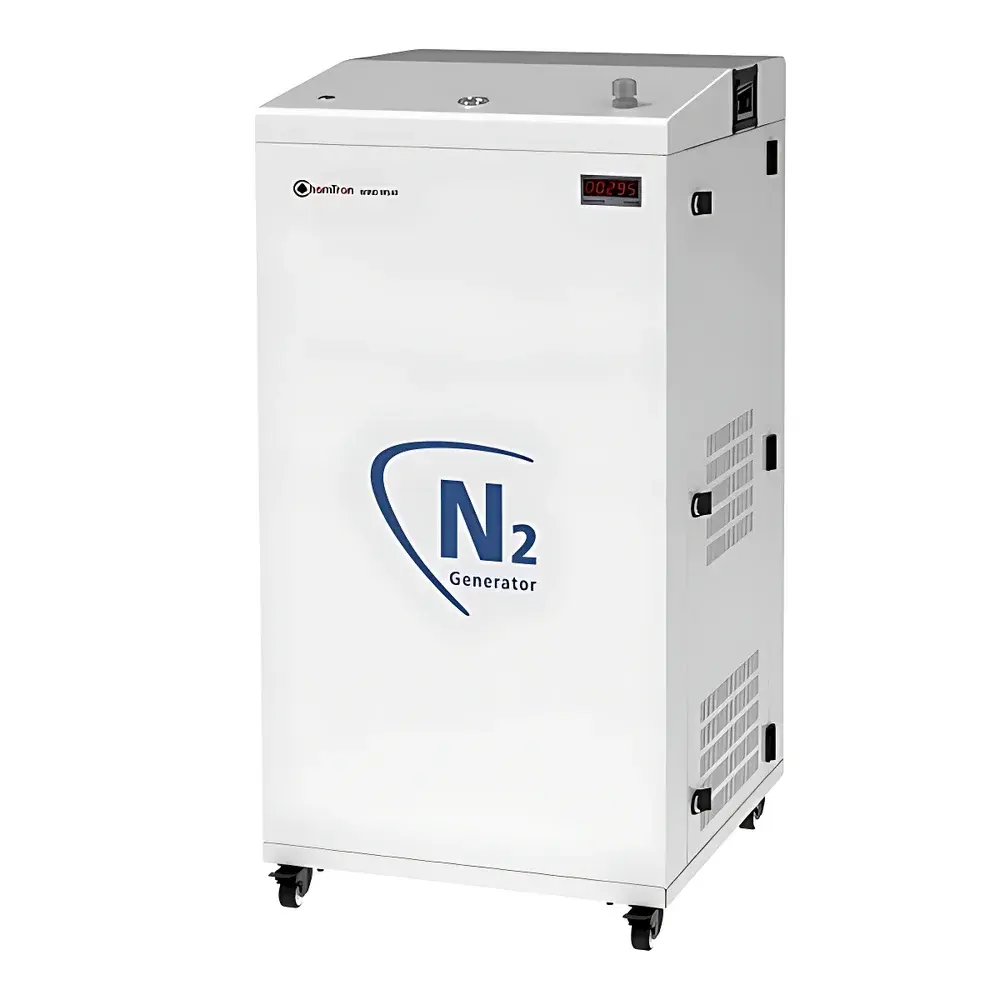
ChemTron WIND MS Dedicated Nitrogen Generator for LC-MS
| Brand | ChemTron |
|---|---|
| Origin | Germany |
| Technology | Hollow-Fiber Membrane |
| Flow Rate | 1–80 L/min |
| Output Pressure | 8 bar (116 psi) |
| Nitrogen Purity | 96–99.9% |
| Dew Point | −45 °C |
| Particle Filtration | <0.01 µm |
| Compressor Protection | Thermal Cut-off, Vibration-Dampened Mounting, Auto-Depressurization at Shutdown |
| Safety | PAE-Free Construction, No High-Pressure or Cryogenic Hazards |
Overview
The ChemTron WIND MS Dedicated Nitrogen Generator is an engineered solution designed specifically to meet the stringent gas supply requirements of liquid chromatography–mass spectrometry (LC-MS) systems and other high-sensitivity analytical instrumentation. It employs hollow-fiber membrane separation technology—proven for stable, continuous nitrogen generation without consumables or regeneration cycles. Unlike pressure swing adsorption (PSA) systems, this membrane-based architecture delivers consistent purity across variable flow rates while eliminating cyclic pressure fluctuations that may affect instrument stability. The integrated oil-free air compressor ensures plug-and-play operation: no external compressed air source, no dew point variability from ambient air lines, and no risk of hydrocarbon contamination from third-party compressors. All wetted surfaces are constructed from PAE-free (phthalate-free) materials compliant with ISO 10993 biocompatibility standards, ensuring zero leachable plasticizers into the nitrogen stream—a critical requirement for trace-level quantitative analysis in regulated environments.
Key Features
- Integrated oil-free scroll compressor with thermal overload protection and vibration-dampened mounting base for extended service life and reduced mechanical stress
- Auto-depressurization function discharges system pressure before restart, enabling safe, low-load compressor startup and minimizing wear on motor windings and valves
- Three-stage pre-filtration (coalescing, activated carbon, ultrafine particulate) delivering air feed with <0.01 µm particle retention prior to membrane module entry
- Thermally stabilized hollow-fiber membrane bundle operating at constant temperature, ensuring reproducible separation efficiency and long-term flux stability
- Active condensate management with automatic electronic drain valve, eliminating manual intervention and preventing moisture carryover
- Front-panel digital display with real-time monitoring of runtime hours, inlet pressure, outlet pressure, and system status alerts
- Low-noise enclosure design: ≤57 dB(A) for WIND MS5; ≤60 dB(A) for WIND MS80—engineered for placement inside analytical laboratories without acoustic isolation
- Quick-access side panel with tool-free fasteners and laminated maintenance checklist for routine filter replacement and system inspection
Sample Compatibility & Compliance
The WIND MS series is validated for continuous operation with LC-MS interfaces (ESI, APCI), charged aerosol detectors (CAD), evaporative light scattering detectors (ELSD), nitrogen blow-down concentrators, purge-and-trap systems, solid-phase extraction (SPE) manifolds, and thermal desorption units. Its output meets ASTM D6352–22 specifications for instrumental-grade nitrogen used in chromatographic carrier and auxiliary gas applications. The absence of phthalates and other extractable organic compounds satisfies USP , ISO 10993–18, and FDA 21 CFR Part 11 data integrity prerequisites when paired with compliant software logging. All models operate within ambient conditions of 10–35 °C and 0–80% RH (non-condensing), with pressure dew point maintained below −45 °C—well within the −40 °C minimum recommended by major LC-MS OEMs for optimal ion source performance and reduced background noise.
Software & Data Management
While the WIND MS operates as a standalone hardware platform without proprietary software dependencies, its operational parameters—including cumulative runtime, compressor cycle count, and fault log timestamps—are stored in non-volatile memory and accessible via front-panel interface. For laboratories requiring audit-ready records under GLP or GMP frameworks, ChemTron provides optional RS-485 Modbus RTU output (standard on WIND MS40/MS80) compatible with SCADA, LabVantage, or custom Python-based logging systems. This enables timestamped, tamper-evident capture of uptime metrics, maintenance intervals, and alarm history—supporting compliance with ISO/IEC 17025 Clause 6.4.3 (equipment monitoring) and FDA 21 CFR Part 11 §11.10(a) for electronic record retention.
Applications
- LC-MS mobile phase nebulization and drying gas supply, where stable 99.9% N₂ minimizes adduct formation and improves signal-to-noise ratio
- CAD and ELSD operation requiring inert, dry, particle-free gas to ensure detector response linearity and baseline stability
- Nitrogen blow-down evaporation of solvent extracts at controlled flow and pressure, reducing analyte degradation risk
- Purge-and-trap and thermal desorption systems demanding high-purity, low-dew-point carrier gas to prevent water-induced column degradation
- SPE manifold pressurization and vacuum-assisted elution, where consistent pressure delivery improves method reproducibility
- Backup or primary nitrogen source for labs transitioning away from high-pressure cylinders or liquid nitrogen dewars—reducing logistical overhead and safety audits
FAQ
Does the WIND MS require external compressed air?
No. It features a fully integrated, oil-free scroll compressor and requires only a standard AC power connection.
What is the expected lifetime of the hollow-fiber membrane module?
Under typical laboratory operating conditions (≤80% duty cycle, ambient humidity ≤80% RH), the membrane retains ≥95% of initial separation efficiency for ≥15,000 hours of operation—equivalent to >5 years of continuous use.
Can the WIND MS be installed in a fume hood or enclosed cabinet?
Yes, provided minimum clearance of 150 mm is maintained around all ventilation grilles and ambient temperature remains within 10–35 °C.
How often must the pre-filters be replaced?
Coalescing and particulate filters should be inspected every 500 operating hours and replaced every 2,000 hours or sooner if pressure drop exceeds 0.3 bar; activated carbon filters require replacement every 4,000 hours.
Is remote monitoring supported?
RS-485 Modbus RTU communication is standard on WIND MS40 and WIND MS80 models; optional on WIND MS5 and WIND MS15 via field-upgrade kit.



