
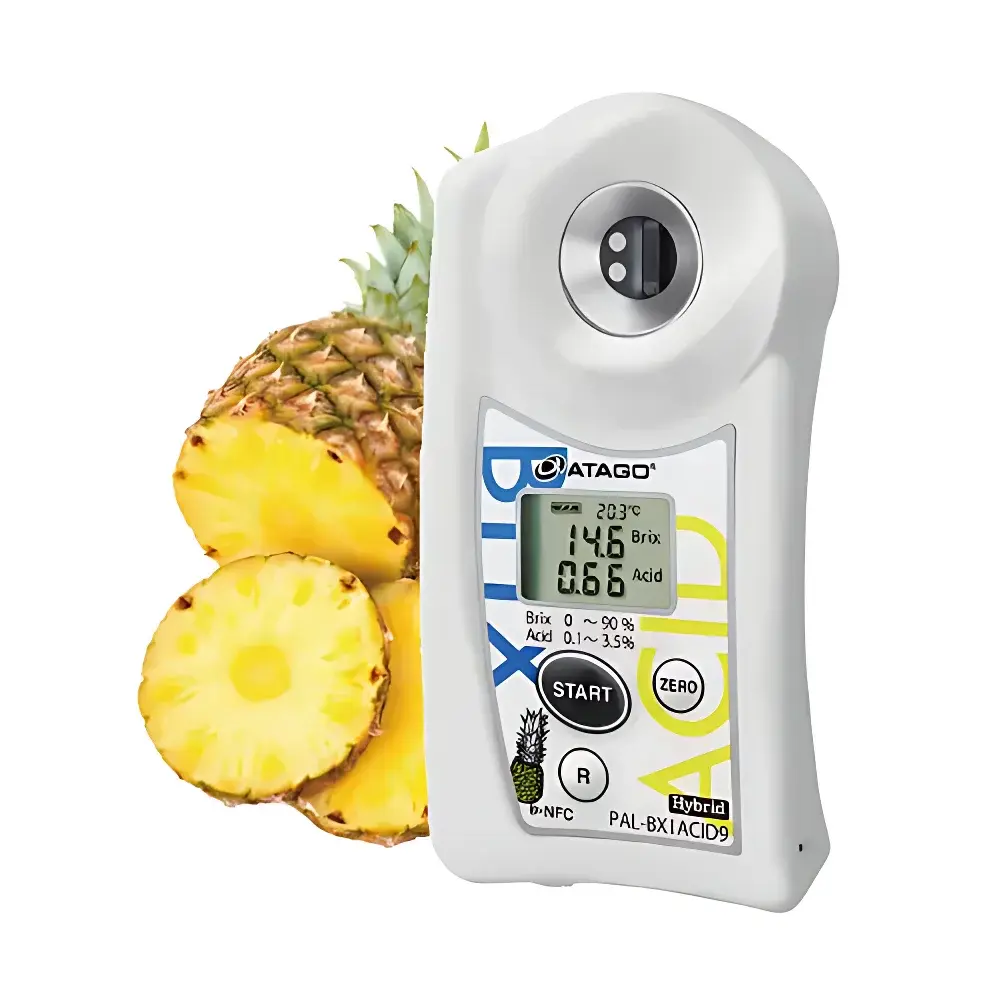
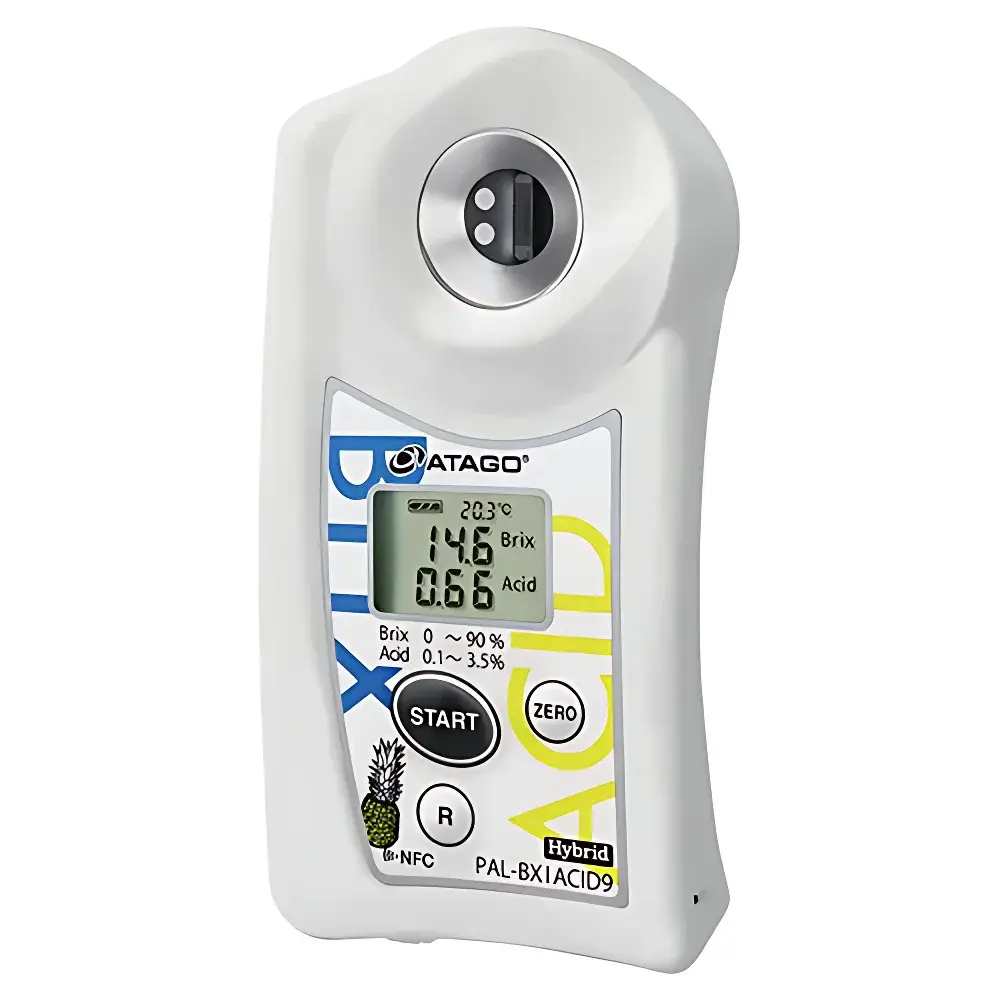
ATAGO PAL-BX/ACID 9 Pineapple-Specific Digital Refractometer with Integrated Acidity Measurement
| Brand | ATAGO |
|---|---|
| Origin | Japan |
| Model | PAL-BX/ACID 9 |
| Product Type | Handheld Refractometer |
| Display | Digital LCD |
| Temperature Compensation Range | 10–40 °C |
| Brix Range | 0.0–60.0 % |
| Acid Range (as citric acid) | 0.10–3.50 % |
| Brix Accuracy | ±0.2 % |
| Acid Accuracy | ±0.10 % (0.10–1.00 %), ±10 % relative (1.01–8.80 %) |
| Brix Resolution | 0.1 % |
| Acid Resolution | 0.01 % (0.00–9.99 %), 0.1 % (≥10.0 %) |
| Sugar-Acid Ratio Resolution | 0.01 (0.00–9.99), 0.1 (10.0–99.9), 1 (≥100) |
| IP Rating | IP65 |
| Power | 2 × AAA alkaline batteries |
| Dimensions | 5.5 × 3.1 × 10.9 cm |
| Weight | 100 g (instrument only) |
Overview
The ATAGO PAL-BX/ACID 9 is a dedicated handheld digital refractometer engineered for rapid, field-deployable assessment of sugar-acid balance in fresh pineapple (Ananas comosus) and processed pineapple products. Unlike general-purpose refractometers, this instrument integrates dual optical-electrochemical measurement principles: Brix quantification via Abbe-type prism-based refractive index analysis at 589 nm (sodium D-line), and acidity estimation through calibrated conductivity-pH correlation optimized specifically for pineapple matrix composition. The device computes the sugar-acid ratio (SAR) — defined as Brix (%) divided by titratable acidity expressed as citric acid equivalent (%) — directly upon user command (R-key activation). This ratio serves as a validated empirical proxy for sensory perception thresholds in tropical fruit quality control, correlating strongly with hedonic evaluation data from sensory panels per ISO 8586:2014 guidelines. Its compact architecture, robust IP65-rated housing, and battery-powered operation make it suitable for orchard-side grading, packinghouse inline QC, and R&D laboratory screening where portability and repeatability are critical.
Key Features
- Pineapple-specific calibration curve preloaded in firmware, compensating for natural variations in organic acid profile (citric > malic > ascorbic) and soluble solids composition unique to Ananas comosus cultivars.
- OFFSET correction function enables traceable alignment with reference methods (e.g., AOAC 975.25 titration), supporting method equivalence validation under GLP-compliant workflows.
- Dual-parameter display: simultaneous real-time readout of Brix (% w/w sucrose equivalent) and acidity (% w/w citric acid), with automatic SAR calculation eliminating manual transcription errors.
- Automatic temperature compensation (ATC) across 10–40 °C using integrated thermistor, referenced to standard ISO 2173:2003 conditions (20 °C).
- High-contrast backlit LCD with multi-tier resolution scaling: 0.1 % for Brix, 0.01 % for low-range acidity (0.00–9.99 %), and adaptive SAR decimal placement (0.01 → 0.1 → 1) depending on magnitude.
- Non-destructive sampling protocol: Brix requires only 0.3 mL undiluted juice; acidity measurement uses standardized 1:50 (w/w) dilution with distilled water (1.00 g sample + 49.00 g H₂O), minimizing reagent consumption and operator variability.
Sample Compatibility & Compliance
The PAL-BX/ACID 9 is validated for use with raw pineapple juice, clarified extracts, frozen-thawed pulp homogenates, and minimally processed canned or bottled pineapple products (e.g., slices in syrup, crushed puree). It excludes heavily pulped, fibrous, or particulate-laden samples requiring centrifugation or filtration prior to analysis. Method performance meets ASTM D7420-19 criteria for portable refractometer precision (repeatability ≤ 0.2 % Brix, intermediate precision ≤ 0.3 % Brix across operators/labs). Acid measurement correlates with AOAC Official Method 975.25 (titrimetric citric acid determination) within ±0.10 % absolute error for typical pineapple acidity ranges (0.4–2.8 %), satisfying internal QC requirements for USDA Grade Standards for Canned Pineapple (7 CFR Part 51) and EU Regulation (EC) No 1221/2008 on fruit quality parameters. Device firmware supports audit-ready logging when paired with optional PC interface (not included).
Software & Data Management
While the PAL-BX/ACID 9 operates as a standalone instrument, its measurement logic embeds ISO/IEC 17025:2017-aligned uncertainty estimation models for both Brix and acidity outputs. The OFFSET function allows users to input correction factors derived from parallel reference measurements, enabling continuous improvement of accuracy traceability. Although no onboard memory or Bluetooth is integrated, the device’s stable analog-to-digital conversion architecture ensures consistent output reproducibility (<0.1 % RSD over 100 consecutive readings), facilitating manual entry into LIMS or Excel-based QA databases compliant with FDA 21 CFR Part 11 when combined with controlled documentation procedures. Calibration verification can be performed using NIST-traceable sucrose standards (SRM 84d) and certified citric acid solutions (NIST SRM 1900).
Applications
- Pre-harvest maturity assessment: Monitoring SAR trends during ripening to determine optimal harvest window aligned with export shelf-life targets.
- In-line sorting: Integration into automated grading lines for real-time bin-level classification per industry SAR thresholds (e.g., SAR 25 = overripe).
- Postharvest quality assurance: Verification of processing consistency across batches of canned, dried, or frozen pineapple products.
- Varietal screening programs: Objective comparison of SAR profiles among breeding lines under controlled agronomic trials (per FAO Fruit Quality Evaluation Handbook).
- Regulatory compliance testing: Supporting documentation for phytosanitary certifications requiring documented sugar-acid specifications per importing country requirements (e.g., China GB/T 10789-2015, Japan JAS Standard for Tropical Fruits).
FAQ
What does the “Acid” value represent, and why is citric acid used as the reference?
The displayed acidity is calculated as total titratable acidity (TTA), converted and reported as % w/w citric acid monohydrate — the dominant organic acid in pineapple and the benchmark specified in AOAC, ISO, and Codex Alimentarius methods.
Is dilution required for both Brix and acidity measurements?
No. Brix is measured directly on undiluted juice. Acidity requires mandatory 1:50 (w/w) dilution with distilled water to bring conductivity into the instrument’s validated linear range and minimize matrix interference.
Can the PAL-BX/ACID 9 be used for fruits other than pineapple?
It is not recommended. The built-in calibration curve is empirically optimized for pineapple’s specific acid-sugar ratio distribution and dielectric properties; using it on mango, papaya, or citrus introduces unquantified bias exceeding ±0.5 % SAR error.
How often should the instrument be calibrated?
Daily verification with 0 % and 30 % Brix sucrose standards is advised before first use and after extended idle periods. Full recalibration by an ATAGO-certified service center is recommended annually or after 5,000 measurements.
Does the device comply with Good Manufacturing Practice (GMP) documentation requirements?
Yes — when used with controlled SOPs, logbooks, and periodic verification against traceable standards, its measurement outputs satisfy GMP Annex 11 and ICH Q7 data integrity expectations for non-automated analytical instruments.




