
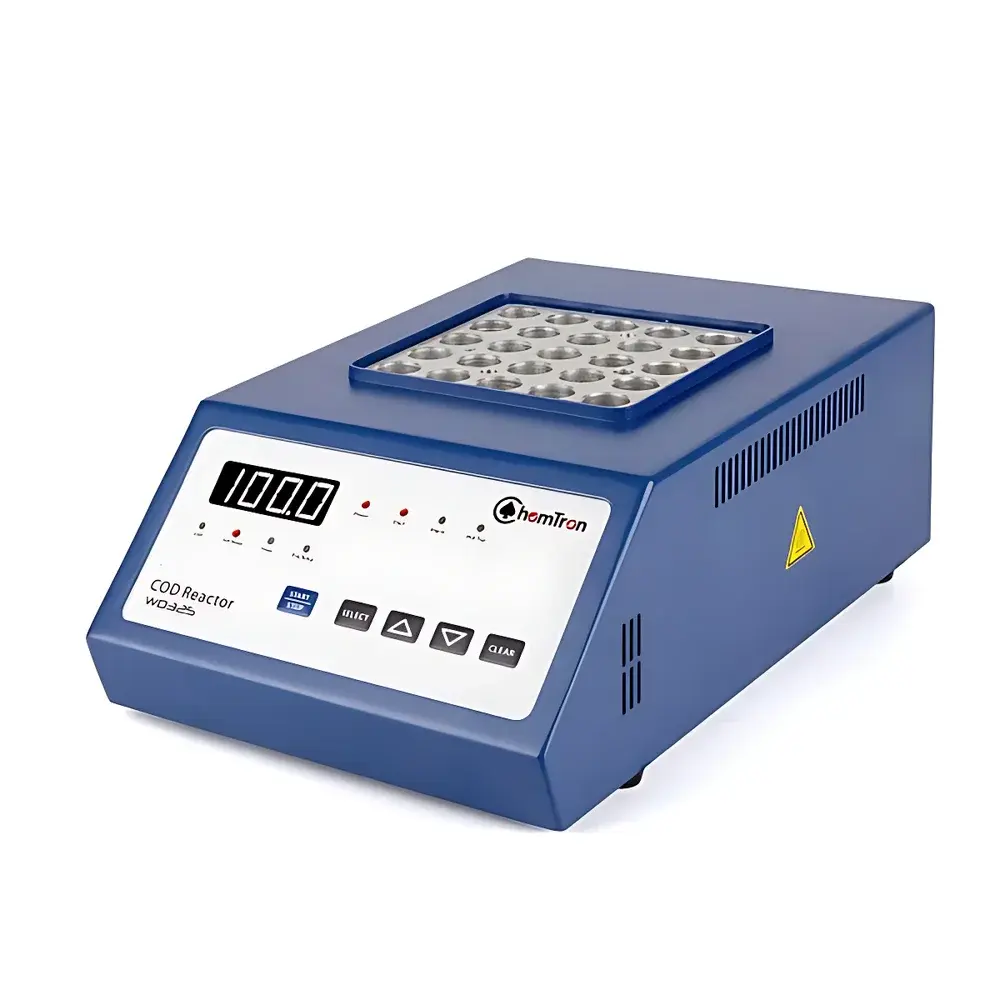
ChemTron WD325 COD Digestion Block (Programmable Metal Bath)
| Brand | ChemTron |
|---|---|
| Origin | Germany |
| Model | WD325 |
| Temperature Range | 60–200°C (adjustable) |
| Temperature Accuracy | ±2°C at 150°C |
| Timer Range | 1–999 min (with continuous mode) |
| Heating Block | Single aluminum block |
| Display | 4-digit LED |
| Power Supply | 220 V, 50 Hz |
| Operating Environment | 10–50°C |
| Safety Features | Visual over-temperature warning ≥70°C |
| Programmable Memory | 3 user-defined temperature/time profiles |
| Compliance | Designed to meet USEPA Method 410.4 requirements for COD digestion |
Overview
The ChemTron WD325 COD Digestion Block is a precision-engineered programmable metal bath specifically designed for standardized chemical oxygen demand (COD) sample preparation in environmental and wastewater laboratories. It operates on the principle of controlled conductive heating via a solid aluminum heating block, ensuring uniform thermal distribution across all sample positions. Unlike generic dry baths, the WD325 integrates a dedicated, pre-configured 150°C/120-minute digestion cycle aligned with USEPA Method 410.4—enabling reproducible oxidation of organic matter under acidic potassium dichromate conditions. Its robust architecture supports both regulatory-compliant COD workflows and flexible method development across a broad operational range (60–200°C, 1–999 min), making it suitable for applications beyond COD, including Kjeldahl digestion, enzymatic assays, and solvent evaporation where precise, stable heating is critical.
Key Features
- Dedicated COD digestion protocol: Pre-programmed 150°C heating with 120-minute countdown and audible end-of-cycle alarm—eliminates manual timer dependency and minimizes operator error.
- Three-user memory slots: Store and recall custom temperature/time profiles for repeatable method execution without reconfiguration.
- Integrated safety system: Dual-stage thermal protection—LED status indicator activates at ≥70°C to warn of surface hazard; microprocessor-triggered power cutoff engages automatically at ≥240°C to prevent hardware damage.
- High-stability aluminum heating block: Optimized thermal mass and uniformity ensure ±2°C accuracy at 150°C (per specification), critical for inter-laboratory comparability in regulatory testing.
- Intuitive 4-digit LED interface: Clear real-time display of setpoint temperature, elapsed/remaining time, and active program status—designed for glove-compatible operation in fume hoods or wet lab environments.
- Continuous heating mode: Supports extended incubation protocols (e.g., BOD pre-incubation, enzyme activation) without timer constraints.
Sample Compatibility & Compliance
The WD325 accommodates standard 16 mm OD glass or quartz digestion tubes (up to 20 positions depending on block configuration—note: base model includes single-block layout). Its thermal profile stability meets the repeatability and control requirements specified in USEPA Method 410.4 for COD determination. While not a certified reference instrument, its performance characteristics align with ISO 15705:2002 recommendations for digestion equipment used in conjunction with spectrophotometric or titrimetric COD analysis. The unit is constructed using corrosion-resistant materials suitable for prolonged exposure to sulfuric acid, silver sulfate, and mercury sulfate reagents common in closed-reflux digestion procedures. No internal moving parts or consumables reduce maintenance burden and enhance long-term calibration integrity.
Software & Data Management
The WD325 operates as a standalone hardware platform with no embedded software or connectivity options. All parameter inputs and cycle execution are managed locally via front-panel controls. This design prioritizes operational reliability, electromagnetic compatibility in shared lab environments, and compliance with GLP/GMP documentation practices where manual log entry of setpoints, start times, and completion verification is standard. For laboratories requiring audit trails, integration with LIMS or electronic lab notebooks (ELN) is achieved through procedural documentation—not digital interface—supporting 21 CFR Part 11-aligned workflows when paired with defined SOPs and signed run logs.
Applications
- Standardized COD digestion per USEPA 410.4, ISO 6060, and DIN 38409-H41.
- Pre-digestion conditioning for TOC analyzers requiring acid-persulfate oxidation steps.
- Controlled heating of reagent blanks, calibration standards, and spiked recovery samples.
- Kjeldahl nitrogen digestion support (when used with compatible digestion racks and reflux condensers).
- Thermal activation of immobilized enzymes or polymerase reactions in method validation studies.
- Evaporation of low-boiling solvents from extract concentrates prior to GC or HPLC injection.
FAQ
Does the WD325 include a digestion rack or tube holder?
No—the WD325 is supplied as a bare heating block. Compatible tube racks (e.g., 16 mm × 20 position) must be ordered separately (part numbers available upon request).
Can the 150°C COD program be modified?
The fixed 150°C/120-min cycle is non-editable to preserve method fidelity; however, users may override it using the manual temperature/time mode for alternative protocols.
Is the unit suitable for use with perchloric acid or hydrofluoric acid digestion?
No—aluminum block construction is incompatible with strongly oxidizing or fluoride-containing acids. Use only with sulfuric/nitric acid mixtures compliant with standard COD methods.
What is the expected service life under daily use?
With proper ventilation and avoidance of thermal shock, the heating element and controller typically exceed 10,000 operating hours—consistent with industrial-grade metal bath benchmarks.
How is traceability maintained for calibration verification?
Users should perform periodic verification using NIST-traceable thermocouple probes inserted into representative tube wells; documented results satisfy ISO/IEC 17025 clause 6.4.6 requirements for equipment monitoring.



