
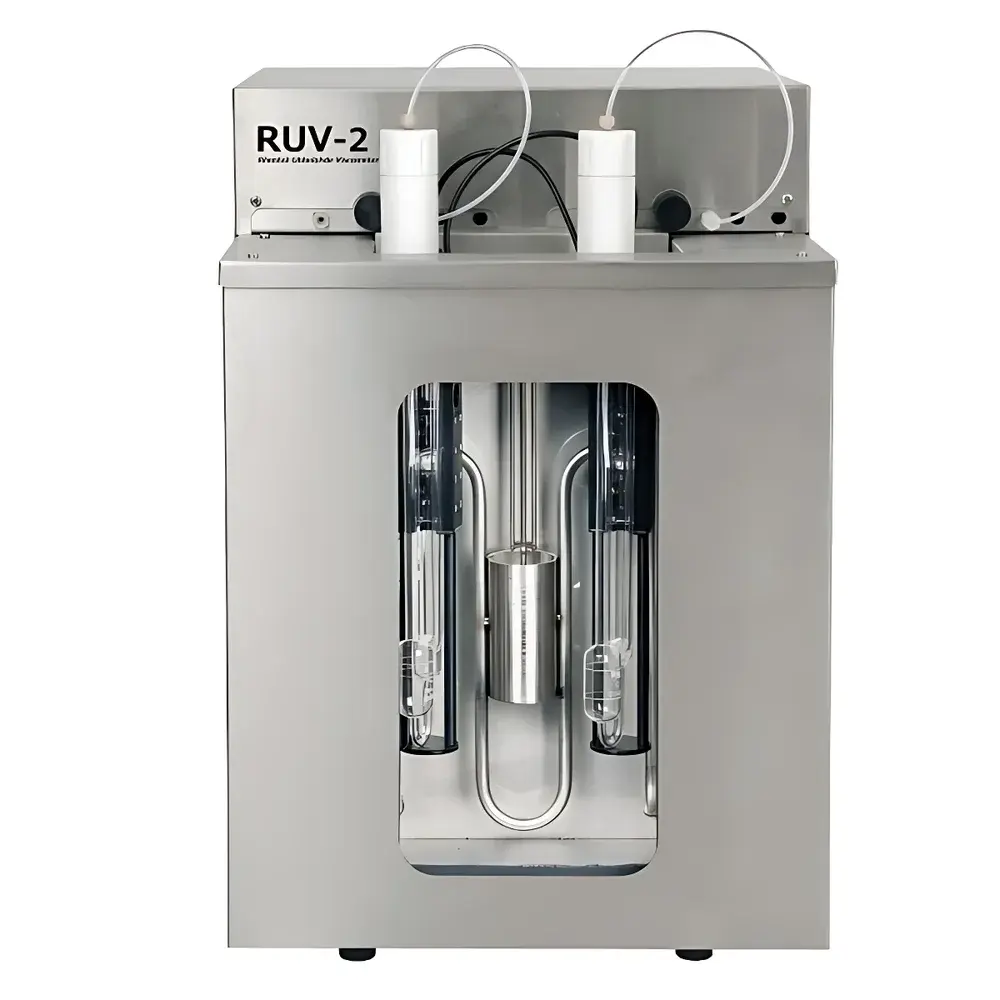
ChemTron RUV-2 Automated Kinematic Viscosity Measurement System
| Brand | ChemTron |
|---|---|
| Origin | Germany |
| Model | RUV-2 |
| Instrument Type | Benchtop Fixed-Position Viscometer |
| Application Environment | Ambient Laboratory Conditions |
| Kinematic Viscosity Range | 1 – 1000 mm²/s (cSt) |
| Temperature Range | 40 – 100 °C |
| Temperature Stability | ±0.01 °C |
| Capillary Type | ASTM Ubbelohde Viscometers (ISO 17025-calibrated) |
| Measurement Positions | 2 |
| Solvent Cleaning & Vacuum Drying | Integrated |
| Power Supply | 100–240 VAC, Max 600 W |
| Dimensions (W × L × H) | 395 × 590 × 580 mm |
| Weight | 75 kg |
| Interfaces | RS232, USB, VGA |
Overview
The ChemTron RUV-2 Automated Kinematic Viscosity Measurement System is a fully integrated, benchtop laboratory instrument engineered for precise, repeatable determination of kinematic viscosity in petroleum and lubricant products according to standardized capillary flow principles. It operates on the fundamental physical principle defined in ASTM D445 and ISO 3104: kinematic viscosity is calculated from the measured efflux time of a fixed volume of liquid flowing under gravity through a calibrated Ubbelohde capillary viscometer at a tightly controlled temperature. The RUV-2 automates the entire sequence—including sample aspiration, thermal equilibration, flow timing, solvent rinsing, and vacuum drying—eliminating manual intervention and operator-dependent variability. Its dual-position design enables parallel or sequential analysis of two samples or reference standards, enhancing throughput without compromising metrological integrity. The system maintains temperature stability within ±0.01 °C across its operational range (40–100 °C), exceeding the requirements of ASTM D445 (±0.02 °C) and ensuring compliance with ISO/IEC 17025 traceability frameworks when used with certified capillaries and optional NIST-traceable temperature probes.
Key Features
- Automated execution of full ASTM D445 / ISO 3104 workflows—including immersion, pre-equilibration, flow timing, and post-analysis cleaning—without manual capillary handling.
- Dual independent measurement positions supporting concurrent analysis or cross-validation using ASTM-type Ubbelohde viscometers (supplied with ISO 17025 calibration certificates).
- High-precision temperature control via thermostatically regulated bath with LED-lit background illumination and real-time monitoring; stability maintained at ±0.01 °C over 40–100 °C.
- Non-contact meniscus detection using dual near-infrared optical sensors, enabling objective, reproducible flow time determination independent of operator judgment or visual interpretation.
- Integrated solvent management system featuring two-stage automated rinsing (with configurable solvent selection) followed by vacuum-assisted drying using an onboard vacuum pump—no external vacuum source required.
- Onboard industrial PC processor running dedicated firmware; no external computer needed for operation, data acquisition, or report generation.
- Comprehensive I/O connectivity including RS232, USB, and VGA ports for peripheral integration, remote diagnostics, and display output.
Sample Compatibility & Compliance
The RUV-2 is validated for transparent and opaque Newtonian and near-Newtonian liquids commonly encountered in refinery, lubricant formulation, and fuel quality control laboratories. Typical applications include kinematic viscosity testing of diesel fuels (at 40 °C), biodiesel blends (40 °C), base oils and formulated lubricants (40 °C or 100 °C), residual marine fuels (50, 80, or 100 °C), and other hydrocarbon-based fluids. All measurements adhere strictly to the procedural rigor of ASTM D445 and ISO 3104. When equipped with ISO 17025-certified capillaries and optional traceable temperature probes, the system supports GLP-compliant documentation and audit-ready data trails. Its architecture facilitates alignment with FDA 21 CFR Part 11 requirements when deployed with validated software configurations and electronic signature protocols.
Software & Data Management
The RUV-2 runs embedded firmware optimized for viscosity metrology, delivering intuitive touchscreen navigation and context-sensitive guidance throughout the workflow. Raw efflux times, calculated kinematic viscosities (mm²/s), temperature logs, and system diagnostic records are stored internally with timestamping and user ID tagging. Data export is supported via USB drive in CSV and PDF formats—structured for direct import into LIMS or QA/QC databases. Audit trail functionality captures all critical events: method selection, calibration status, capillary ID, operator login, environmental deviations, and cleaning cycle completion. Optional firmware upgrades enable enhanced reporting templates compliant with internal SOPs and external regulatory submissions.
Applications
- Quality assurance of distillate fuels per ASTM D975 and EN 590 specifications.
- Base oil classification and blending verification per API 1509 and ASTM D2006.
- Residual fuel oil characterization (e.g., ISO 8217 RMG/RME grades) at elevated temperatures.
- Stability assessment of biofuels and synthetic lubricants during accelerated aging studies.
- Batch release testing in GMP-regulated manufacturing environments where viscosity serves as a critical process parameter.
- Reference material certification and interlaboratory comparison studies requiring high inter-operator reproducibility.
FAQ
Does the RUV-2 require an external computer to operate?
No—the system includes an integrated industrial PC processor and operates autonomously; only optional peripherals (e.g., external monitor or printer) require connection.
Can the RUV-2 measure samples below 40 °C?
The standard configuration supports 40–100 °C; operation down to 15 °C is technically feasible but not validated for ASTM D445 compliance and requires optional chiller integration.
Is ISO 17025 calibration included with the capillaries?
Yes—each supplied ASTM Ubbelohde capillary is delivered with a valid ISO 17025 calibration certificate traceable to national metrology institutes.
How is solvent waste managed?
The system uses disposable solvent and waste bottles connected via quick-coupling fittings; capacity and disposal frequency depend on daily sample volume and rinse protocol settings.
What maintenance is required for long-term reliability?
Routine tasks include periodic verification of temperature sensor accuracy, optical sensor cleaning, bath fluid replacement every 6–12 months, and vacuum pump oil inspection—detailed in the maintenance logbook provided with shipment.



