
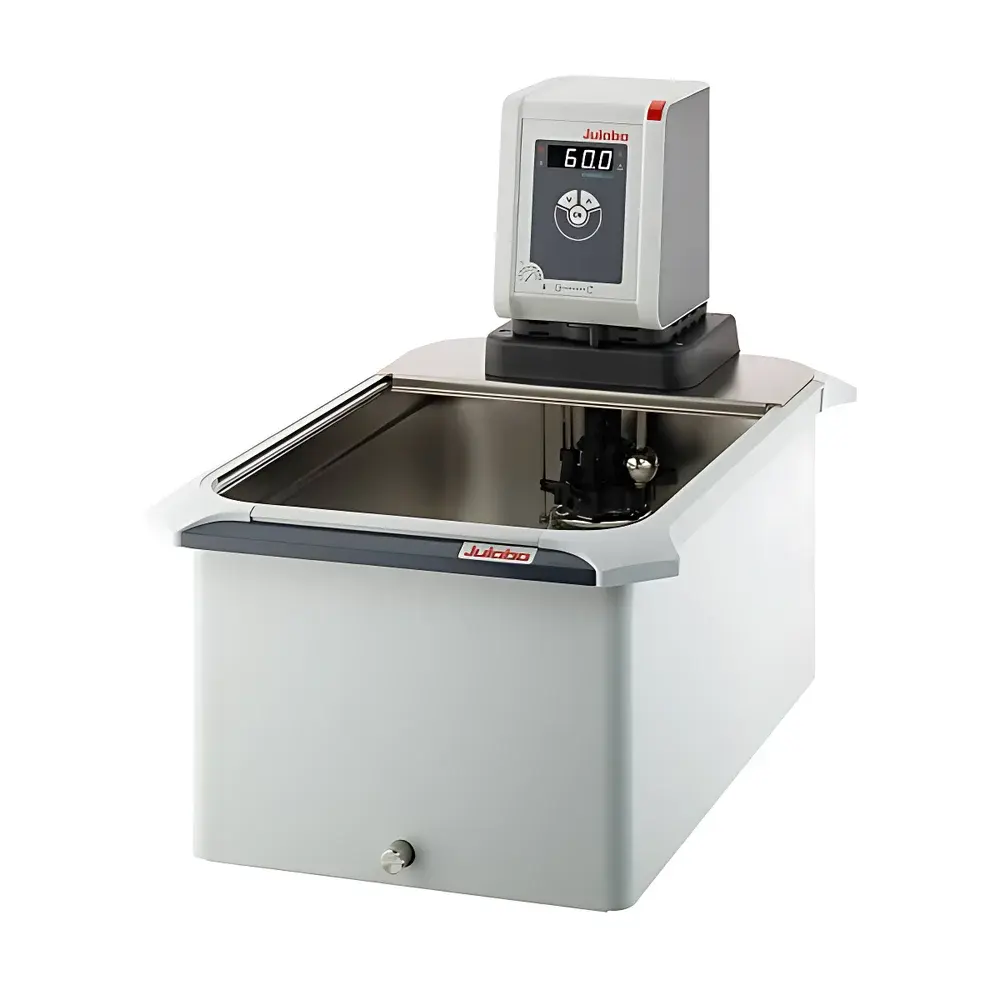
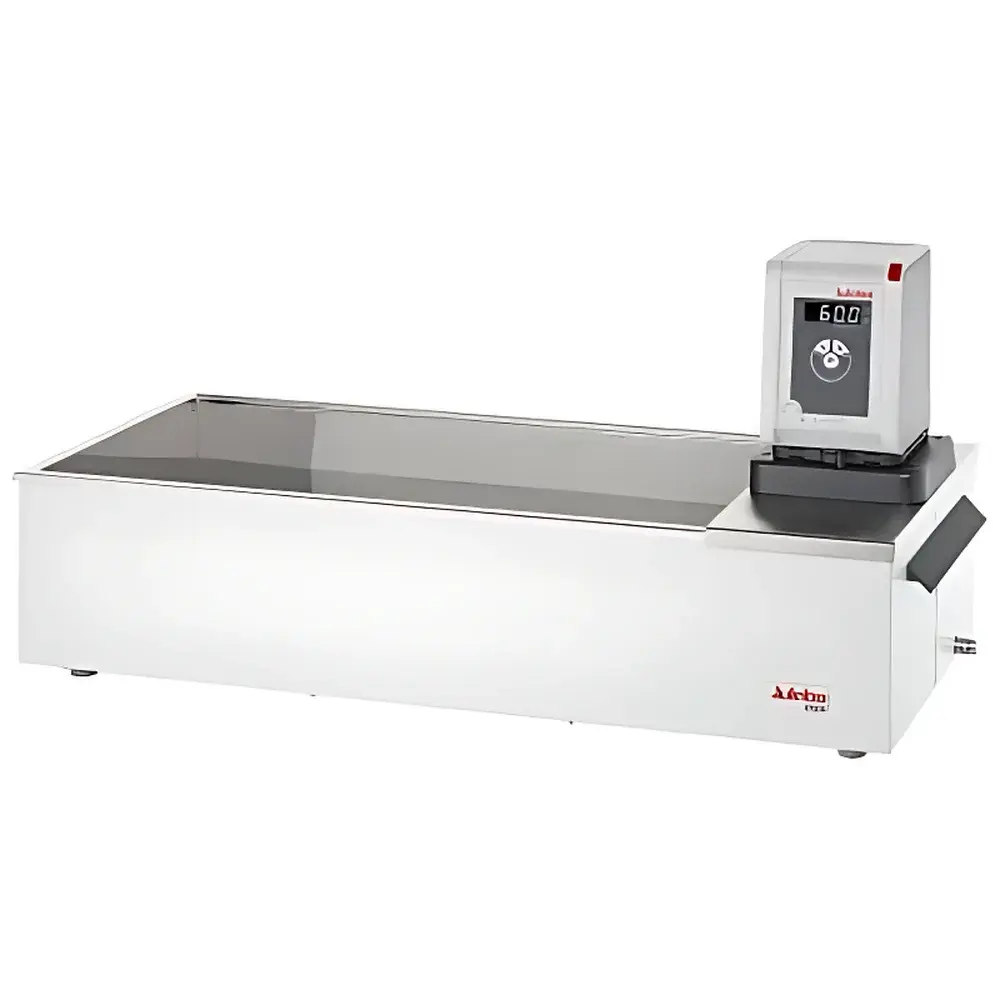
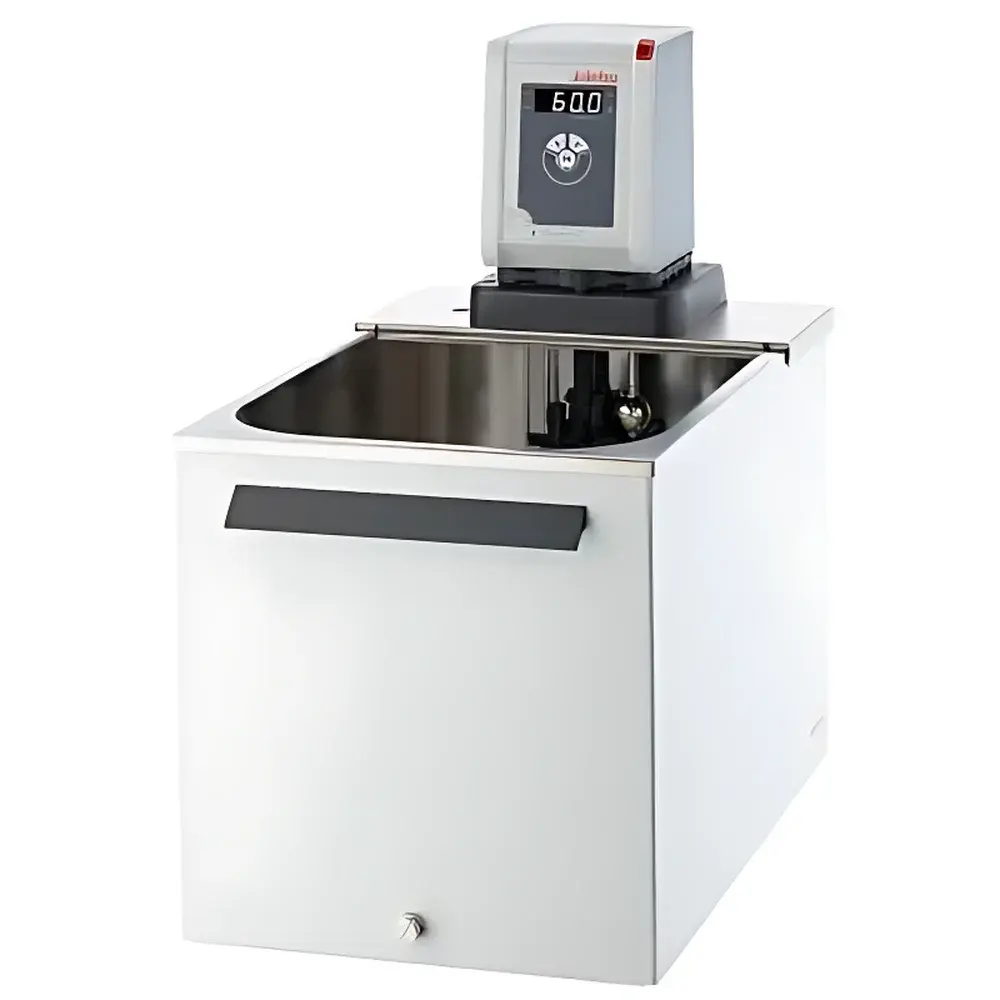
JULABO CORIO CD-B27 Open-Circuit Heating Circulator
| Brand | JULABO |
|---|---|
| Origin | Germany |
| Model | CD-B27 |
| Temperature Range | +5 to +150 °C |
| Temperature Stability | ±0.03 °C |
| Internal/External Circulation | Yes |
| Heating-Only Operation | Yes |
| Display Resolution | 0.01–0.1 °C |
| Pump Flow Rate | 15 L/min |
| Max. Pump Pressure | 0.35 bar |
| Bath Volume Capacity | 17–27 L |
| Bath Dimensions (W×L×D) | 30×35×20 cm |
| Overall Dimensions (W×L×H) | 38×58×47 cm |
| Weight | 13 kg |
| Compliance | EN 61010, EN 61326, DIN 12876-1 Class III (FL), RoHS/WEEE |
Overview
The JULABO CORIO CD-B27 is a high-precision open-circuit heating circulator engineered for demanding laboratory and industrial applications requiring stable, reproducible temperature control across a wide operational range (+5 °C to +150 °C). Unlike sealed bath systems, the CD-B27 employs an open stainless-steel bath architecture with integrated circulation pump, enabling both internal sample immersion and external temperature regulation of auxiliary equipment—such as jacketed reactors, viscometers, chromatography columns, polarimeters, electrophoresis units, and spectrophotometers. Its core thermal regulation relies on dual-stage PID1 control combined with Adaptive Cascade Control (ACC), dynamically adjusting heater output and pump response to minimize overshoot and drift under varying thermal loads. The system’s ±0.03 °C temperature stability—verified across the full operating range—is achieved through precision platinum resistance thermometry (PT100) and real-time thermal inertia compensation, ensuring traceable performance suitable for method validation and regulated workflows.
Key Features
- Intelligent temperature control architecture integrating PID1 algorithm and ACC (Adaptive Cascade Control) for rapid stabilization and minimal setpoint deviation.
- ATC1 (Absolute Temperature Calibration) function enabling user-performed single-point calibration at any temperature within the operating range—no external reference standard required.
- High-brightness white LED display with 0.01–0.1 °C adjustable resolution, viewable from >2 meters in ambient lab lighting.
- Corrosion-resistant stainless-steel bath and immersion-heating coil; designed for compatibility with water, silicone oils, and synthetic heat-transfer fluids—resistant to scaling and chemical degradation.
- Adjustable immersion depth (7.5–16.5 cm) for optimal thermal coupling with diverse vessel geometries and external loop configurations.
- Rotatable internal circulation outlet (360° swivel) for flexible hose routing and minimized flow resistance in complex external circuits.
- Low-noise pump operation (<45 dB(A)) compliant with ISO 7779, supporting quiet environments including analytical labs and QA/QC suites.
- Comprehensive safety system: overtemperature cut-off (independent hardware limiter), low-level float switch with audible/visual alarm and automatic power disconnection, lockable IEC 60320 C14 inlet, and reinforced grounding per EN 61010-1.
- Front-access drain valve and ergonomic side-mounted handles for safe handling and routine maintenance.
- DIN 12876-1 Class III (FL) certification confirming suitability for flammable liquid applications up to 150 °C.
Sample Compatibility & Compliance
The CD-B27 accommodates a broad spectrum of sample formats and external devices via its open-bath design and dual-mode circulation (internal immersion or external loop). It supports standard laboratory glassware (e.g., 1–5 L jacketed vessels), metal reaction blocks, and OEM-integrated thermal jackets. Fluid compatibility includes deionized water, glycol-water mixtures, silicone oils (e.g., DC200 series), and polyalphaolefin (PAO)-based heat-transfer media—validated for continuous operation at 150 °C. Regulatory alignment includes EN 61010-1 (safety requirements for electrical equipment), EN 61326-1 (EMC for laboratory use), and WEEE/RoHS directives. For GLP/GMP environments, the device supports audit-ready documentation through optional JULABO LabSoft software (see Software section), and its ATC1 calibration log meets traceability requirements per ISO/IEC 17025 and ASTM E2877-21.
Software & Data Management
While the CD-B27 operates autonomously via its front-panel interface, it is fully compatible with JULABO LabSoft PC software (optional) for remote monitoring, parameter logging, and report generation. LabSoft enables time-stamped recording of temperature setpoints, actual bath temperature, pump status, and alarm events—with export to CSV or PDF formats. When configured with JULABO’s optional Ethernet or RS232 interface module, the system supports integration into centralized lab management platforms and satisfies FDA 21 CFR Part 11 requirements for electronic records and signatures (with appropriate user access controls and audit trail activation). All calibration actions—including ATC1 execution—are timestamped and stored locally in non-volatile memory, accessible via software or display menu.
Applications
- Controlled-temperature sample conditioning prior to rheological, viscometric, or spectroscopic analysis.
- Active thermal management of HPLC/UHPLC column ovens and detector cells.
- Stabilization of optical instruments (e.g., polarimeters, refractometers) where thermal lensing must be minimized.
- Temperature-dependent material testing (e.g., polymer melt flow index, elastomer modulus vs. T).
- Process simulation in pilot-scale bioreactors and chemical synthesis reactors using external jacket loops.
- Calibration of temperature-sensitive sensors and transducers against NIST-traceable references.
- Long-duration stability studies (ICH Q1A) requiring uninterrupted thermal profiles over 72+ hours.
FAQ
Is the CD-B27 suitable for use with flammable heat-transfer fluids?
Yes—certified to DIN 12876-1 Class III (FL), it is approved for operation with silicone oils and other non-aqueous media classified as flammable liquids.
Can the unit maintain ±0.03 °C stability while circulating externally to a 5-L jacketed reactor?
Yes—stability specification is validated under loaded conditions, including external loops up to 15 m total hose length and 2 kPa backpressure.
Does the ATC1 calibration require external reference equipment?
No—ATC1 uses the instrument’s internal PT100 sensor and factory-characterized thermal model; only a verified reference thermometer is needed if cross-validation is performed.
What is the maximum recommended viscosity for compatible heat-transfer fluids?
Up to 500 mm²/s at 40 °C (e.g., Dow Corning DC200 Fluid 50 cSt); higher viscosities may reduce flow rate and thermal response time.
Is firmware update capability available?
Yes—updates are delivered via USB stick using JULABO’s official ServiceTool software; version history and release notes are published on the JULABO support portal.



