
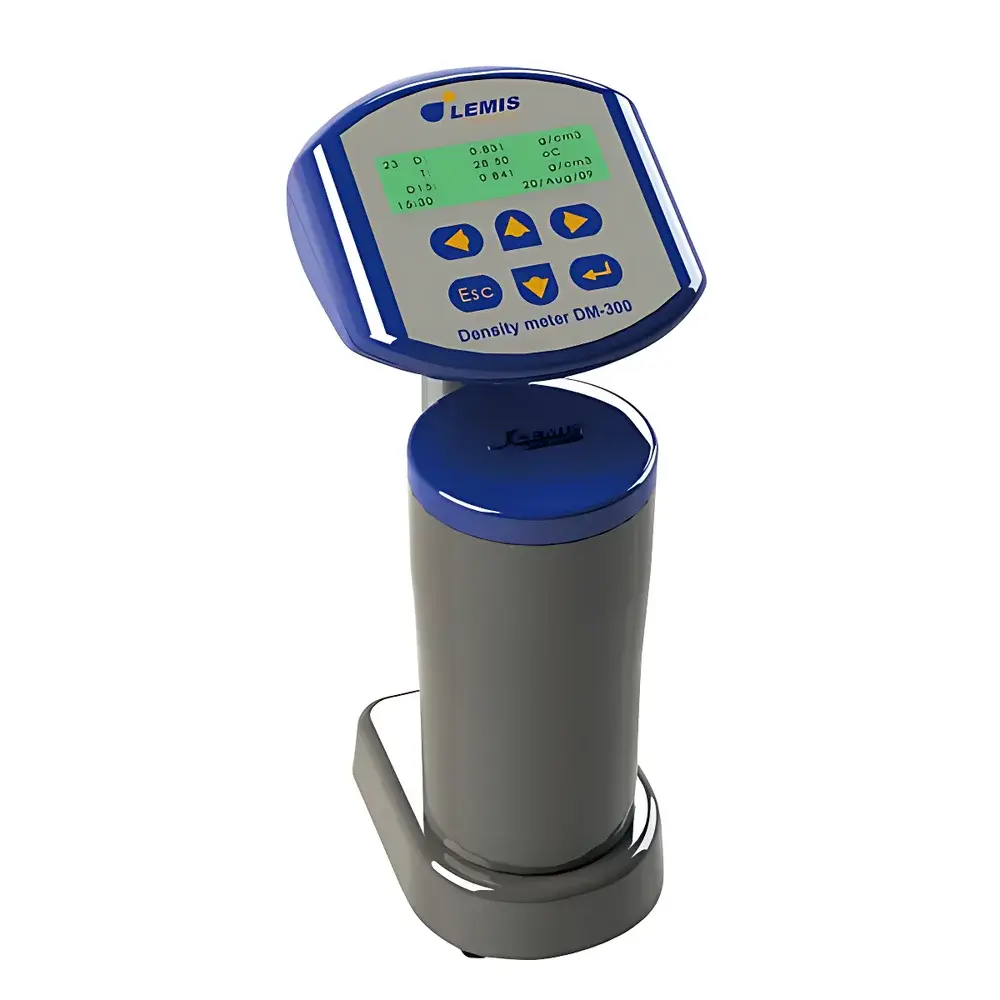
ChemTron DM-300 Desktop Digital Density Meter
| Brand | ChemTron |
|---|---|
| Origin | Germany |
| Model | DM-300 |
| Density Measurement Range | 0–3 g/cm³ |
| Density Accuracy | ±0.0002 g/cm³ |
| Temperature Range | 0–50 °C |
| Temperature Accuracy | ±0.1 °C |
| Probe Material | 316L Stainless Steel, Nickel-Based Alloy, Hastelloy C-22 |
| Dimensions | 140 × 100 × 290 mm |
| Weight | ~2 kg |
| Compliance | CE (EN 61326, EN 5011, EN 50082-2) |
| Data Interface | Bluetooth |
| Viscosity Compensation | Yes |
| Instrument Type | Oscillating U-tube Digital Density Meter |
Overview
The ChemTron DM-300 Desktop Digital Density Meter is an oscillating U-tube density measurement system engineered for high-precision, rapid, and operator-independent determination of liquid density and derived concentration values in laboratory and quality control environments. Based on the fundamental principle of resonant frequency shift—where the natural oscillation frequency of a precisely machined, evacuated U-shaped glass tube immersed in a sample correlates inversely with the sample’s mass density—the DM-300 delivers traceable, SI-traceable density results without reliance on volumetric calibration or manual buoyancy calculations. Its design integrates temperature-controlled sample containment and real-time thermal compensation to ensure metrological integrity across the full operating range (0–50 °C). Unlike traditional pycnometers or hydrometers, the DM-300 eliminates human error associated with meniscus reading, glassware cleaning, and thermal equilibration delays—reducing typical measurement cycle time by up to 50% while maintaining repeatability better than ±0.0002 g/cm³ under controlled conditions.
Key Features
- Oscillating U-tube transducer with borosilicate glass cell and integrated Peltier-based temperature stabilization
- Triple-level density accuracy configuration: selectable ±0.0002 g/cm³ (high-resolution mode), ±0.0005 g/cm³ (standard QC mode), and ±0.001 g/cm³ (rapid screening mode)
- Automatic viscosity compensation algorithm compliant with ISO 12058-1 for non-Newtonian and shear-thinning samples
- Corrosion-resistant probe assembly constructed from 316L stainless steel, nickel-based alloy, and Hastelloy C-22 for compatibility with aggressive solvents, acids, and caustics
- Bluetooth 5.0 wireless interface supporting direct data streaming to Windows/Linux workstations and networked thermal printers
- CE-marked per electromagnetic compatibility (EN 61326), low-voltage directive (EN 5011), and immunity standards (EN 50082-2)
- Compact footprint (140 × 100 × 290 mm) and lightweight design (~2 kg) enabling flexible benchtop deployment without dedicated vibration isolation
Sample Compatibility & Compliance
The DM-300 accommodates a broad spectrum of liquid-phase samples—including aqueous solutions, organic solvents, polymer melts (above pour point), pharmaceutical syrups, cosmetic emulsions, and food-grade beverages—without requiring dilution or phase separation. Its sealed U-tube architecture prevents evaporation and cross-contamination between sequential measurements. The instrument meets critical regulatory expectations for analytical instrumentation used in GMP-compliant facilities: audit trail capability (when paired with ChemTron’s optional DMS-Link software), electronic signature support per FDA 21 CFR Part 11, and full traceability to NIST-traceable density standards. It is routinely deployed in laboratories adhering to ASTM D4052 (Standard Test Method for Density of Liquids by Digital Density Meter), ISO 12185 (Crude Petroleum and Liquid Petroleum Products — Determination of Density), and USP (Density and Specific Gravity).
Software & Data Management
The DM-300 operates autonomously via its onboard microcontroller but achieves full data governance when connected to ChemTron’s DMS-Link desktop application (Windows 10/11, 64-bit). DMS-Link provides GLP-compliant reporting templates, customizable pass/fail limits, multi-user access control, and automated export to CSV, PDF, or LIMS-compatible XML formats. All density and temperature readings are timestamped, annotated with operator ID, and stored with metadata including ambient humidity, calibration certificate ID, and last verification date. The Bluetooth interface supports concurrent connection to two endpoints—e.g., live display on a local PC and archival transmission to a central QA server—ensuring continuity during routine batch release testing.
Applications
- Quality assurance of ethanol/water blends in beverage and biofuel production
- Concentration monitoring of HCl, H₂SO₄, NaOH, and other process chemicals in fine chemical manufacturing
- API purity verification via density deviation from theoretical values in pharmaceutical synthesis
- Sugar content quantification (°Brix, %w/w sucrose) in fruit juice, syrup, and dairy processing
- Density profiling of silicone oils, glycols, and surfactant solutions in personal care R&D
- Batch-to-batch consistency validation for adhesives, inks, and coating formulations
FAQ
What density standards are required for initial calibration?
The DM-300 ships pre-calibrated using certified air and water standards traceable to PTB (Physikalisch-Technische Bundesanstalt). Users may perform verification with secondary standards such as dry air (ρ = 0.00120 g/cm³ at 20 °C) and pure water (ρ = 0.99820 g/cm³ at 20 °C), both referenced to ISO 3696 Grade 1 water.
Can the DM-300 measure slurries or suspended particles?
No—it is designed exclusively for homogeneous, particle-free liquids. Suspended solids will interfere with oscillation stability and violate ISO 12058-1 assumptions; filtration or centrifugation is required prior to analysis.
Is temperature equilibration mandatory before each measurement?
Yes. The instrument requires ≥60 seconds of thermal stabilization after sample introduction to achieve ±0.01 °C internal cell uniformity, as specified in ASTM D4052 Section 7.3.
Does the device support automatic density-to-concentration conversion?
Yes—DMS-Link includes built-in lookup tables for >120 binary systems (e.g., ethanol–water, glycerol–water, NaCl–water) conforming to IUPAC-recommended equations of state. Custom polynomial models may be imported via CSV.
How often must the U-tube be cleaned or replaced?
Under normal use with non-polymerizing samples, cleaning is required only after every 50–100 measurements using recommended solvents (e.g., isopropanol, acetone). The U-tube has a service life exceeding 50,000 cycles and is not user-replaceable; field replacement requires factory recalibration.



