
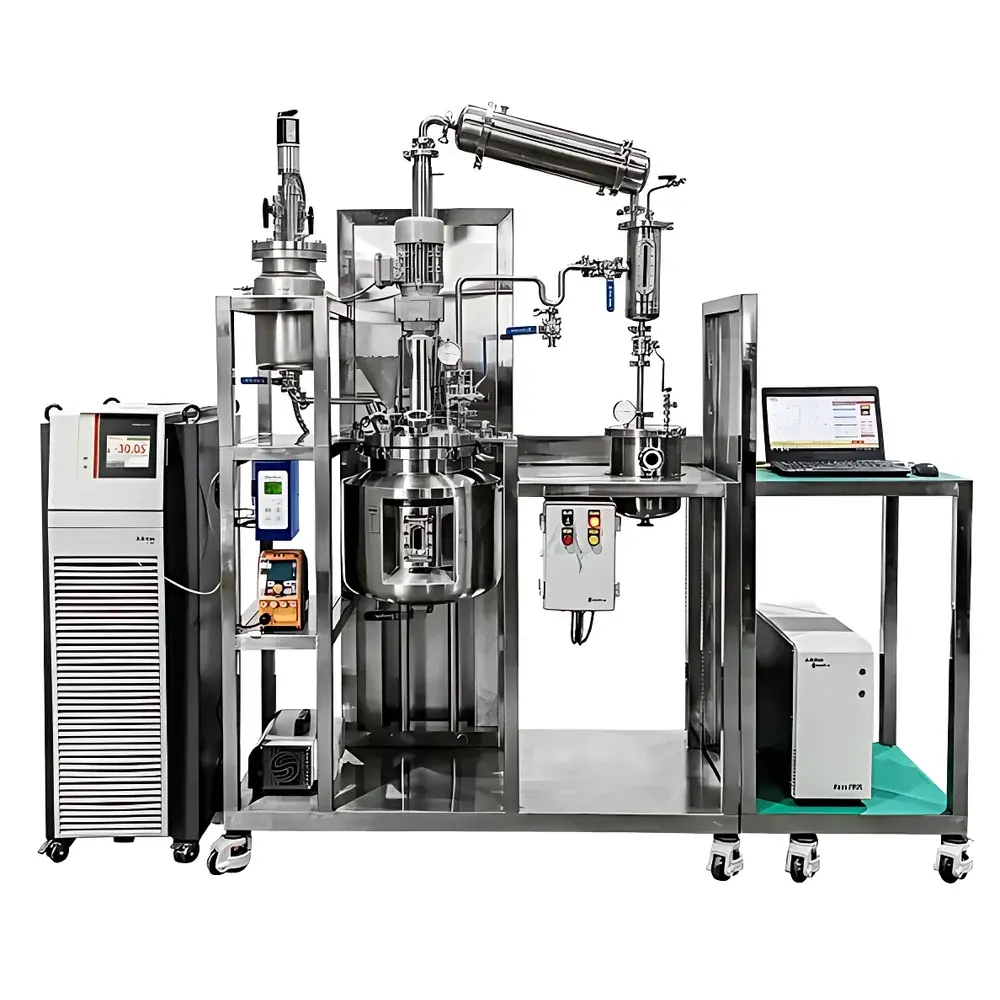
ChemTron NR-20L / NR-30L / NR-50L Medium-Pressure Laboratory Reactor System
| Brand | ChemTron |
|---|---|
| Origin | USA |
| Model | NR-20L, NR-30L, NR-50L |
| Vessel Capacity | 20 L, 30 L, 50 L |
| Design Pressure | up to 20 bar |
| Maximum Operating Temperature | 200 °C or 250 °C (dependent on seal material) |
| Construction Material | 316 stainless steel (standard) |
| Jacketed | Yes |
| Jacket Pressure Rating | 3 bar |
| Jacket Volume | ≈5.3 L / ≈15.8 L / ≈20.0 L |
| Bottom Drain Valve | Standard |
| Sealing Options | Viton® (FKM), PTFE, Kalrez® (FFKM) |
| Magnetic Coupling | RV-400 series |
| Standard Fittings | 7 total ports per lid (including 1× central magnetic drive port, 1× thermowell, 1× rupture disc assembly, 1× vent valve, 2× 6 mm ports for heating/cooling coils, 3× 8 mm auxiliary ports) |
| Handle-equipped lid | Yes |
Overview
The ChemTron NR-20L, NR-30L, and NR-50L medium-pressure laboratory reactor systems are engineered for controlled chemical synthesis, catalytic testing, hydrogenation, polymerization, and process development under elevated pressure and temperature conditions. Designed in accordance with ASME BPVC Section VIII Div. 1 guidelines and compliant with international pressure equipment directives (PED 2014/68/EU), these reactors operate reliably at design pressures up to 20 bar and temperatures up to 250 °C—enabling safe execution of exothermic, gas-liquid, and solid-in-suspension reactions at laboratory scale. Each unit features a robust 316 stainless steel vessel body and lid, with optional Hastelloy C-276 construction for enhanced corrosion resistance in aggressive media (e.g., halogenated solvents, strong acids, or sulfidic environments). The reactor architecture integrates a precision-engineered magnetic coupling (RV-400 series) that eliminates dynamic shaft seals, ensuring zero leakage and high operational integrity during long-duration experiments.
Key Features
- Modular capacity options: 20 L, 30 L, and 50 L working volumes—optimized for scalability from benchtop process optimization to pilot-scale feasibility studies.
- Integrated jacketed vessel design with 3 bar pressure rating, supporting external temperature control via oil bath circulation (e.g., JULABO systems), electric heating jackets, or dual-function heating/cooling coils.
- Quick-clamp lid retention system with ergonomic handles—enabling tool-free, repeatable assembly and disassembly while maintaining alignment accuracy and gasket compression uniformity.
- Multi-material sealing compatibility: Viton® (FKM), PTFE, and Kalrez® (FFKM) O-rings—selected based on thermal stability, chemical resistance, and compression set performance across defined operating envelopes.
- Standardized port configuration: seven threaded ports per lid—including one central 1.5″ NPT magnetic drive inlet, one 1/2″ NPT thermowell, one certified rupture disc assembly (ASME-certified, set at 20 bar), one manual vent valve, two 6 mm ports for coil integration, and three 8 mm auxiliary ports for sensors, sampling lines, or gas inlets.
- Bottom discharge valve (316 SS, ball or diaphragm type) as standard—facilitating complete material evacuation, slurry handling, and cleaning-in-place (CIP) procedures without vessel tipping.
Sample Compatibility & Compliance
These reactors accommodate heterogeneous, multiphase, and viscous reaction mixtures—including slurries, catalyst suspensions, and high-boiling-point solvents—without compromising mechanical integrity or thermal homogeneity. All wetted surfaces meet ASTM A240/A276 specifications for 316 stainless steel, and optional Hastelloy C-276 components conform to ASTM B575. Pressure containment systems are CE-marked and PED-compliant; rupture discs carry valid TÜV certification. For regulated environments (e.g., pharmaceutical process R&D), the reactor platform supports integration with validated data acquisition systems meeting FDA 21 CFR Part 11 requirements—provided third-party software and audit-trail-enabled controllers are deployed.
Software & Data Management
While the base NR-series reactors operate as standalone hardware units, they are fully compatible with industry-standard process control ecosystems. Analog outputs (4–20 mA) from optional pressure transducers and RTD temperature sensors interface directly with PLCs (e.g., Siemens S7, Allen-Bradley ControlLogix) or SCADA platforms. ChemTron provides detailed I/O pinouts and communication protocols (Modbus RTU/TCP) for seamless integration into existing lab automation frameworks. When paired with validated controllers (e.g., Eurotherm 3508, Watlow F4T), the system supports electronic recordkeeping, alarm logging, and full traceability—meeting GLP and GMP documentation expectations for method development and tech transfer.
Applications
- Catalytic hydrogenation and hydroformylation under H₂ pressures up to 20 bar
- Solvent-based polymerization (e.g., polyesters, polyurethanes) with precise temperature ramping and inert gas blanketing
- Electrochemical synthesis requiring sealed, corrosion-resistant environments
- Batch-wise oxidation/reduction screening with real-time gas evolution monitoring
- Materials synthesis—including MOFs, metal oxides, and nanocomposites—under controlled atmosphere and thermal profiles
- Reaction calorimetry (when coupled with jacket flow calorimetry modules)
FAQ
What is the maximum allowable working pressure for the NR-series reactors?
The design pressure is 20 bar (gauge) for all models (NR-20L, NR-30L, NR-50L); this value is verified through hydrostatic testing at 1.5× design pressure prior to shipment.
Can the reactor be operated under vacuum?
Yes—the vessel is rated for full vacuum service (−1 bar gauge) when equipped with appropriate elastomeric seals (e.g., Kalrez®) and verified by leak testing per ASTM E499.
Is automated temperature control included as standard?
No—temperature regulation is achieved externally via user-supplied circulators, heating jackets, or coil systems; however, all models include provisions for RTD insertion and analog signal output for closed-loop control.
Are explosion-proof electrical components available?
Optional ATEX/IECEx-certified motor drives, junction boxes, and instrumentation can be integrated upon request—subject to zone classification and ambient gas group requirements.
What documentation is provided with each unit?
Each reactor ships with a Manufacturer’s Declaration of Conformity, ASME U-1 Data Report, material test reports (MTRs), pressure test records, and a comprehensive operations manual including torque specifications, maintenance intervals, and seal replacement procedures.



