
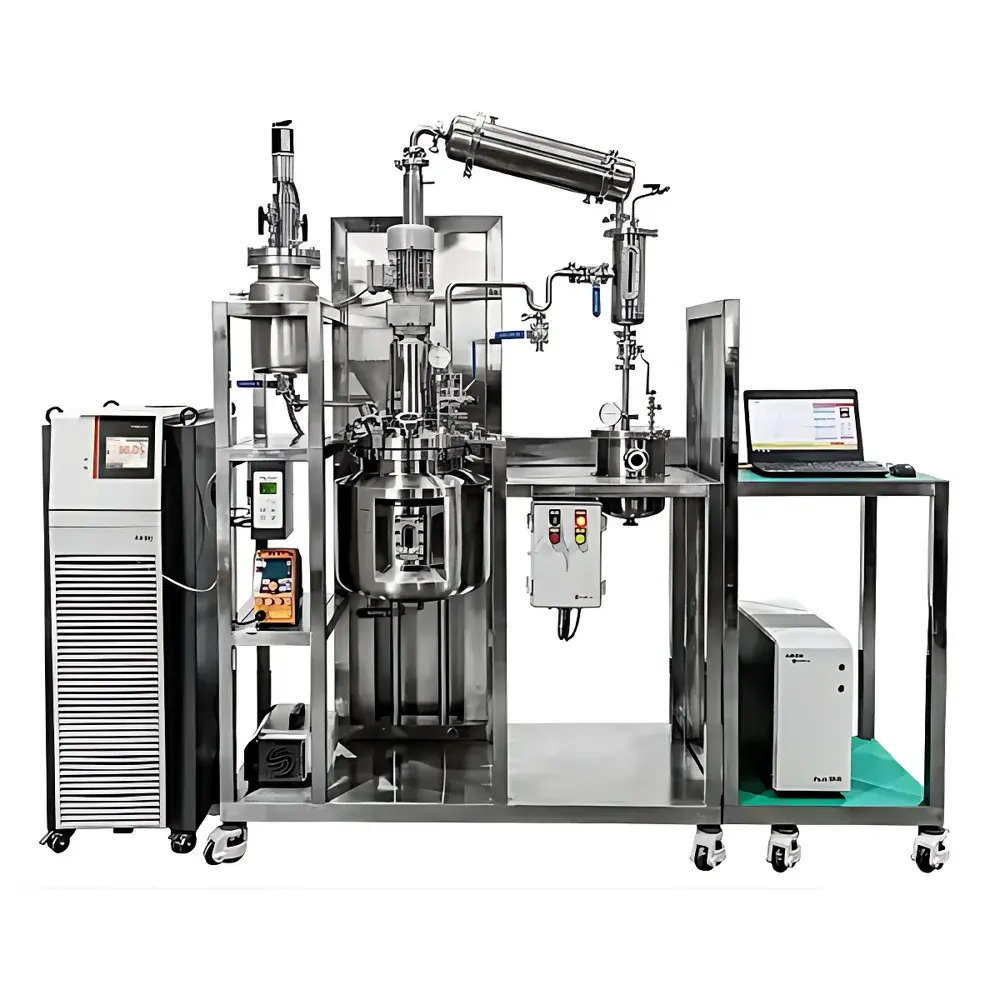
ChemTron VR-Series Stainless Steel Pilot-Scale Jacketed Reactors (VR-10L, VR-20L, VR-30L, VR-50L)
| Brand | ChemTron |
|---|---|
| Origin | Germany |
| Model | VR-10L / VR-20L / VR-30L / VR-50L |
| Material | ASTM A240 316L stainless steel |
| Max Operating Temperature | 200 °C |
| Max Working Pressure | 5 bar (g) |
| Vessel Capacity | 10–50 L |
| Jacketed | Yes |
| Stirring Speed Range | 20–1800 rpm |
| Sealing | Dual-face mechanical seal with PTFE/Viton/FFKM O-rings |
| Heating/Cooling | Compatible with JULABO thermostatic circulators |
| Connection Options | 7 standardized flanged ports per vessel |
| Compliance | Designed per PED 2014/68/EU Annex I essential safety requirements for pressure equipment |
Overview
The ChemTron VR-Series stainless steel pilot-scale jacketed reactors are engineered for reproducible, scalable chemical synthesis and process development under controlled thermal and mechanical conditions. These vessels operate on the principle of batch-wise conductive heat transfer via integrated double-walled jackets and precision agitation—enabling uniform temperature distribution and efficient mass transfer across reaction volumes ranging from 10 to 50 liters. Designed for transition from laboratory benchtop synthesis to pre-commercial production, the VR-Series meets the engineering rigor required for GMP-aligned process validation, catalyst screening, crystallization studies, and exothermic reaction management. Each reactor is constructed in full compliance with the Pressure Equipment Directive (PED 2014/68/EU) Annex I safety requirements, with full traceability of material certifications (EN 10204 3.1), hydrostatic test reports, and dimensional verification documentation provided upon delivery.
Key Features
- Robust construction from ASTM A240 316L stainless steel—electropolished interior surface finish (Ra ≤ 0.4 µm) for enhanced cleanability and corrosion resistance against organic solvents, acids, and halogenated reagents.
- Integrated thermal jacket with optimized flow geometry for uniform ΔT distribution; compatible with external JULABO F200 or PRESTO A40 thermostatic circulators delivering precise ±0.3 °C temperature control from –40 °C to +200 °C.
- Top-mounted high-torque agitator system featuring dual-face mechanical seals rated for continuous operation at 5 bar and 200 °C; shaft sealing options include Viton, FFKM, or PTFE elastomers depending on chemical compatibility requirements.
- Standardized conical flange closure (DIN 2526 Type B) with torque-controlled clamping mechanism enabling repeatable sealing integrity and rapid vessel opening/closing cycles—critical for multi-step sequential reactions or solid dosing intervals.
- Seven configurable ISO-KF and DIN 28178 flanged connection ports (including vapor outlet, thermocouple well, pressure transducer port, gas inlet, sampling valve, sight glass, and auxiliary feed line) supporting modular integration with condensers, scrubbers, or inline analytics.
- Bottom discharge valve with sanitary tri-clamp (DIN 11851) interface and full-bore design for residue-free emptying—validated for particulate-laden slurries and viscous polymer melts up to 50,000 mPa·s.
Sample Compatibility & Compliance
The VR-Series accommodates heterogeneous catalytic systems, suspension polymerizations, hydrogenations, nitration, esterification, and solvent-free melt reactions. Its 316L stainless steel wetted parts exhibit compatibility with chlorinated solvents (e.g., DCM, chlorobenzene), alcohols, ketones, esters, and moderately aggressive inorganic media (e.g., dilute H₂SO₄, HNO₃). All vessels are supplied with CE marking per PED 2014/68/EU and carry a manufacturer’s declaration of conformity. Optional third-party inspection (TÜV or DEKRA) and ASME Section VIII Div. 1 certification packages are available upon request. Design documentation supports FDA 21 CFR Part 11-compliant electronic record retention when paired with validated data acquisition software.
Software & Data Management
While the base VR-Series operates as a standalone hardware platform, it integrates seamlessly with industry-standard process control systems via 4–20 mA analog outputs (temperature, pressure, stirrer torque) and Modbus RTU (RS-485) digital interface. When coupled with ChemTron’s optional ProcessLog™ data logger or third-party SCADA platforms (e.g., Siemens Desigo CC, Ignition SCADA), users achieve full audit-trail capability—including timestamped parameter logging, alarm event history, and user-access-controlled configuration changes—meeting GLP and GMP documentation standards. All calibration certificates (temperature sensors, pressure transducers) are NIST-traceable and issued with uncertainty budgets.
Applications
- Pharmaceutical intermediate synthesis requiring strict thermal profiling and residual solvent control.
- Polymerization kinetics studies (e.g., polycondensation, free-radical addition) with real-time viscosity and exotherm monitoring.
- Catalyst performance evaluation under industrially relevant residence time distributions (RTDs).
- Crystallization process optimization—including supersaturation control, seeding protocol validation, and polymorph screening.
- Green chemistry process intensification using solvent-free or low-solvent reaction pathways.
- Scale-up support for QbD (Quality by Design) frameworks, including DoE-based parameter mapping and failure mode analysis (FMEA).
FAQ
What pressure and temperature ratings apply across all VR-Series models?
All VR-10L through VR-50L reactors are rated for continuous operation at ≤5 bar(g) and ≤200 °C. Hydrostatic test pressure is 1.43× MAWP (7.15 bar), certified per EN 13445.
Is explosion-proof motor integration available?
Yes—ATEX-certified (II 2G Ex db IIB T4 Gb) top-drive motors and intrinsically safe instrumentation packages can be specified for Class I, Division 1 hazardous area installations.
Can the reactor be supplied with automated PID control loops?
Standard configuration includes manual local control; fully automated cascade PID control (temperature → jacket flow → stirrer speed) is available with the ChemTron AutoControl™ module and PLC-based architecture.
Are validation documents (IQ/OQ) included?
Factory acceptance testing (FAT) reports are standard. Site-specific IQ/OQ protocols and execution support are offered as an optional service, aligned with ASTM E2500 and Annex 15 guidelines.
What maintenance intervals are recommended for the mechanical seal and drive system?
Under normal operating conditions, dual-face mechanical seals require inspection every 1,500 operational hours; gearmotor lubrication is scheduled biannually per ISO 1219-1 hydraulic fluid standards.



