
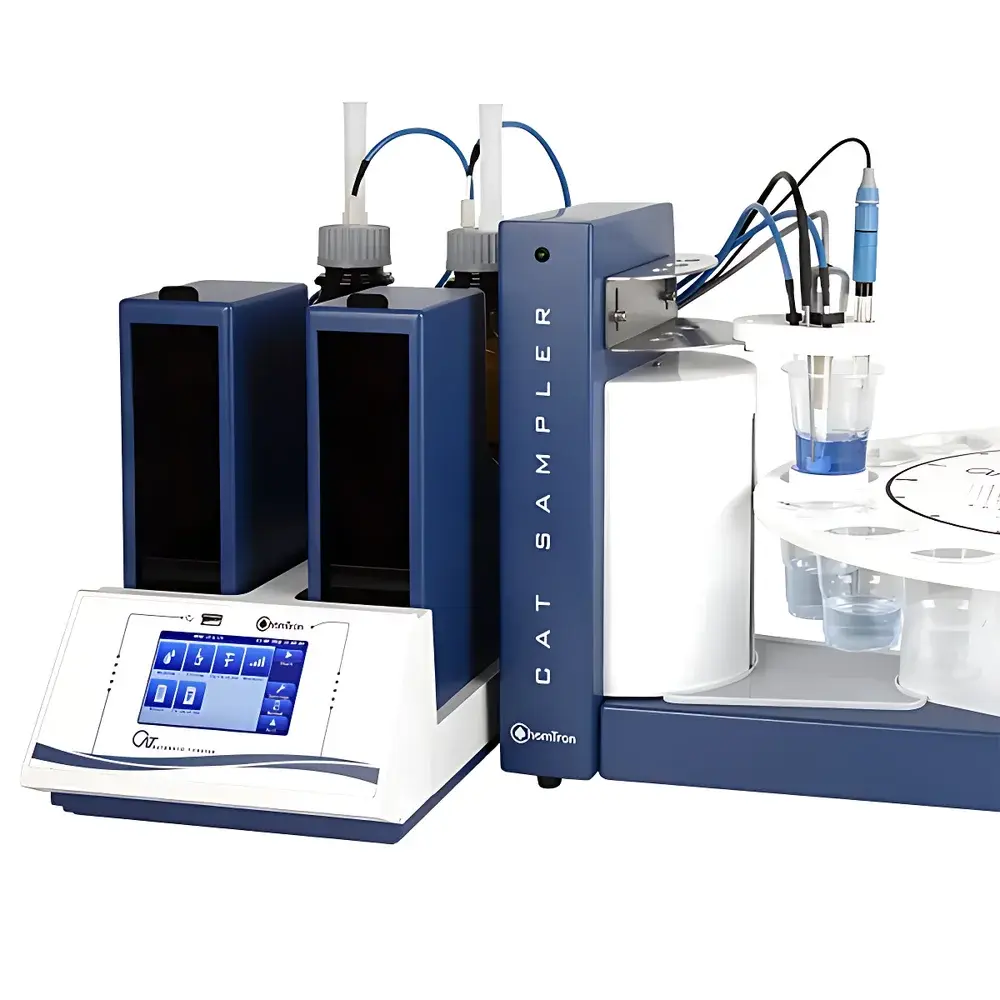
ChemTron CAT2-16 Automatic Potentiometric Titrator
| Brand | ChemTron |
|---|---|
| Origin | Germany |
| Model | CAT2-16 |
| Instrument Type | General-purpose Potentiometric Titrator |
| pH Range | 0–14 |
| pH Accuracy | ±0.02 |
| pH Resolution | ±0.01 |
| Titration Accuracy | ±0.02 pH |
| Titration Resolution | ±0.01 pH |
| Display | 4.3″ Touchscreen |
| Burette Capacity | 10 mL (up to two mounted) |
| Burette Resolution | 12,000 steps |
| Burette Accuracy | <0.2% (2 µL for 10 mL) |
| Burette Repeatability | ±0.2% |
| Peristaltic Pump Flow Rate | 1 mL/s (up to three units) |
| mV Range | ±2000 mV, Accuracy: ±2 mV, Resolution: ±0.1 mV |
| Current Range | ±10 µA, Accuracy: ±2 µA, Resolution: ±0.1 µA |
| Temperature Range | 0–100 °C, Accuracy: ±1 °C, Resolution: ±0.1 °C |
| Pre-programmed Methods | 30 (incl. EP, EQ, Free SO₂, Total SO₂, Double SO₂) |
| Calibration Modes | Auto-buffer recognition, zero-point, zero-slope, Nernst equation, wine-specific calibration |
| Data Storage | 50 titration reports, 10 calibration records |
| Interfaces | pH/mV electrode port, µA electrode port, USB-A, USB-B, RS232, Bluetooth |
Overview
The ChemTron CAT2-16 Automatic Potentiometric Titrator is an engineered solution for routine and regulated potentiometric analysis in quality control, research, and production laboratories. Based on classical potentiometric endpoint detection—measuring potential difference between a reference and indicator electrode as a function of titrant volume—the CAT2-16 delivers high reproducibility in acid-base, redox, precipitation, and complexometric titrations. Its architecture supports both single-sample endpoint determination and automated continuous batch analysis via integrated 16-position sample carousels. Designed and assembled in Germany under strict ISO 9001-compliant manufacturing protocols, the system complies with fundamental requirements of ISO 8655 (volumetric apparatus), ASTM E2087 (standard practice for potentiometric titration), and aligns with GLP/GMP data integrity expectations through secure method storage, audit-ready calibration logs, and timestamped result archiving.
Key Features
- 4.3-inch high-contrast capacitive touchscreen interface with icon-driven navigation—enabling intuitive operation without training overhead
- Modular burette configuration: up to two 10 mL burettes (12,000-step resolution; <0.2% volumetric accuracy per ISO 8655-3)
- Expandable peristaltic pump system: up to three independently controlled pumps for reagent delivery, rinsing, or sample aspiration
- Integrated auto-leveling module with liquid level sensor—reducing manual volumetric handling time for bulk sample sets
- Optional automatic degassing unit—programmable for pre-titration inert gas purging in oxygen-sensitive assays (e.g., iodometric titrations)
- Real-time dual-curve display: simultaneous visualization of titration curve (E vs. V) and first derivative (dE/dV) for unambiguous endpoint identification
- Pre-loaded method templates compliant with European Pharmacopoeia (EP), USP Chapter <541>, and OIV standards for sulfur dioxide analysis in beverages
Sample Compatibility & Compliance
The CAT2-16 accommodates standard laboratory glassware including GL45 and S40 bottles, 100–500 mL titration vessels, and magnetic stir bars. Its electrode interfaces support common pH, redox (Pt or Ag/AgCl), ion-selective (e.g., fluoride, chloride), and amperometric sensors. All calibration and measurement routines follow traceable procedures aligned with ISO/IEC 17025 requirements for testing laboratories. The instrument’s firmware implements electronic signature-capable user authentication, full audit trail logging (including method edits, calibration events, and result exports), and encrypted USB export—meeting foundational expectations of FDA 21 CFR Part 11 for electronic records when paired with validated CAT software.
Software & Data Management
The CAT software suite (Windows-based, included) provides full remote control, method development, and report generation. It enables creation of multi-step sequences—including rinse cycles, blank subtraction, and conditional branching based on intermediate potential thresholds. All raw data (potential, volume, temperature, time stamps) are stored in open CSV format alongside metadata (operator ID, method version, calibration history). Internal memory retains the last 50 titration reports and 10 calibration sessions; external export is supported via USB-A or network-connected PC. Software-generated reports include compliance headers, uncertainty estimates derived from burette and electrode specifications, and optional PDF signing with digital certificate integration.
Applications
- Acid-base titrations: total acidity in food extracts, alkalinity in wastewater per ISO 9963-1
- Redox titrations: iron content in pharmaceutical intermediates (USP <541>), vitamin C in fortified beverages
- Precipitation titrations: chloride in drinking water (ISO 9297), silver nitrate standardization
- Complexometric titrations: hardness (Ca²⁺/Mg²⁺) in industrial process water
- Sulfur dioxide quantification: free and total SO₂ in wine and must per OIV Method CX-IV-02
- pH stability profiling: buffer capacity studies in formulation development
FAQ
Does the CAT2-16 support GLP-compliant data handling?
Yes—when used with validated CAT software, it maintains full audit trails, electronic signatures, and immutable calibration/titration logs required for GLP audits.
Can the instrument perform non-aqueous titrations?
Yes—via compatible non-aqueous electrodes and solvent-resistant tubing; method parameters (e.g., drift compensation, endpoint slope thresholds) are fully configurable.
Is ISO/IEC 17025 calibration documentation available?
Factory calibration certificates (traceable to PTB/NIST standards) are provided with each unit; on-site verification protocols are included in the operator manual.
What is the maximum sample throughput with the 16-position carousel?
Under typical conditions (2-minute titration + 30-second rinse cycle), throughput exceeds 25 samples/hour with full automation.
How is electrode maintenance managed within the software?
The system logs electrode usage hours, prompts recalibration after defined intervals, and stores slope/offset history for trending—supporting predictive maintenance planning.




