
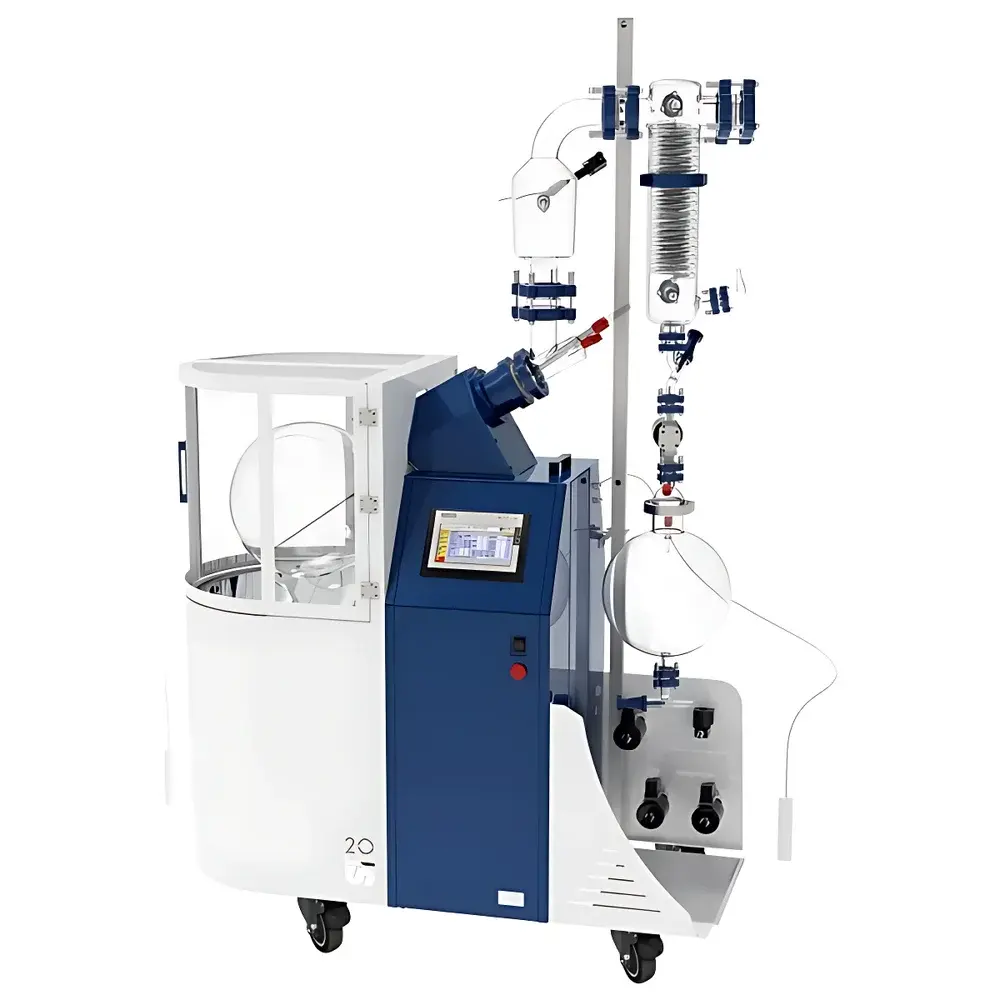
ChemTron ST20 CRE Continuous Rotary Evaporator
| Brand | JULABO-Chemtron |
|---|---|
| Origin | Italy |
| Model | ST20 CRE |
| Capacity | 6 L / 10 L / 20 L |
| Ultimate Vacuum | 8 mbar |
| Rotation Speed | 10–150 rpm |
| Temperature Range | Ambient to +150 °C |
| Heating Accuracy | ±2 °C |
| Condenser Surface Area | 0.5 m² |
Overview
The ChemTron ST20 CRE Continuous Rotary Evaporator is an industrial-grade, PLC-controlled purification system engineered for seamless integration into continuous processing workflows. Unlike conventional batch-mode rotary evaporators, the ST20 CRE implements a true continuous distillation architecture—enabling uninterrupted solvent removal, concentration, or fractionation directly coupled to upstream reactors or feed systems. Its operation is grounded in controlled thin-film evaporation under reduced pressure: sample solution is continuously fed into a rotating evaporating flask, where centrifugal force and thermal energy generate a uniform, high-surface-area film; volatile components vaporize, travel vertically (or optionally downward) through a precisely temperature-regulated vapor path, and condense on a 0.5 m² surface before collection. This design ensures stable mass transfer kinetics, minimizes thermal degradation of heat-sensitive compounds, and supports reproducible process scale-up from lab to pilot scale.
Key Features
- PLC-based automation with integrated HMI: 7-inch high-resolution touchscreen interface displaying real-time bath temperature, vacuum level, rotation speed, and vapor temperature
- Dual operational modes: selectable batch distillation (standard mode) and continuous distillation (cascade mode), the latter supporting direct connection to reactor vessels via programmable feed and discharge sequences
- Configurable glass train options: vertical upward vapor path (steam rising) or vertical downward vapor path (steam sinking), both optimized for low entrainment and high condensation efficiency
- Comprehensive liquid-level monitoring: four independent capacitive sensors detect low level in the feed vessel, low level in the evaporating flask, and high level in both the receiving flask and final collection tank
- Multi-function solenoid valve manifold: includes vacuum control valve, inert gas (N₂) purging valve, atmospheric vent valve, automated feed valve (for controlled sample introduction), and discharge valve (for timed product transfer)
- Integrated safety architecture: thermal insulation on all heated surfaces, automatic shutdown upon critical level detection, and CE-compliant safety enclosure as standard equipment
Sample Compatibility & Compliance
The ST20 CRE accommodates a broad range of organic solvents, aqueous solutions, and thermally labile mixtures—including APIs, natural extracts, polymer solutions, and reaction intermediates. Its stainless-steel frame, PTFE-sealed glass joints, and chemically resistant wetted materials ensure compatibility with aggressive media such as chlorinated solvents, esters, and low-polarity hydrocarbons. The system complies with EU Machinery Directive 2006/42/EC and Electromagnetic Compatibility Directive 2014/30/EU. All electronic controls meet IEC 61000-6-2/6-4 immunity and emission standards. For regulated environments, the PLC firmware supports audit trail generation and user-access level management—facilitating alignment with GLP and GMP documentation requirements per ISO/IEC 17025 and FDA 21 CFR Part 11 when paired with validated software protocols.
Software & Data Management
The embedded controller logs all critical process parameters at configurable intervals (1–60 seconds), storing time-stamped datasets locally on internal flash memory (≥16 GB). Data export is supported via USB 2.0 port in CSV format for offline analysis in MATLAB, Python, or LIMS platforms. Optional Ethernet connectivity enables remote monitoring and alarm notification via Modbus TCP or OPC UA protocols. All setpoints, alarms, and sequence steps are password-protected and versioned; system configuration changes trigger automatic log entries including operator ID, timestamp, and parameter delta. Firmware updates are performed via signed binary packages to prevent unauthorized modification—ensuring data integrity and traceability throughout instrument lifecycle.
Applications
- Continuous solvent recovery in API synthesis campaigns, reducing cycle time and improving E-factor metrics
- In-line concentration of botanical extracts during supercritical fluid or ethanol-based extraction processes
- Removal of residual monomers or initiators from polymerization effluents prior to precipitation
- Distillative purification of heat-sensitive vitamins, flavors, or fragrances under precise temperature/vacuum profiles
- Integration into automated reaction platforms (e.g., ChemSpeed, Uniqsis) for end-to-end synthesis–purification sequences
- Pilot-scale feasibility studies for pharmaceutical continuous manufacturing (CM) regulatory submissions
FAQ
What distinguishes continuous distillation mode from batch mode on the ST20 CRE?
In batch mode, the evaporating flask is charged manually or semi-automatically and processed to endpoint before unloading. In continuous mode, the PLC synchronizes feed rate, rotation, heating, and vacuum to maintain steady-state film thickness and vapor flux—enabling indefinite operation as long as feed and collection reservoirs are replenished.
Can the ST20 CRE be validated for GMP use?
Yes—the system’s deterministic control logic, sensor redundancy, electronic audit trail capability, and mechanical design allow IQ/OQ/PQ protocol development. Validation support documentation, including FAT/SAT checklists and calibration certificate templates, is provided upon request.
Is the 0.5 m² condenser area sufficient for high-boiling solvents?
The condenser is actively cooled via external chiller integration (recommended: −20 °C supply); its surface geometry and flow dynamics are optimized for condensation of solvents with boiling points up to 180 °C at 8 mbar, provided cooling capacity meets ∼2.5 kW thermal load.
How does the vertical steam sinking configuration improve separation efficiency?
By directing vapor downward against gravity, the sinking path increases residence time in the vapor zone and reduces droplet carryover—particularly beneficial for foaming or high-viscosity feeds where upward flow may induce entrainment.
What maintenance intervals are recommended for the electromagnetic valve manifold?
Valves require inspection every 500 operating hours; full replacement of PTFE diaphragms is advised every 2,000 hours or annually—whichever occurs first—to maintain leak-tight performance at sub-10 mbar vacuum levels.



