
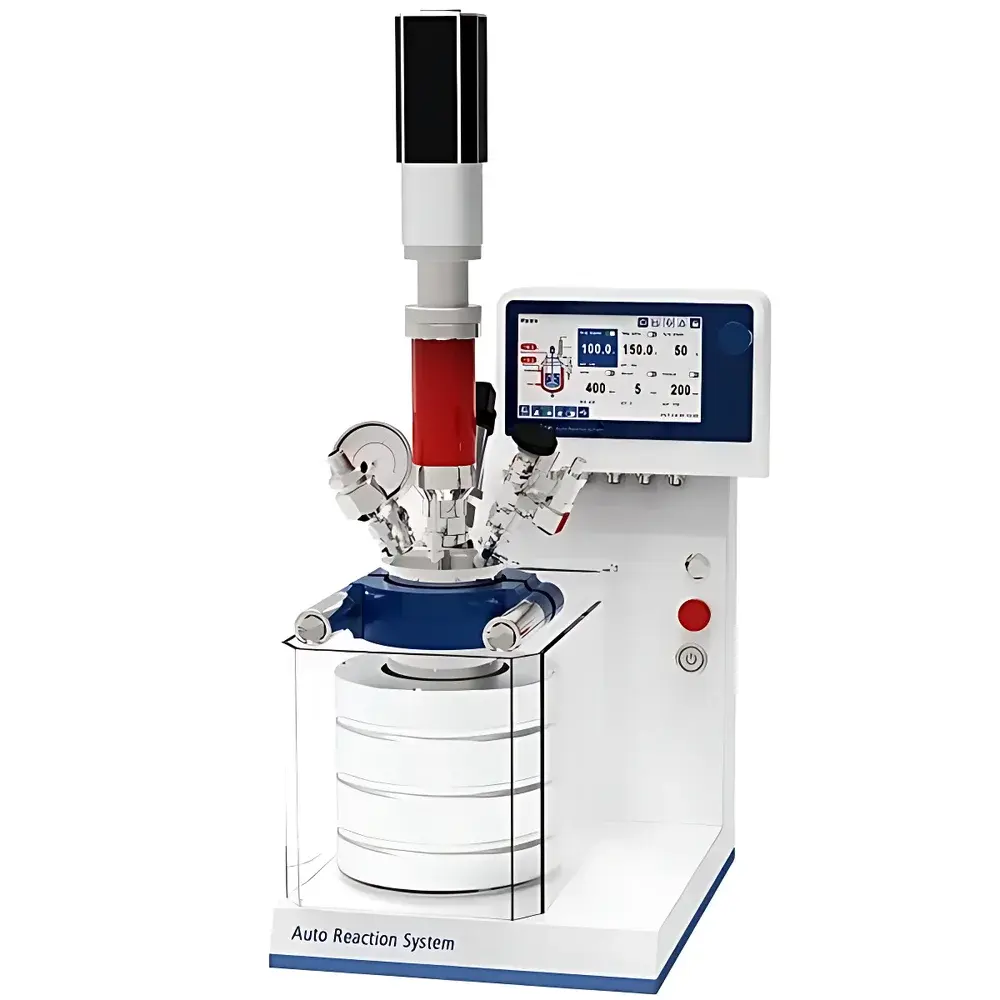
ChemTron CR-300 High-Pressure Reactor
| Brand | ChemTron |
|---|---|
| Origin | Germany |
| Model | CR-300 |
| Vessel Capacity | 30 mL – 5 L |
| Maximum Operating Pressure | 100 bar |
| Maximum Temperature | 300 °C (stainless steel) / 230 °C (with PTFE liner) |
| Construction Material | High-grade stainless steel (e.g., 316Ti, 1.4571) |
| Sealing Options | Viton®, PTFE, Kalrez® O-rings |
| Heating Options | Electric heating jacket, JULABO oil-bath jacket, or heating/cooling coil |
| Stirring | Bottom magnetic stirring (BLH800/BLH801) or top-driven mechanical stirring with magnetic coupling shaft seal (e.g., WB20C/18C series) |
| Safety Features | Rupture disc, pressure relief valve, temperature sleeve, dual 8 mm auxiliary ports, chain-type quick-release clamp |
| Compliance | Designed for GLP/GMP-aligned laboratory environments |
Overview
The ChemTron CR-300 High-Pressure Reactor is an engineered solution for controlled, small-to-medium scale chemical synthesis, catalytic studies, hydrogenation, oxidation, polymerization, and hydrothermal reactions under elevated pressure and temperature conditions. Based on Couette-flow fluid dynamics and sealed-vessel thermodynamics, the CR-300 operates on a robust pressure containment principle—utilizing precision-machined stainless steel (316Ti, 1.4571) vessel bodies and rigorously tested sealing interfaces to maintain integrity up to 100 bar and 300 °C. Its modular architecture enables configuration flexibility without compromising structural reliability or regulatory traceability. Unlike generic benchtop reactors, the CR-300 integrates deterministic safety logic—pressure-limiting rupture discs, calibrated relief valves, and redundant pressure monitoring pathways—ensuring compliance with fundamental hazard mitigation requirements outlined in ISO 4775 and ASTM E2913 for laboratory-scale pressure equipment.
Key Features
- Modular vessel design supporting capacities from 30 mL to 5 L, with standardized CR-300 nominal volume of 390 mL
- High-integrity sealing system featuring interchangeable O-ring materials: Viton® (for broad solvent compatibility), PTFE (for acid resistance), and Kalrez® (for extreme thermal and chemical stability)
- Chain-type quick-clamp mechanism enabling tool-free, repeatable vessel opening/closing with torque-controlled engagement
- Dual 8 mm auxiliary ports for integration of gas dosing modules, liquid injection units, sampling valves, or in-situ sensors (e.g., pH, conductivity, FTIR probes)
- Standardized central port accommodating magnetic coupling shaft seals (e.g., WB20C series) for leak-tight mechanical agitation up to 1200 rpm
- Integrated temperature sleeve for Pt100 or thermocouple insertion, ensuring accurate internal temperature feedback
- Optional pressure transducer interface (4–20 mA or digital RS485 output) for real-time logging and closed-loop control
Sample Compatibility & Compliance
The CR-300 accommodates heterogeneous, homogeneous, and multiphase reaction mixtures—including slurries, viscous polymers, gaseous reagents (H₂, CO, O₂, NH₃), and corrosive media—when configured with appropriate liner options (e.g., PTFE-lined variants for HF or strong acids). Stainless steel construction meets EN 10088-1 standards for corrosion-resistant steels; pressure components are ASME BPVC Section VIII Division 1–aligned in design philosophy. All safety-critical elements—including rupture discs, pressure gauges, and relief valves—are CE-marked and calibrated per ISO/IEC 17025-accredited procedures. The reactor supports audit-ready operation in GLP and GMP environments through optional data-logging packages compliant with FDA 21 CFR Part 11 requirements for electronic records and signatures.
Software & Data Management
While the base CR-300 operates as a standalone unit, it is fully compatible with ChemTron’s optional Central Reaction Control System (CRCS), a PC-based platform enabling synchronized control of temperature, pressure, stirring speed, gas flow rates, and automated sampling sequences. CRCS provides timestamped parameter logging with SHA-256 checksum integrity verification, user-access-level permissions, and export to CSV or ASTM E1382-compliant .rxp files. Audit trails record all setpoint changes, manual interventions, and alarm events—supporting full experimental reproducibility and regulatory submission readiness. Integration with LabArchives ELN and DeltaV DCS is available via OPC UA or Modbus TCP protocols.
Applications
- Catalytic screening under industrially relevant H₂ pressures (up to 100 bar) for pharmaceutical intermediate development
- Hydrothermal synthesis of metal–organic frameworks (MOFs) and nanomaterials requiring precise T/P trajectories
- High-pressure enzymatic reactions where substrate solubility is enhanced under compressed CO₂ or N₂
- Accelerated aging studies of battery electrolytes and solid-state ion conductors
- Supercritical fluid processing (e.g., scCO₂ extraction kinetics) using compatible PTFE-liner configurations
- Reaction calorimetry when coupled with heat-flow sensors and jacket temperature differentials
FAQ
What is the maximum allowable working pressure for the CR-300?
The CR-300 is rated for continuous operation at up to 100 bar (1450 psi) at 300 °C with stainless steel construction; pressure rating reduces to 100 bar at 230 °C when equipped with PTFE liner.
Can the CR-300 be used for exothermic reactions requiring cooling?
Yes—via optional heating/cooling coil integration or external JULABO thermostatic circulator connection to the CTM-300 jacket; temperature ramp rates down to –5 °C/min are achievable depending on heat transfer fluid and ambient conditions.
Is third-party calibration documentation available for pressure and temperature sensors?
Certified calibration reports (traceable to NIST or PTB standards) are provided upon request and included with IQ/OQ documentation packages for regulated laboratories.
How is agitation performance validated across viscosity ranges?
Torque curves and shear rate profiles for BLH800 magnetic stirrers and WB20C magnetic couplings are published in ChemTron Technical Bulletin TB-CR300-AGIT, covering η = 1–5000 mPa·s under representative load conditions.
Does the CR-300 support automated gas dosing and stoichiometric control?
Yes—through integration with ChemTron’s GDS-300 gas delivery system, enabling programmable multi-step gas introduction with mass flow controllers (MFCs) and back-pressure regulation.



