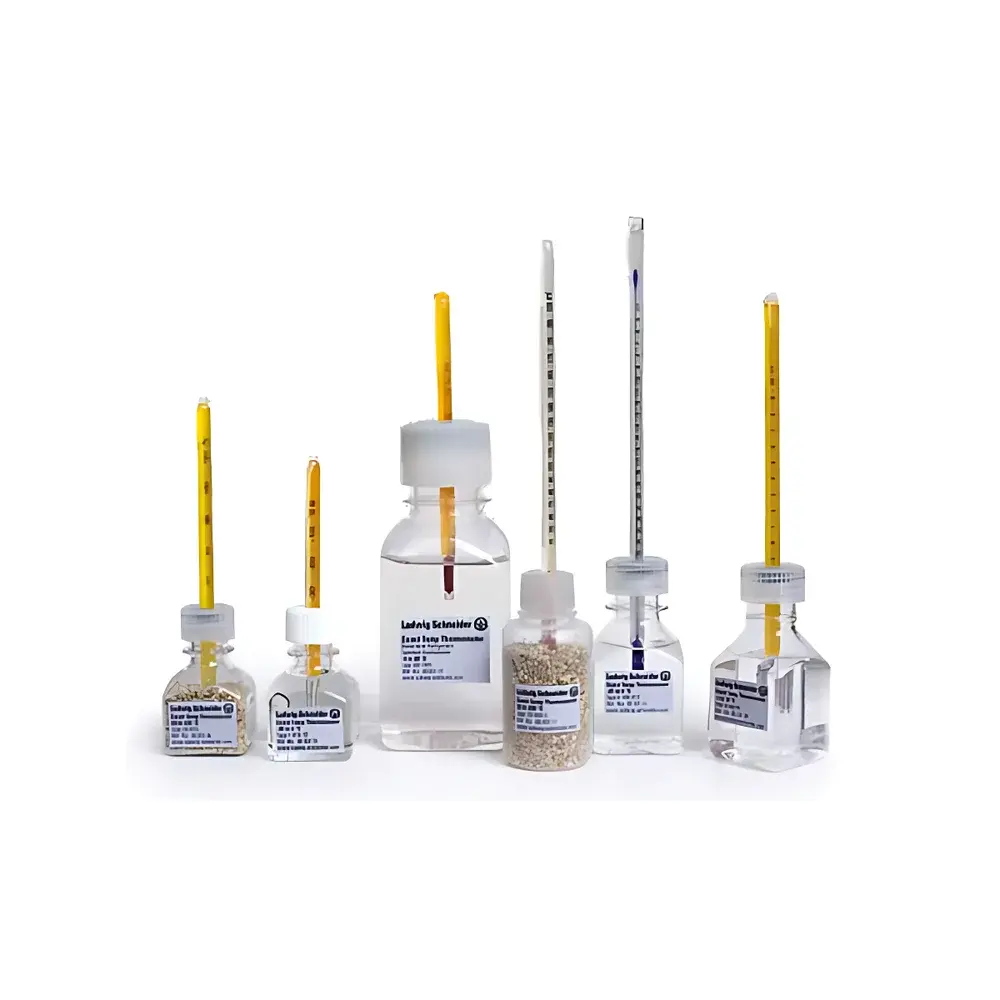
ChemTron ULF-010S Ultra-Low Temperature Refrigerator Thermometer
| Brand | JULABO-Chemtron |
|---|---|
| Origin | Germany |
| Model | ULF-010S |
| Temperature Measurement Range | −90 to +20 °C |
| Minimum Scale Division | 1.0 °C |
| Accuracy | ±2.0 °C |
| Length | 180 mm |
| Bulb Volume | 60 mL |
| Bulb Material | PETG |
| Fill Fluid | Organic Liquid (Red-Dyed) |
| Measurement Principle | Liquid-in-Glass Thermometry |
| Measurement Method | Immersion (Contact) |
| Application-Specific Design | Dedicated for Ultra-Low-Temperature Freezers, Explosion-Proof Chemical Refrigerators, and Blood Bank Refrigerators |
Overview
The ChemTron ULF-010S Ultra-Low Temperature Refrigerator Thermometer is an immersion-type liquid-in-glass thermometer engineered specifically for accurate monitoring of sample temperature within ultra-low temperature freezers (−80 °C class), explosion-proof chemical refrigerators, blood bank units, and cryogenic storage environments. Unlike standard air-sensing digital displays or generic probe thermometers—which report ambient cabinet air temperature—the ULF-010S is designed to be placed directly inside sample containers (e.g., cryovials, solvent bottles, serum bags) to measure the *actual thermal state of stored materials*. Its calibrated organic liquid column (red-dyed) ensures stable, hysteresis-free response across extreme sub-zero conditions down to −90 °C, with mechanical robustness validated for continuous operation in vibration-prone laboratory cold rooms and transport-stable freezer cabinets.
Key Features
- Optimized immersion geometry: 180 mm total length with a 60 mL PETG expansion bulb—designed to fully submerge in common storage vessels while maintaining structural integrity at −90 °C
- Organic liquid fill (red-dyed) with low freezing point and linear thermal expansion coefficient—certified for reproducible readings in ultra-low temperature regimes without mercury hazards
- PETG (polyethylene terephthalate glycol) bulb material: chemically inert, impact-resistant, and compliant with ISO 8573-1 for non-contaminating contact with pharmaceutical and biological samples
- Graduated scale from −90 to +20 °C at 1.0 °C intervals; reference calibration traceable to PTB (Physikalisch-Technische Bundesanstalt, Germany)
- No electronics, batteries, or firmware—immune to electromagnetic interference, condensation-induced drift, or software obsolescence
- Designed for GLP-compliant manual temperature verification workflows per ISO/IEC 17025:2017 Annex A.4 and USP Analytical Instrument Qualification
Sample Compatibility & Compliance
The ULF-010S is validated for direct immersion in aqueous solutions, ethanol/water mixtures, glycerol-based cryoprotectants, and non-aggressive organic solvents commonly used in biobanking and chemical storage. Its PETG construction resists stress cracking in repeated freeze-thaw cycles and exhibits no leachable compounds under ICH Q5C stability testing protocols. The thermometer meets DIN 12770:2021 requirements for laboratory glass thermometers and complies with EU Directive 2011/65/EU (RoHS) regarding hazardous substances. It supports audit-ready documentation for FDA 21 CFR Part 11–aligned cold chain validation when used alongside calibrated reference standards (e.g., Fluke 1523 with dry-well calibrator).
Software & Data Management
As a passive, analog measurement instrument, the ULF-010S does not interface with software or data acquisition systems. Its role is strictly defined within manual calibration and verification procedures: it serves as a primary field reference for validating electronic temperature loggers (e.g., DicksonOne, DeltaTRAK) installed in ultra-low temperature freezers. Users record readings manually into paper-based or LIMS-integrated logbooks, with entries timestamped, signed, and cross-referenced against chamber setpoints and alarm histories. This analog-first approach satisfies regulatory expectations for redundancy and independence in critical temperature monitoring per WHO Technical Report Series No. 961 (Annex 9) and EU GMP Annex 15.
Applications
- Verification of sample core temperature in −86 °C ultra-low temperature freezers used for stem cell, plasma, and mRNA vaccine storage
- Qualification of temperature uniformity mapping studies (per ISO 14644-3) in explosion-proof chemical refrigerators storing flammable reagents
- Periodic checks of blood bag equilibration time in blood bank refrigerators operating at +2 to +6 °C
- Supporting IQ/OQ/PQ protocols for cold chain equipment qualification under ASTM E2810–22 and ISO/IEC 17025
- Backup verification during power outages or sensor failure events where digital loggers may become unreliable
FAQ
Is the ULF-010S suitable for measuring temperatures below −90 °C?
No. Its validated range is strictly −90 to +20 °C. Operation beyond −90 °C risks fill fluid solidification and permanent scale distortion.
Can this thermometer be sterilized using autoclaving or ethylene oxide?
No. PETG is not autoclavable (max service temperature: 70 °C). Ethylene oxide exposure may cause clouding or dimensional change; surface disinfection only with 70% isopropanol is recommended.
How often should the ULF-010S be recalibrated?
Per ISO/IEC 17025, annual recalibration against a certified reference thermometer is required. Additional verification is mandatory after mechanical shock, visible damage, or deviation exceeding ±2 °C during routine use.
Does it comply with FDA requirements for pharmaceutical cold chain monitoring?
Yes—as a secondary verification tool aligned with FDA Guidance for Industry: Process Validation (2011) and EU Annex 15, provided calibration records, usage logs, and traceability documentation are maintained.
Why is immersion depth critical for accuracy?
Liquid-in-glass thermometers require full bulb immersion to prevent stem conduction error. For the ULF-010S, minimum immersion depth is 75 mm; insufficient depth introduces systematic bias >±1.5 °C at −80 °C.