
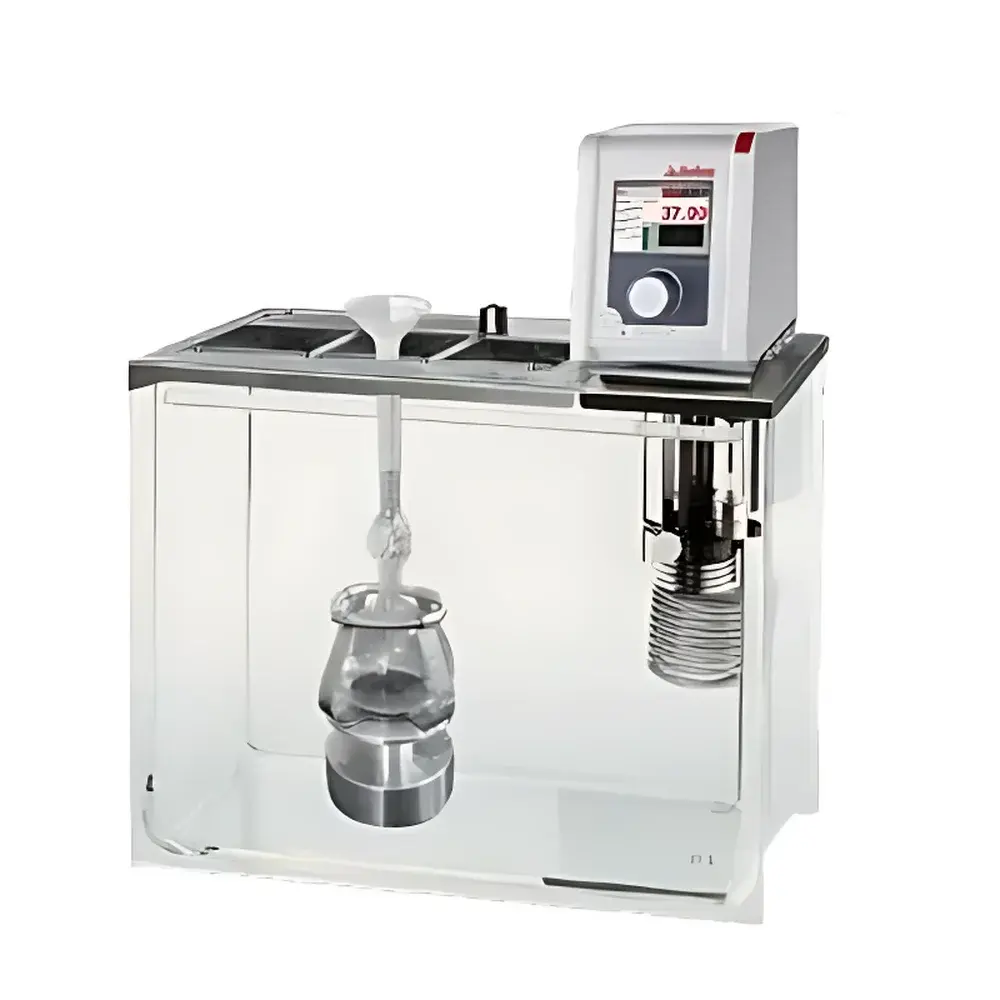
ChemTron DM-070 Pycnometer-Based Density Measurement Kit
| Brand | ChemTron |
|---|---|
| Origin | Germany |
| Model | DM-070 |
| Instrument Type | Density Gradient Tube System |
| Portability | Portable |
| Measurement Medium | Liquids |
| Temperature Range | +5–60 °C |
| Temperature Stability | ±0.01 °C |
| Temperature Resolution | 0.01 °C |
| Bath Volume | 25–31 L |
| Heating Power | 2–11 W |
| Circulation Pump Pressure | 0.23–0.45 bar |
| Interface | RS-232 |
| Compliance | ASTM D1505, ISO 1183-1, USP <841> |
Overview
The ChemTron DM-070 Pycnometer-Based Density Measurement Kit is a precision-engineered system designed for accurate, repeatable determination of liquid density using the classical pycnometric (specific gravity bottle) method—commonly referred to in polymer and materials science as the “Liqui-Density” or “Li’s method”. Unlike digital oscillating U-tube densimeters or hydrostatic weighing systems, the DM-070 implements a gravimetric principle: sample mass is measured in air and in a reference fluid (typically distilled water or calibrated standard liquid), enabling calculation of density via Archimedes’ principle. This approach remains the reference method for regulatory submissions where traceability to SI units and metrological rigor are required—particularly in QC labs supporting ISO 17025 accreditation, pharmaceutical excipient qualification (USP ), and polymer characterization per ASTM D1505 and ISO 1183-1.
Key Features
- High-stability transparent temperature-controlled bath (LDD-31AL) with ±0.01 °C thermal uniformity across the measurement zone, ensuring minimal buoyancy drift during extended weighing cycles
- Integrated real-time clock and programmable temperature ramping for GLP-compliant sequence logging and audit-ready time-stamped operation
- RS-232 interface enables bidirectional communication with analytical balances and external LIMS or ELN platforms for automated data capture and metadata tagging
- Dual-stage safety logic: independent high/low temperature alarms plus low-bath-level detection prevent thermal runaway and ensure consistent immersion depth for pycnometer calibration
- Modular design includes three certified JU3S-N-50 pycnometers (10 mL nominal volume, Class A tolerance per DIN EN ISO 1042) and three JU3S-N-01 support stands with anti-roll geometry for stable positioning inside the bath
- Optically clear acrylic bath chamber allows visual verification of meniscus alignment and bubble-free filling—critical for minimizing systematic error in manual pycnometer reading
Sample Compatibility & Compliance
The DM-070 supports aqueous solutions, organic solvents (e.g., chloroform, toluene, ethanol), molten polymers (within viscosity limits permitting full pycnometer filling), and low-volatility oils. Its operational range (+5–60 °C) accommodates both ambient-condition testing and elevated-temperature measurements required for thermal expansion correction in polymer density profiling. The system complies with ISO/IEC 17025 clause 6.4.10 (environmental monitoring), meets traceability requirements for calibration certificates issued under ISO/IEC 17025, and supports 21 CFR Part 11–compliant electronic records when paired with validated balance software and timestamped audit logs.
Software & Data Management
While the DM-070 operates as a standalone hardware platform, its RS-232 port enables integration with third-party laboratory software such as LabWare LIMS, Thermo Fisher SampleManager, or custom Python-based acquisition scripts. Temperature setpoints, dwell times, and alarm thresholds are configurable via terminal command protocol. All thermal events—including bath stabilization duration, deviation from setpoint, and alarm triggers—are logged with UTC timestamps. When used in GxP environments, the system supports retrospective validation of environmental conditions for each density run, fulfilling FDA expectations for raw data integrity and attributable, legible, contemporaneous, original, and accurate (ALCOA+) recordkeeping.
Applications
- Quality control of industrial solvents and cleaning agents per ASTM D1475
- Density profiling of thermoplastic resins (e.g., HDPE, PP) at multiple temperatures to derive crystallinity indices
- Verification of specific gravity in battery electrolyte formulations prior to cell assembly
- Reference-density calibration of inline process densitometers in chemical manufacturing
- Educational laboratories requiring hands-on instruction in fundamental metrology principles and uncertainty budgeting (Type A/B evaluation)
- Regulatory batch release testing for medical device lubricants and ophthalmic vehicle components under USP monographs
FAQ
Is the DM-070 suitable for volatile or hazardous liquids?
Yes—when operated within the bath’s sealed configuration and used with appropriate fume hood ventilation, it accommodates Class IIIB flammable liquids (flash point >60 °C). For highly volatile samples (e.g., acetone), pre-chilling the pycnometer and minimizing exposure time is recommended.
Can the system be validated for GMP use?
Yes—the LDD-31AL bath includes factory-issued calibration certificates traceable to PTB (Physikalisch-Technische Bundesanstalt), and its temperature stability profile satisfies IQ/OQ protocols outlined in ASTM E2877 for liquid density instrumentation.
What balance compatibility is required?
A Class I analytical balance with ≥0.0001 g readability and internal calibration capability is required; the system has been verified with Mettler Toledo XSR and Sartorius Cubis II platforms.
Does the kit include density reference standards?
No—certified reference liquids (e.g., NIST SRM 2190a water, or potassium chloride solutions) must be procured separately to establish traceable calibration curves.
How is thermal equilibration confirmed before measurement?
The integrated real-time clock synchronizes with bath temperature logging; users define a minimum stabilization period (e.g., 30 min at ±0.01 °C tolerance) prior to initiating pycnometer weighing—this parameter is recorded in the audit trail.



