
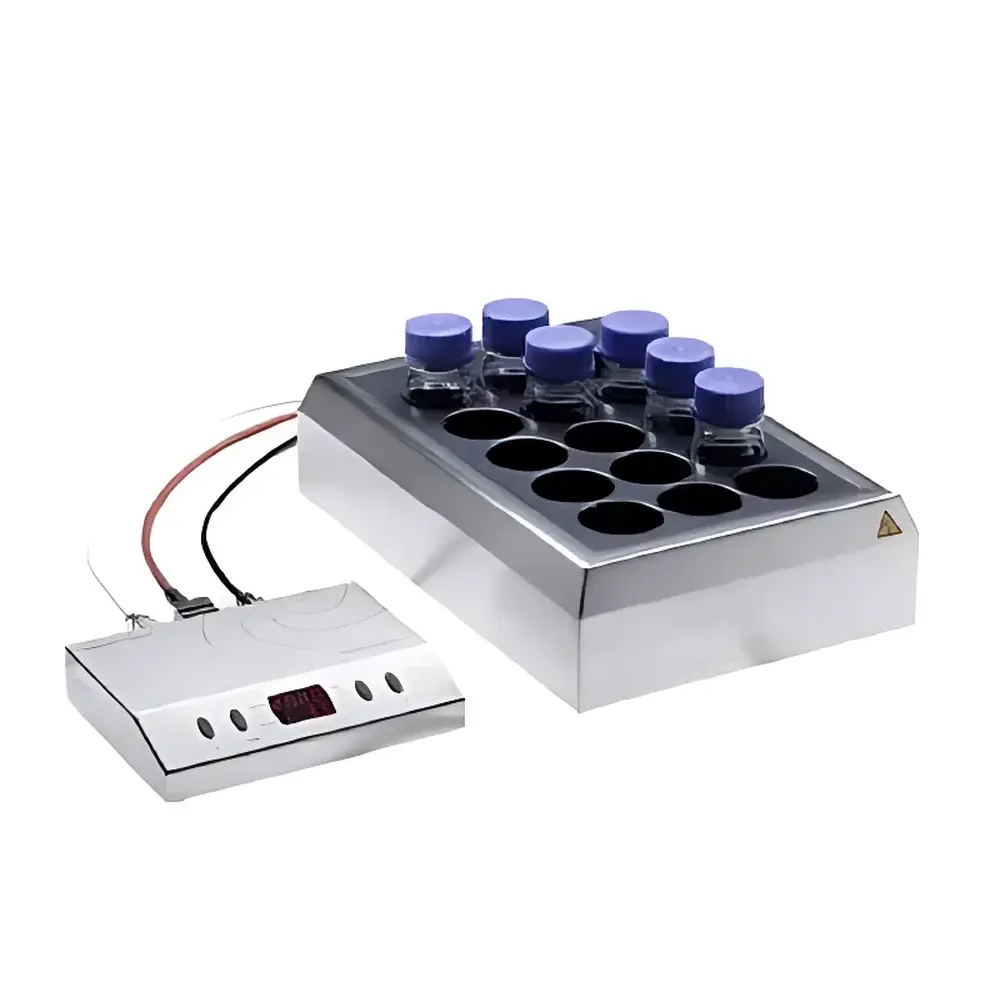
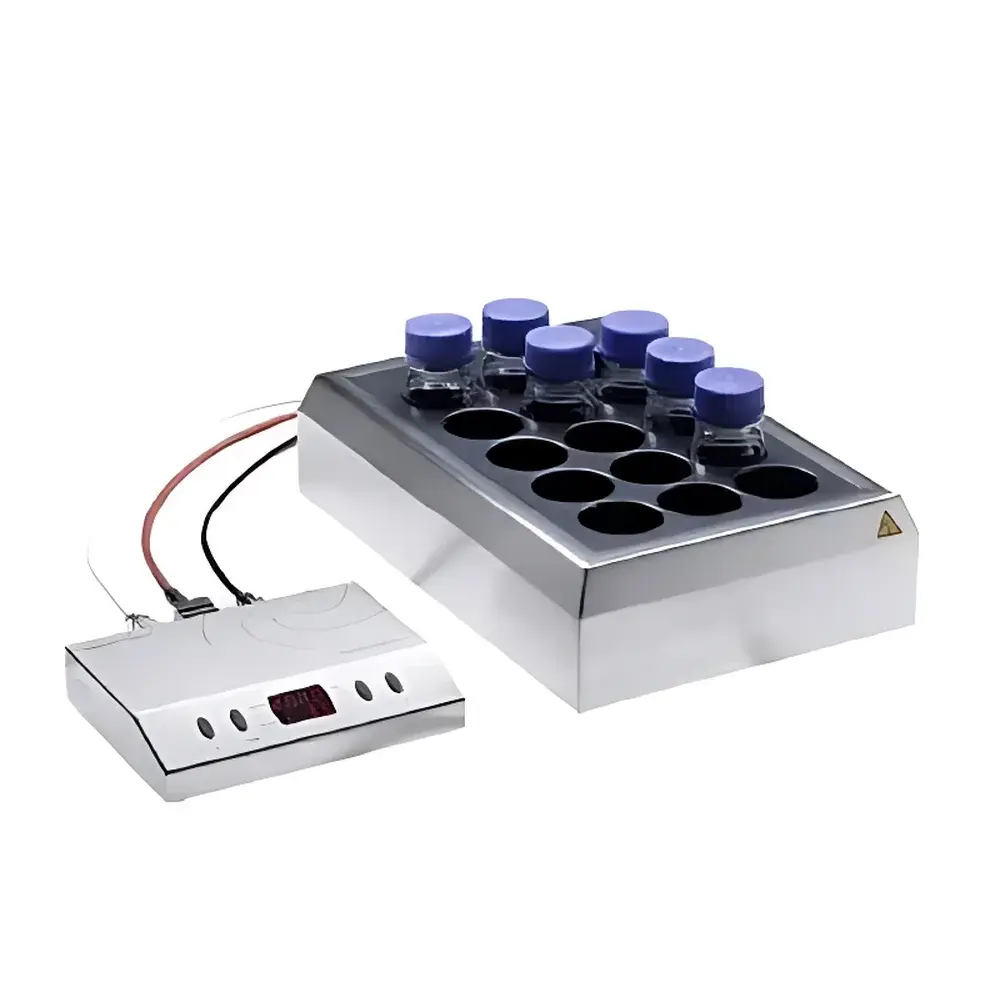
ChemTron SD15-100 Inductive Magnetic Drive Multi-Position Heated Dry Bath Stirrer
| Brand | ChemTron |
|---|---|
| Origin | Germany |
| Model | SD15-100 |
| Instrument Type | Magnetic Stirrer |
| Max. Stirring Volume per Position | 1–400 mL |
| Speed Range | 100–2000 rpm |
| Temperature Range | 0–200 °C |
| Heating Power | 1000 W |
| Stirring Power per Position | 40 W |
| Position Count | 15 |
| Inter-Position Spacing | 65 mm |
| Well Diameter/Depth | 57.5 × 48 mm |
| Power Setting Levels | 25 / 50 / 75 / 100 % (4-step) |
| Protection Rating | IP20 |
| Operating Environment | −10 to +40 °C at ≤80% RH |
| Dimensions (W×D×H) | 295 × 445 × 110 mm |
| Weight | ~23 kg |
| Ordering Code (incl. Control Unit) | 63100 |
Overview
The ChemTron SD15-100 is an inductively coupled, multi-position heated dry bath stirrer engineered for precise, contactless magnetic stirring and temperature-controlled sample processing in regulated laboratory environments. Unlike conventional stirrers employing direct-drive motors or mechanical couplings, this system utilizes electromagnetic induction to drive PTFE-coated stir bars within sealed vessels—eliminating shaft seals, reducing maintenance, and ensuring full compatibility with inert atmospheres and vacuum conditions. Its dry bath architecture replaces liquid baths with aluminum heating blocks, delivering rapid thermal response, uniform heat distribution across all 15 positions, and zero risk of fluid contamination or evaporation loss. Designed for reproducible kinetic studies, parallel synthesis workflows, and quality control assays, the SD15-100 operates under strict thermal and rotational stability criteria—maintaining ±0.5 °C temperature accuracy and ±10 rpm speed consistency over extended durations. The unit complies with IEC 61010-1 safety standards for laboratory electrical equipment and meets structural requirements for integration into automated platforms (e.g., robotic liquid handlers or modular synthesis stations).
Key Features
- Inductive magnetic drive technology: No physical motor coupling—enables sterile, sealed-vessel operation and eliminates wear-prone mechanical components.
- 15 independently addressable heating/stirring positions with fixed 65 mm center-to-center spacing—optimized for standard microcentrifuge tubes, vials, and small reaction vessels.
- Precise dual-control architecture: Simultaneous, programmable regulation of temperature (0–200 °C, resolution 0.1 °C) and stirring speed (100–2000 rpm, resolution 1 rpm).
- Four-level power modulation (25/50/75/100%) per position—allows fine-tuned torque delivery for low-viscosity solvents or high-viscosity polymer solutions (up to ~10,000 mPa·s at 25 °C).
- Aluminum heating block with integrated Pt100 sensor and PID feedback loop—ensures spatial uniformity ≤±1.2 °C across all wells at 100 °C.
- IP20-rated enclosure with reinforced thermal insulation—suitable for ambient lab use (−10 to +40 °C, ≤80% RH); no forced-air cooling required.
- Modular control interface supporting analog (0–10 V) and digital (RS-485 Modbus RTU) communication protocols for OEM integration.
Sample Compatibility & Compliance
The SD15-100 accommodates cylindrical vessels ranging from 1.5 mL microcentrifuge tubes to 50 mL conical tubes, provided internal diameters fall between 10–28 mm and depths do not exceed 48 mm. It supports common labware materials including borosilicate glass, polypropylene, PTFE, and quartz—compatible with organic solvents (e.g., DMF, THF), aqueous buffers, and mildly corrosive reagents (pH 2–12). From a regulatory standpoint, the device satisfies essential requirements for GLP-compliant method development and routine QC testing. Its non-invasive stirring mechanism avoids sample shear artifacts critical in protein stability studies or nanoparticle dispersion characterization. While not intrinsically certified for FDA 21 CFR Part 11, its control unit supports external audit-trail logging when interfaced with validated LIMS or ELN systems.
Software & Data Management
The SD15-100 operates via front-panel membrane keypad with real-time LED display of setpoints and actual values. For advanced protocol management, optional ChemTron LabControl Suite (v3.2+) enables remote configuration, multi-step ramp-soak profiles, and timestamped data export (CSV/TXT). All operational parameters—including temperature history, speed logs, and error flags—are stored in non-volatile memory for traceability. When deployed in networked environments, the RS-485 interface permits synchronization with scheduling software (e.g., LabArchives, Benchling) and supports event-triggered alerts (e.g., overtemperature, stir bar stall detection). Data integrity is preserved through cyclic redundancy check (CRC) validation on all serial transmissions.
Applications
- Parallel reaction screening in combinatorial chemistry and catalyst optimization.
- Viscosity-dependent dissolution testing per USP <711> for immediate-release solid dosage forms.
- Thermal denaturation profiling of enzymes and antibodies under controlled agitation.
- Standardized extraction protocols in food safety labs (e.g., pesticide residue analysis per EN 15662).
- Pre-concentration steps in environmental water testing (e.g., EPA Method 525.3).
- Cell lysis and buffer equilibration in molecular biology workflows requiring gentle yet consistent mixing.
FAQ
Can the SD15-100 be used under inert gas or vacuum?
Yes—the inductive drive eliminates rotating feedthroughs, allowing safe operation inside gloveboxes or sealed reactor chambers.
Is calibration traceable to national standards?
Temperature calibration is performed using NIST-traceable Pt100 reference probes; users receive a factory calibration certificate with uncertainty budget.
What stir bar sizes are recommended for optimal performance?
For 15–100 mL volumes: 25 × 8 mm elliptical PTFE-coated bars; for >100 mL: 30 × 10 mm bars with embedded samarium-cobalt magnets.
Does the unit support gradient temperature profiles across positions?
No—block temperature is uniform across all 15 wells; independent thermal zoning is not supported.
How often does maintenance require intervention?
No scheduled maintenance is required; periodic cleaning of the aluminum block surface with isopropanol is recommended every 6 months.



