
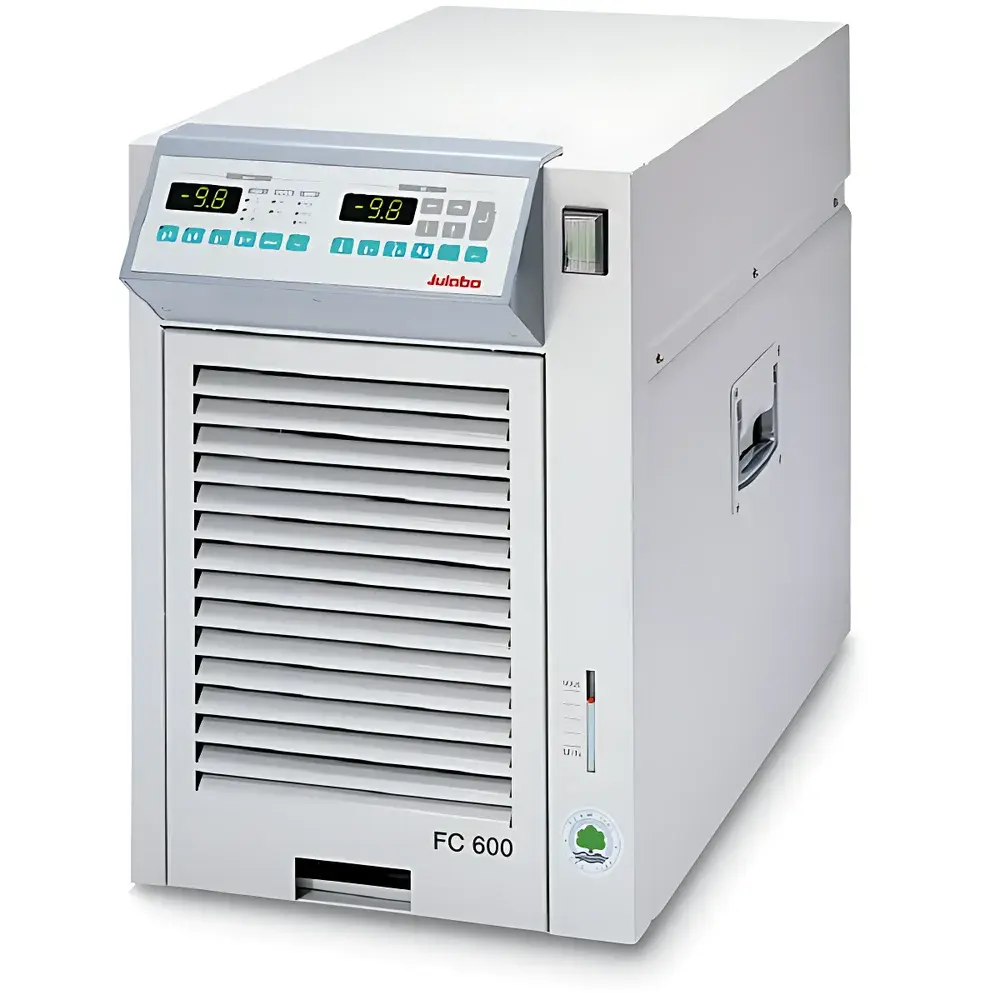
Julabo FC600 Circulating Chiller
| Brand | Julabo |
|---|---|
| Origin | Germany |
| Model | FC600 |
| Instrument Type | Integrated Circulating Chiller |
| Cooling Method | Air-Cooled |
| Temperature Range | -20 to +80 °C |
| Temperature Stability | ±0.2 °C |
| Refrigeration Capacity | 600 W at 20 °C |
| Heating Power | 1.2 kW |
| Pump Flow Rate | 20 L/min |
| Pump Pressure | 0.5 bar |
| Reservoir Volume | 6–8 L |
| Operating Mode | Continuous |
| Refrigerant | R134a (GWP = 1430) |
| Compressor | Single-Stage Air-Cooled |
| Communication Interface | RS232 (optional), Analog Output (0–10 V / 4–20 mA) |
| External Sensor Input | Pt100 compatible |
| Dimensions (W×L×H) | 35 × 54 × 49 cm |
| Weight | 43 kg |
| Sound Pressure Level (1 m) | ≤51 dBA |
| Ambient Operating Temperature | 5–40 °C |
Overview
The Julabo FC600 Circulating Chiller is a precision-engineered, air-cooled, integrated temperature control system designed for demanding laboratory and pilot-scale applications requiring stable, continuous cooling and heating across an extended range of –20 °C to +80 °C. Based on vapor-compression refrigeration with a single-stage R134a compressor and integrated electric heating (1.2 kW), the FC600 operates via closed-loop circulation—eliminating dependence on municipal water cooling and reducing environmental impact while ensuring consistent thermal management. Its thermodynamic architecture supports both active cooling and precise heating, enabling accurate setpoint maintenance under dynamic load conditions typical in analytical instrumentation (e.g., HPLC column ovens, spectrometer detectors, laser sources), material testing systems, and reactor jacketing. The unit complies with IEC 61000-6-3 (EMC emissions) and IEC 61000-6-2 (immunity), and its refrigerant selection adheres to EU F-Gas Regulation (EU No. 517/2014) requirements for low-leakage design and service documentation.
Key Features
- Integrated dual-mode operation: simultaneous refrigeration (up to 600 W at 20 °C ambient) and resistive heating (1.2 kW) for seamless transition between cooling and heating phases
- High-stability temperature control with ±0.2 °C stability and 0.1 °C resolution on dual LED displays—one for setpoint, one for actual bath or outlet temperature
- Adjustable inlet/outlet temperature differential (ΔT) to optimize heat exchange efficiency with external devices
- Top-fill reservoir with transparent level indicator and audible/visual low-level alarm to prevent dry-run operation
- Robust centrifugal pump delivering 20 L/min flow at 0.5 bar pressure, compatible with 8 mm and 12 mm ID tubing via standard M16×1 male thread ports
- RS232 serial interface (optional) and analog output (0–10 V / 4–20 mA) for integration into centralized lab automation systems or SCADA platforms
- Pt100 sensor input support for external process temperature feedback—enabling cascade or master-slave control configurations
- Acoustically optimized housing with noise emission ≤51 dBA at 1 m distance, suitable for shared laboratory environments
Sample Compatibility & Compliance
The FC600 is compatible with aqueous and water-glycol solutions (up to 30% v/v ethylene or propylene glycol) as heat transfer fluids. It is not intended for use with organic solvents or corrosive media. All wetted components—including reservoir, pump head, and internal tubing—are constructed from corrosion-resistant stainless steel (AISI 304), EPDM seals, and PPS polymer housings. The unit meets CE marking requirements under the Low Voltage Directive (2014/35/EU) and EMC Directive (2014/30/EU). For regulated environments, audit trails and user-access logs can be implemented externally via RS232 data logging; though the device itself does not natively support FDA 21 CFR Part 11 electronic signatures, it may be validated within a GxP-compliant infrastructure when paired with compliant software and procedural controls per ISO/IEC 17025 and ASTM E2500 guidelines.
Software & Data Management
While the FC600 operates autonomously via front-panel controls, its RS232 interface enables bidirectional communication with third-party software such as LabVIEW, MATLAB, or custom Python-based monitoring tools using standard ASCII protocol commands. Analog outputs allow real-time recording of temperature, pump status, and alarm states using commercial chart recorders or PLCs. Data export formats include CSV-compatible timestamped streams. Firmware updates are performed offline via USB-to-serial adapter and Julabo’s proprietary PC utility (Windows only). Configuration parameters—including PID tuning constants, alarm thresholds, and ΔT limits—are retained in non-volatile memory during power loss.
Applications
- HPLC and UHPLC column ovens and detector cooling blocks
- Mass spectrometer source and analyzer cooling
- Laser diode and solid-state laser thermal stabilization
- DSC, TGA, and rheometer environmental chambers
- Small-scale bioreactor and fermenter jacket temperature control
- Calibration baths for temperature probe verification (per ISO/IEC 17025)
- Electronics testing rigs requiring thermal cycling between –20 °C and +80 °C
FAQ
What is the maximum allowable inlet fluid temperature when operating in cooling mode?
The FC600 accepts return fluid up to 80 °C—enabling compatibility with high-temperature processes that require post-heating cooling recovery.
Can the FC600 maintain temperature stability under variable thermal loads?
Yes—the unit employs adaptive PID control with auto-tuning capability and maintains ±0.2 °C stability even during step-load changes typical in chromatography or laser duty cycles.
Is glycol mixture required for sub-zero operation?
A water–propylene glycol mixture (e.g., 30% v/v) is recommended below 0 °C to prevent freezing and ensure adequate viscosity for pump performance.
Does the FC600 support remote start/stop and alarm notification?
Yes—via digital I/O signals (optional module) or through RS232 command set (e.g., “ON”, “OFF”, “ALM?”), enabling integration into facility-wide monitoring networks.
What maintenance intervals are recommended for long-term reliability?
Compressor oil and refrigerant integrity should be verified annually; air filter cleaning is recommended every 3 months in dusty environments; pump impeller inspection is advised every 24 months under continuous operation.



