
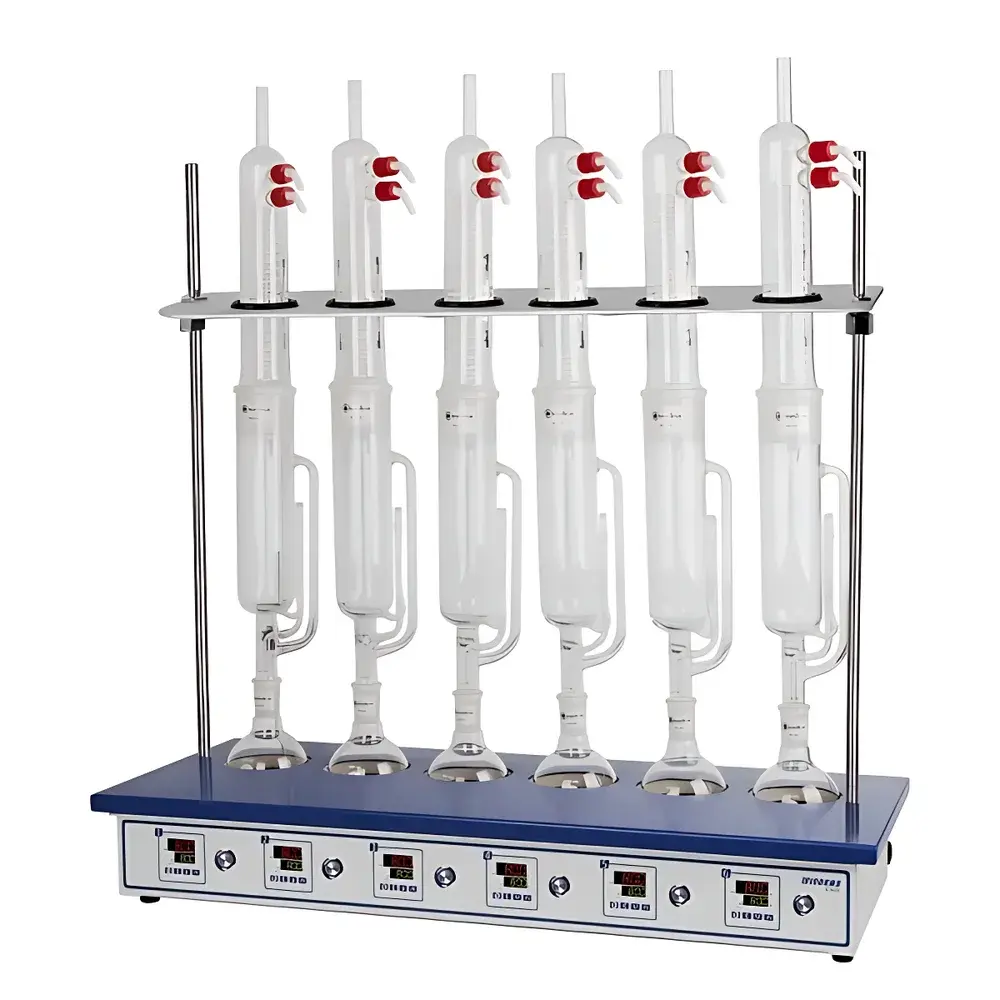
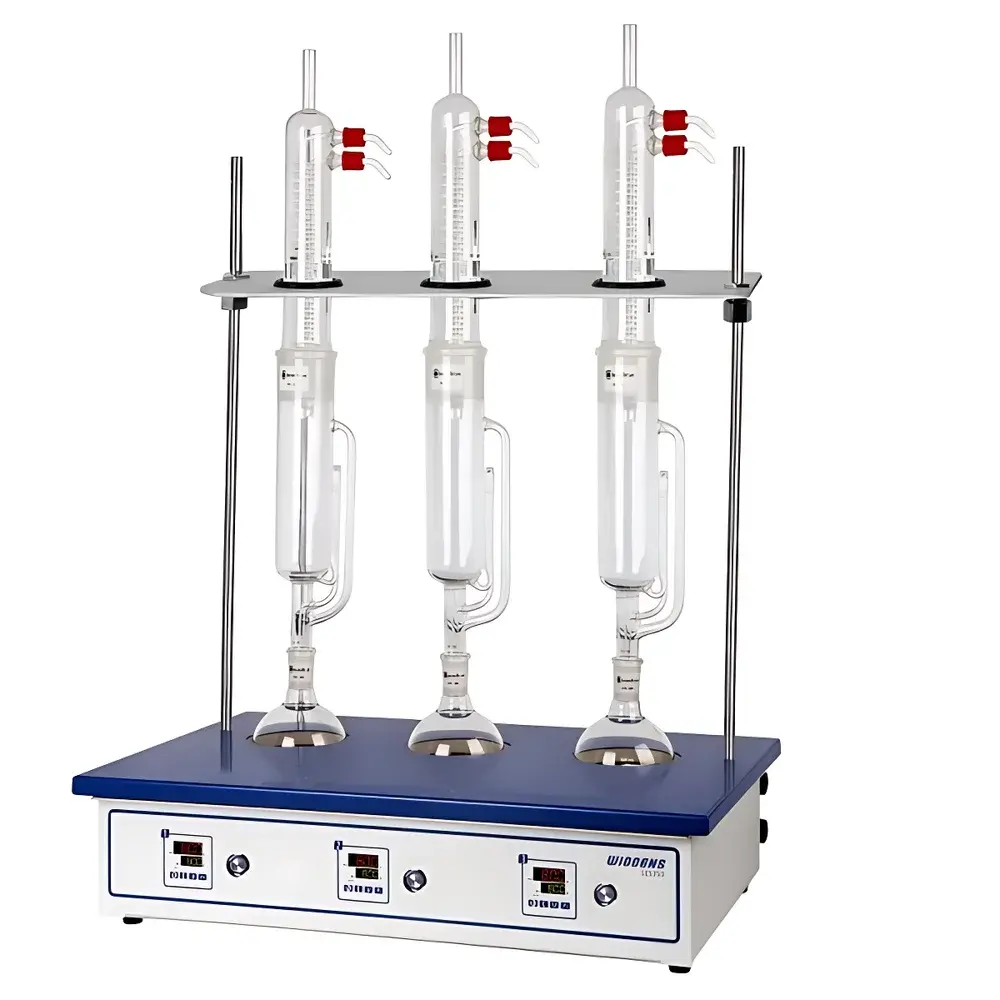
ChemTron SES Soxhlet Extraction System
| Brand | ChemTron |
|---|---|
| Origin | Germany |
| Model | SES |
| Temperature Range | RT +5 to 450 °C |
| Power | 125–290 W (model-dependent) |
| Flask Capacity | 300, 500, or 1000 mL |
| Extractor Tube Dimensions | 45 mm ID × 130 mm H |
| Sintered Glass Porosity | 20–35 µm or 100–200 µm |
| Configuration | 3-position or 6-position modular heating block with independent temperature control per position |
| Display | Dual LED readout (setpoint & actual temperature, 0.1 °C resolution) |
| Vessel Compatibility | Flat-bottom and round-bottom flasks |
| Solvent Recovery | Integrated reflux condensation and closed-loop solvent recycling |
Overview
The ChemTron SES Soxhlet Extraction System is a precision-engineered benchtop instrument designed for automated, reproducible solid-liquid extraction based on the classical Soxhlet principle. It operates through continuous cyclic percolation of heated solvent vapor through a solid sample contained in a sintered-glass thimble, followed by condensation and return of enriched solvent to the extraction chamber. This thermodynamically efficient process enables exhaustive extraction of analytes—such as lipids, waxes, pesticides, residual solvents, or extractable organic compounds—from complex solid or semi-solid matrices without manual intervention. Engineered for compliance with standardized methodologies including ASTM D2236, ISO 6497, AOAC 991.36, and USP , the SES system supports GLP- and GMP-aligned workflows in regulated laboratories where traceability, thermal stability, and inter-batch consistency are critical.
Key Features
- Modular heating architecture: Available in 3-position (SES3xx) and 6-position (SES6xx) configurations, each with independently controlled heating zones—enabling parallel extractions under differing temperature protocols within a single run.
- Precision digital temperature regulation: Microprocessor-controlled heating mantles maintain setpoints from ambient +5 °C up to 450 °C with ±1 °C accuracy and 0.1 °C display resolution; PID algorithm ensures minimal overshoot and thermal drift.
- Dual LED interface: Simultaneously displays both target and real-time temperature for each position, facilitating rapid verification and protocol documentation.
- Optimized glassware compatibility: Supports both flat-bottom and round-bottom boiling flasks (300 mL, 500 mL, and 1000 mL options), paired with standardized sintered-glass extractor tubes (45 mm inner diameter × 130 mm height) featuring selectable porosity (20–35 µm for fine particulates; 100–200 µm for coarse or fibrous samples).
- Integrated solvent management: Reflux condensers operate passively via water-cooling (standard) or optional recirculating chiller coupling; closed-loop design minimizes solvent loss and enables >95% solvent recovery over multi-hour extractions.
- Robust mechanical construction: Stainless-steel support frame with ceramic-insulated heating elements and IP20-rated electrical housing ensures long-term operational safety and resistance to solvent vapors.
Sample Compatibility & Compliance
The SES system accommodates a broad spectrum of heterogeneous samples—including foodstuffs (e.g., cereal grains, dairy powders), animal feed, pharmaceutical excipients, environmental solids (soil, sludge, sediment), polymers, textiles, rubber, and petrochemical residues. Its thermal stability and inert glass pathway ensure compatibility with chlorinated solvents (e.g., dichloromethane), hydrocarbons (hexane, petroleum ether), alcohols (ethanol), and ethyl acetate. All models conform to IEC 61010-1 for laboratory electrical equipment safety and are CE-marked. When operated within validated SOPs, the system meets data integrity requirements under FDA 21 CFR Part 11 when integrated with compliant LIMS or ELN platforms—particularly when paired with external audit-trail logging of temperature profiles and run timestamps.
Software & Data Management
While the SES operates as a stand-alone hardware platform, its analog temperature outputs (0–10 V or 4–20 mA, optional) permit integration with programmable logic controllers (PLCs) or SCADA systems for centralized monitoring. For full digital traceability, ChemTron recommends coupling the SES with third-party data acquisition software capable of time-stamped logging of temperature setpoints and actual values per channel at user-defined intervals (e.g., every 30 seconds). Such records satisfy GLP audit requirements for method validation, equipment qualification (IQ/OQ), and routine performance verification. No proprietary firmware or cloud connectivity is embedded—ensuring full data sovereignty and alignment with ITAR- and GDPR-restricted environments.
Applications
- Lipid quantification in animal feed and edible oils (AOAC 920.39, ISO 12966-2)
- Pesticide residue screening in agricultural commodities (EN 15662)
- Extractable/leachable studies for pharmaceutical packaging (USP )
- Total petroleum hydrocarbon (TPH) analysis in contaminated soils (EPA Method 3541)
- Wax content determination in crude oil and bitumen (ASTM D7213)
- Solvent-soluble polymer fractionation (e.g., PP/PE separation in recycled plastics)
- Active ingredient recovery from herbal matrices in natural product R&D
FAQ
What types of solvents are compatible with the SES system?
The SES supports common low-to-medium boiling point organic solvents including n-hexane, petroleum ether, chloroform, dichloromethane, ethanol, and ethyl acetate—provided their boiling points fall within the operating temperature range (RT+5 °C to 450 °C) and condenser cooling capacity is sufficient.
Can different flask sizes be used simultaneously on a single 3-position unit?
Yes—each heating position operates independently; users may load 300 mL, 500 mL, and 1000 mL flasks concurrently, provided appropriate extractor tube lengths and condenser alignment are maintained.
Is the sintered glass thimble included with the system?
Sintered glass extractor tubes are supplied standard with all SES configurations; optional porosity grades (20–35 µm or 100–200 µm) must be specified at time of order.
Does the SES meet requirements for regulatory submissions?
When deployed within a validated analytical method and supported by documented calibration, preventive maintenance, and raw temperature log retention, the SES fulfills instrumentation criteria for FDA, EMA, and PMDA submissions—particularly for compendial assays requiring Soxhlet extraction.
What maintenance is required for long-term reliability?
Routine inspection of glassware integrity, cleaning of heater mantle surfaces, descaling of condenser jackets (if using hard water), and annual verification of temperature sensor accuracy against NIST-traceable references constitute the core maintenance protocol.



