
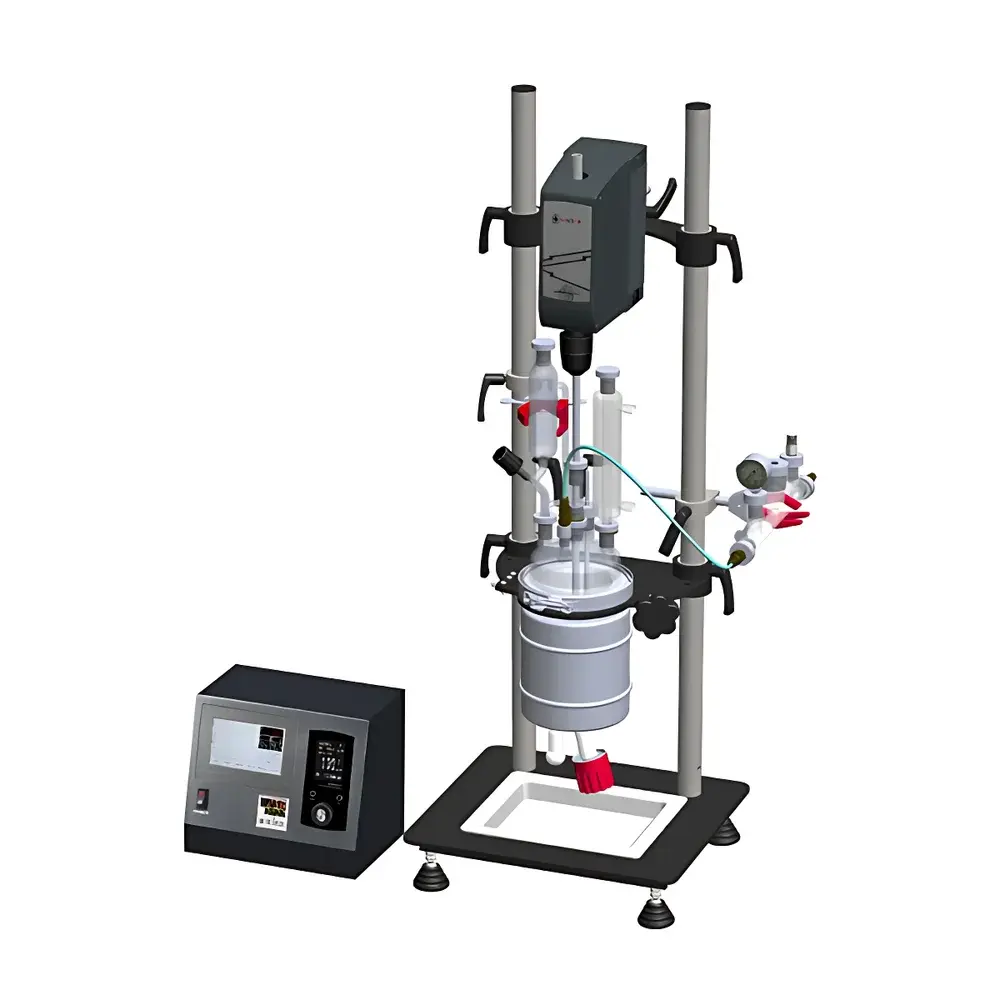
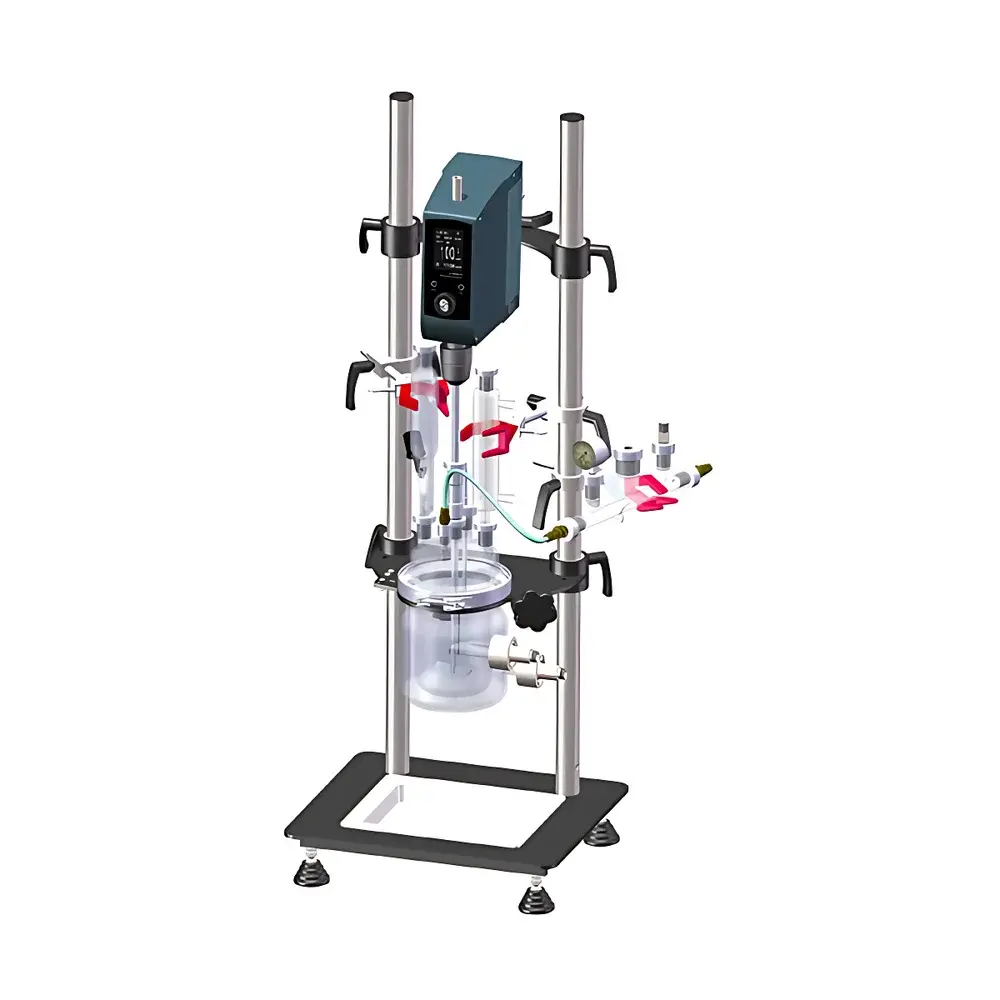
ChemTron GPR Borosilicate Glass Pressure Reactor
| Brand | ChemTron |
|---|---|
| Origin | Germany |
| Model | GPR |
| Vessel Capacity | 0.5–5 L (standard) |
| Operating Pressure | 2.4–3.1 bar (GPR-M1–M4: 2.4 bar |
| GPR-M5–M8 | 3.1 bar) |
| Vacuum Range | -0.7 to -0.9 bar (i.e., absolute pressure 0.3–0.1 bar) |
| Construction Material | High-purity borosilicate glass 3.3 (DIN ISO 3585) |
| Sealing System | ACE-Thrend® precision glass-threaded joints with fluorocarbon O-rings |
| Temperature Range (with JULABO integration) | -50 °C to +200 °C |
| Vessel Type | Split-body or monolithic (one-piece) design |
| Safety Package | Integrated pressure gauge, adjustable relief valve, and certified rupture disc |
| Compliance | Designed per PED 2014/68/EU Annex I essential safety requirements for Category I pressure equipment |
Overview
The ChemTron GPR Borosilicate Glass Pressure Reactor is an engineered laboratory-scale reaction system designed for controlled chemical synthesis under elevated pressure and inert atmosphere conditions. Built from DIN-certified borosilicate glass 3.3, the GPR series enables real-time visual monitoring of reaction progress—including phase separation, crystallization, gas evolution, and precipitate formation—while maintaining mechanical integrity under sustained pressure loads. Its core operating principle relies on static pressurization via inert gas (e.g., N₂, Ar) or self-generated vapor pressure, with pressure containment achieved through ACE-Thrend® high-precision ground-glass threading—a proprietary joint geometry that ensures axial load distribution, repeatable sealing torque, and resistance to thermal cycling-induced loosening. The reactor is classified as Category I pressure equipment under the EU Pressure Equipment Directive (PED 2014/68/EU), reflecting its validated compliance with fundamental safety requirements for maximum allowable pressure (PS) up to 3.1 bar and volume thresholds below 50 L. It serves as a primary platform for catalytic hydrogenation, polymerization kinetics, photochemical reactions under inert blanket, and solvent-free or low-solvent stoichiometric studies where transparency, chemical inertness, and trace-metal-free surfaces are critical.
Key Features
- Two structural configurations: split-body (GPR-M1–M4) for enhanced accessibility and modular accessory integration, and monolithic (GPR-M5–M8) for superior pressure retention and mechanical rigidity
- ACE-Thrend® glass-to-glass threaded connections with Viton® or Kalrez® O-ring seals—validated for >10,000 pressure cycles without degradation
- Standardized #15 and #25 ISO glass thread interfaces (DIN 15847) enabling direct compatibility with industry-standard condensers, dropping funnels, thermowells, and gas inlets
- Configurable jacketed vessel option for precise temperature control using JULABO F200 or FT1000 series heating/cooling circulators (–50 °C to +200 °C)
- Single-wall variant compatible with ChemTron-approved heating mantles and PID temperature controllers for applications requiring rapid thermal ramping or cost-optimized setups
- Integrated safety package including calibrated analog pressure gauge (0–5 bar), spring-loaded adjustable relief valve (setpoint ±0.1 bar tolerance), and ASME BPVC Section VIII-compliant rupture disc (certified burst pressure matching vessel rating)
- Stainless steel SSS support frame with integrated drip tray and universal clamping system for stable mounting across fume hoods and reactor workstations
Sample Compatibility & Compliance
The GPR reactor exhibits broad chemical compatibility due to its borosilicate glass 3.3 construction—resistant to concentrated acids (except HF and hot phosphoric acid), alkalis (up to 30% NaOH at <100 °C), organic solvents, and halogenated reagents. It is unsuitable for hydrofluoric acid, strong oxidizing mixtures above 120 °C (e.g., HNO₃/H₂SO₄), or prolonged exposure to molten alkali metals. All standard configurations comply with GLP documentation standards when used with ChemTron AR1.8 software (21 CFR Part 11-ready audit trail, electronic signatures, and parameter lockout). Pressure components meet PED 2014/68/EU Annex I essential safety requirements and carry CE marking for pressure equipment. Optional third-party calibration certificates (DAkkS-accredited) are available for pressure transducers and temperature sensors.
Software & Data Management
The optional ChemTron AR1.8 Reaction Control Software transforms the GPR into a digitally traceable reaction workstation. It supports real-time acquisition of up to eight process variables—including internal pressure, jacket temperature, stirring speed, and optional pH or conductivity inputs—via RS485 or USB-to-serial interface. Data is logged at user-defined intervals (100 ms–60 s), stored in encrypted .csv and .tdms formats, and visualized as synchronized time-series plots with customizable scaling and derivative overlays. The software enforces procedural compliance through step-based protocol execution, password-protected parameter limits, and automatic generation of PDF reports containing metadata (operator ID, timestamp, instrument serial number, calibration status). When deployed in regulated environments, AR1.8 satisfies FDA 21 CFR Part 11 requirements for electronic records and signatures, including full audit trail logging, user access hierarchy, and data immutability verification.
Applications
- Catalytic hydrogenation and transfer hydrogenation under controlled H₂ partial pressure (0.5–3.0 bar)
- Heterogeneous catalysis screening with immobilized catalysts under reflux or sealed conditions
- Polymerization initiation studies (e.g., ring-opening, condensation) with in-situ viscosity and exotherm tracking
- Photochemical reactions using UV-transparent glass vessels coupled with external LED or mercury lamp sources
- Crystallization kinetics under supersaturation control via pressure-mediated solvent volatility modulation
- Green chemistry development: solvent-free reactions, mechanochemical activation in confined gas phase, and CO₂-expanded liquid systems
- Education and method development labs requiring visual confirmation of reaction endpoints and intermediate stability
FAQ
What is the maximum operating temperature for the GPR reactor when used with a JULABO circulator?
The system achieves –50 °C to +200 °C with appropriate heat transfer fluid (e.g., silicone oil for high-temp operation; aqueous glycol for sub-zero ranges). Thermal stability is maintained within ±0.3 °C over 24 h at steady state.
Can the GPR be used for reactions requiring vacuum conditions?
Yes—the vessel is rated for absolute pressures down to 0.1 bar (–0.9 bar gauge), verified via helium leak testing (<1×10⁻⁹ mbar·L/s) and hydrostatic pressure hold tests per EN 13445-3.
Is the ACE-Thrend® joint compatible with non-ChemTron accessories?
Only accessories conforming to ISO 15847 (formerly DIN 15847) #15 or #25 thread specifications guarantee dimensional and torque compatibility; deviation risks seal failure or glass fracture.
How often must the O-rings be replaced during routine use?
Under normal operation (≤2 bar, ambient to 120 °C), Viton® O-rings require replacement every 12 months or after 200 pressure cycles—whichever occurs first. Kalrez® variants extend service life to 24 months under identical conditions.
Does the GPR support automated dosing or gas flow control?
Not natively—but the standardized side ports and pressure-rated feedthroughs allow integration with third-party mass flow controllers (MFCs), syringe pumps, and solenoid valves via custom manifold adapters compliant with ISO-KF or Swagelok® standards.



