
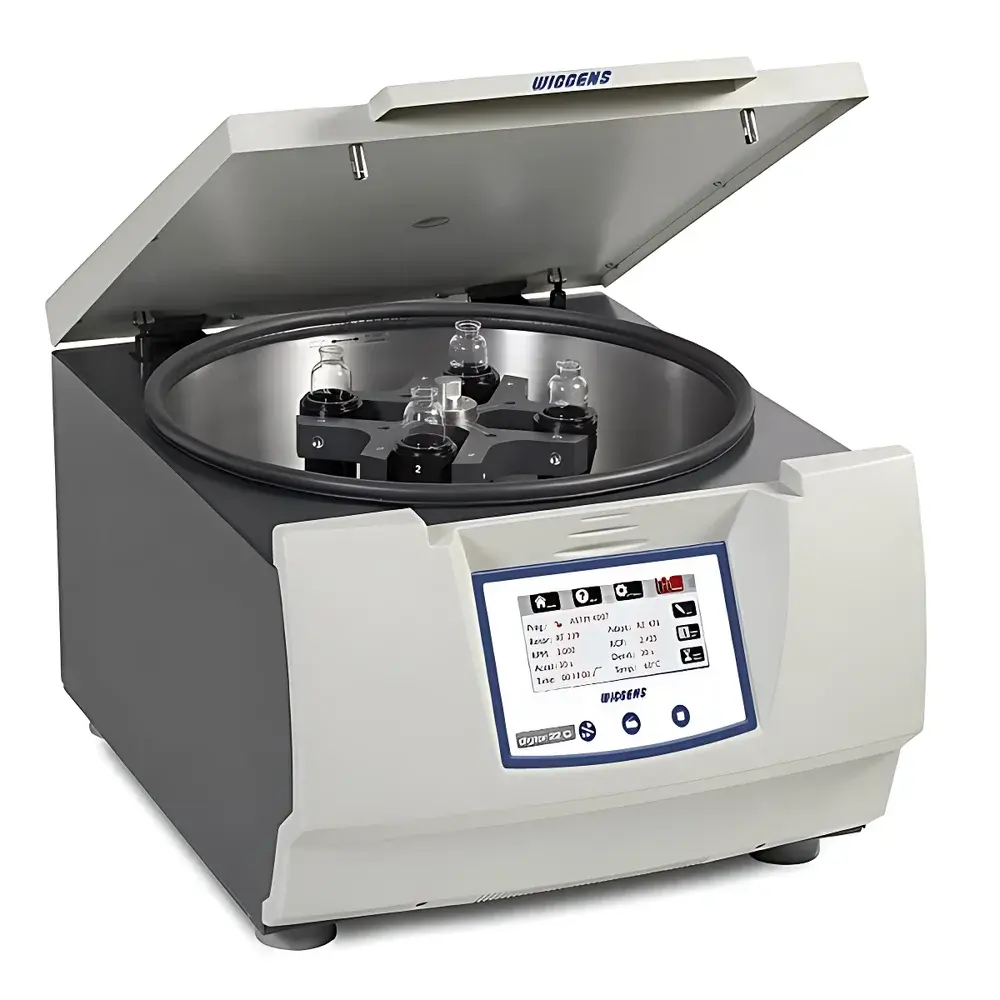
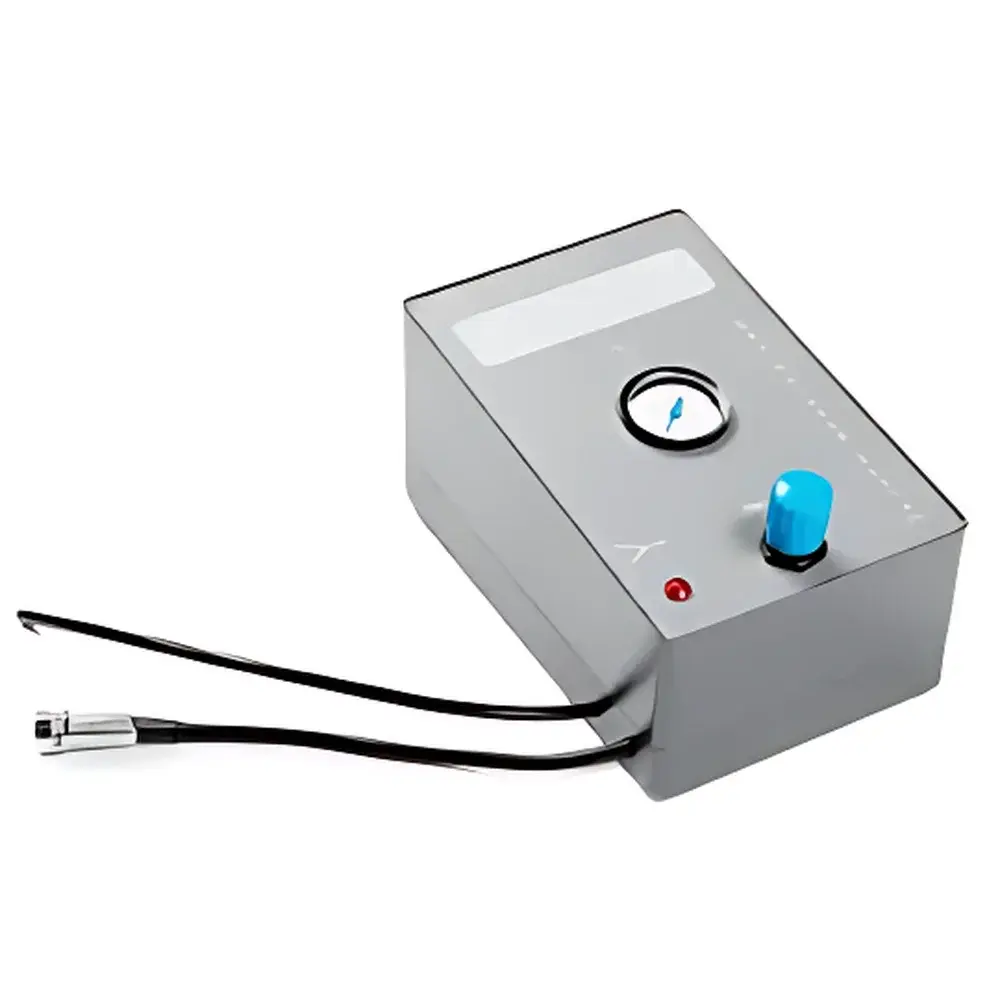
ChemTron Digtor 22C Oil Water and Sediment Analyzer (Centrifuge System)
| Brand | ChemTron |
|---|---|
| Origin | Germany |
| Model | Digtor 22C |
| Instrument Type | Benchtop Centrifuge |
| Max Speed | 3000 rpm |
| Max RCF | 2425 × g |
| Capacity | 4 × 100 mL (for 6" or 8" tubes) |
| Dimensions (W × D × H) | 540 × 650 × 400 mm |
| Weight | 77 kg |
| Power Supply | 220–230 V, 50–60 Hz, 1260 W |
| Compliance | ASTM D91, D96, D893, D1796, D2273, D2709, D2711, D4007, D5546 |
| Safety Certifications | EN 61010-1, EN 61010-2-020, EN 61326-2-6, EN 61326-1, EN 61010-2-010 |
| Optional GRS (Gas Release System) | Air inlet pressure 2 bar, exhaust flow ≥10 L/min, cycle interval 5 min, noise <40 dB(A), power consumption 20 W |
Overview
The ChemTron Digtor 22C Oil Water and Sediment Analyzer is a purpose-engineered benchtop centrifuge system designed specifically for standardized quantitative determination of water content, sediment, and insoluble contaminants in petroleum-based fluids—including crude oil, lubricants, diesel fuel, jet fuel, and used engine oils. It operates on the principle of controlled gravitational sedimentation under precisely regulated centrifugal acceleration (up to 2425 × g), enabling phase separation of immiscible components—free water, suspended particulates, and emulsified phases—according to internationally recognized test methods. Unlike general-purpose centrifuges, the Digtor 22C integrates application-specific mechanical design, thermal management, and safety architecture aligned with ASTM, ISO, API, and IP standards for hydrocarbon analysis laboratories operating under GLP or refinery QA/QC protocols.
Key Features
- Application-optimized rotor configuration supporting up to four 100 mL conical centrifuge tubes (6″ or 8″ height) or 28 microfuge-style finger tubes—enabling parallel processing per ASTM D96 and D2709 requirements.
- Microprocessor-controlled operation with real-time RPM/RCF display on a high-visibility TFT color screen (viewable at >3 m), featuring stepwise speed adjustment (10 rpm / 10 × g increments) and automatic rotor identification with overspeed protection.
- Stainless steel centrifuge chamber and removable rotor assembly compatible with autoclaving (121 °C, 2 bar), ensuring compliance with microbiological traceability requirements in reused-oil analysis.
- Integrated imbalance detection system (ULS) that identifies and displays the exact unbalanced position (e.g., “Rotor Position #3”) and triggers immediate shutdown—critical for reproducible sediment quantification and operator safety.
- Dual-mechanical lid lock with emergency manual release, anti-drop guard, and transparent observation window; lid remains locked during operation and permits safe rotor access only when fully stationary.
- Thermal control module offering programmable pre-heating (RT+5 °C to 80 °C, ±1 °C accuracy), cavity-mounted temperature sensor with overtemperature cutoff, and insulated chamber walls to minimize thermal drift during extended runs (e.g., 99-hour timed assays).
- Programmable acceleration/deceleration profiles (PCBS) with 175 selectable ramp slopes—preventing resuspension of settled particulates and preserving stratified layer integrity post-centrifugation.
- Energy-efficient brushless motor, <60 dB(A) acoustic emission, auto-power-off function, and 40 password-protected user programs with last-run parameter recall.
Sample Compatibility & Compliance
The Digtor 22C accommodates standard ASTM/IP-compliant glass or polymer centrifuge tubes used in petroleum testing—including flat-bottomed and conical formats up to 100 mL volume. Its mechanical stability, calibrated RCF output, and consistent thermal environment ensure full alignment with method-defined procedural constraints across key standards: ASTM D91 (settling time and temperature control), D96 (water and sediment measurement by centrifugation), D2709 (water in aviation turbine fuels), ISO 9030 (determination of water and sediment in crude oil), and API RP 2542 (field-use specifications for portable sediment analyzers). All electrical and mechanical subsystems conform to EN 61010-1 (safety requirements for lab equipment) and EN 61010-2-020 (particular requirements for centrifuges), with full CE marking under applicable EU directives.
Software & Data Management
While the Digtor 22C operates via embedded firmware without external PC dependency, its control interface supports full audit-trail functionality required in regulated environments. Each run logs timestamp, selected program ID, final RCF, elapsed time, temperature profile, and ULS event status. Parameter changes during runtime are recorded with user ID (if password-authenticated), satisfying basic FDA 21 CFR Part 11 data integrity expectations for non-networked instruments. Optional GRS integration includes status signaling via dedicated control interface—allowing synchronized activation of gas extraction cycles with centrifuge start/stop commands. No proprietary software installation is required; all settings are retained after power cycling.
Applications
- Quantitative determination of bottom sediment and water (BS&W) in crude oil prior to custody transfer (ASTM D4007, API RP 2542).
- Verification of water content in aviation turbine fuel (ASTM D2709, IP 75) and diesel fuel (ISO 9030, EN 12937).
- Analysis of sludge formation and oxidation by-products in in-service lubricants (ASTM D893, D2273).
- Assessment of cleaning efficiency in solvent-degreasing operations using hydrocarbon-based cleaners (ASTM D1796).
- Preparatory separation for subsequent elemental analysis (e.g., ICP-OES of sediment ash) or FTIR characterization of water-in-oil emulsions.
- Field-deployable QA screening in mobile refinery labs where temperature-stable, low-vibration centrifugation is critical for repeatable visual layer assessment.
FAQ
What standards does the Digtor 22C directly support for oil-water-sediment analysis?
It is validated for ASTM D91, D96, D2709, D4007; ISO 3734, ISO 9030; API RP 2542; IP 75; and DIN 51793—covering both laboratory and field-based petroleum testing protocols.
Is the GRS (Gas Release System) mandatory for routine operation?
GRS is optional but strongly recommended when analyzing samples containing volatile organic solvents (e.g., chlorinated cleaners, xylene washes) or aged fuels prone to off-gassing—ensuring operator safety and preventing internal condensation or pressure buildup.
Can the Digtor 22C be used for biological sample preparation?
No—it is not designed for biosafety-level applications. Its rotor geometry, sealing, and certification scope are limited to petroleum and industrial fluid matrices under Class II mechanical safety (EN 61010-2-020), not ISO 22196 or CLSI guidelines.
How is rotor imbalance detected and handled during operation?
The integrated ULS (Unbalance Location System) continuously monitors vibration signatures and, upon detection, halts rotation within <1.5 seconds while displaying the specific rotor position number requiring correction—eliminating guesswork in tube loading verification.
Does the centrifuge retain calibration data after power loss?
Yes—firmware stores all user parameters, program history, and operational logs in non-volatile memory. No recalibration is required following routine power interruption.



