
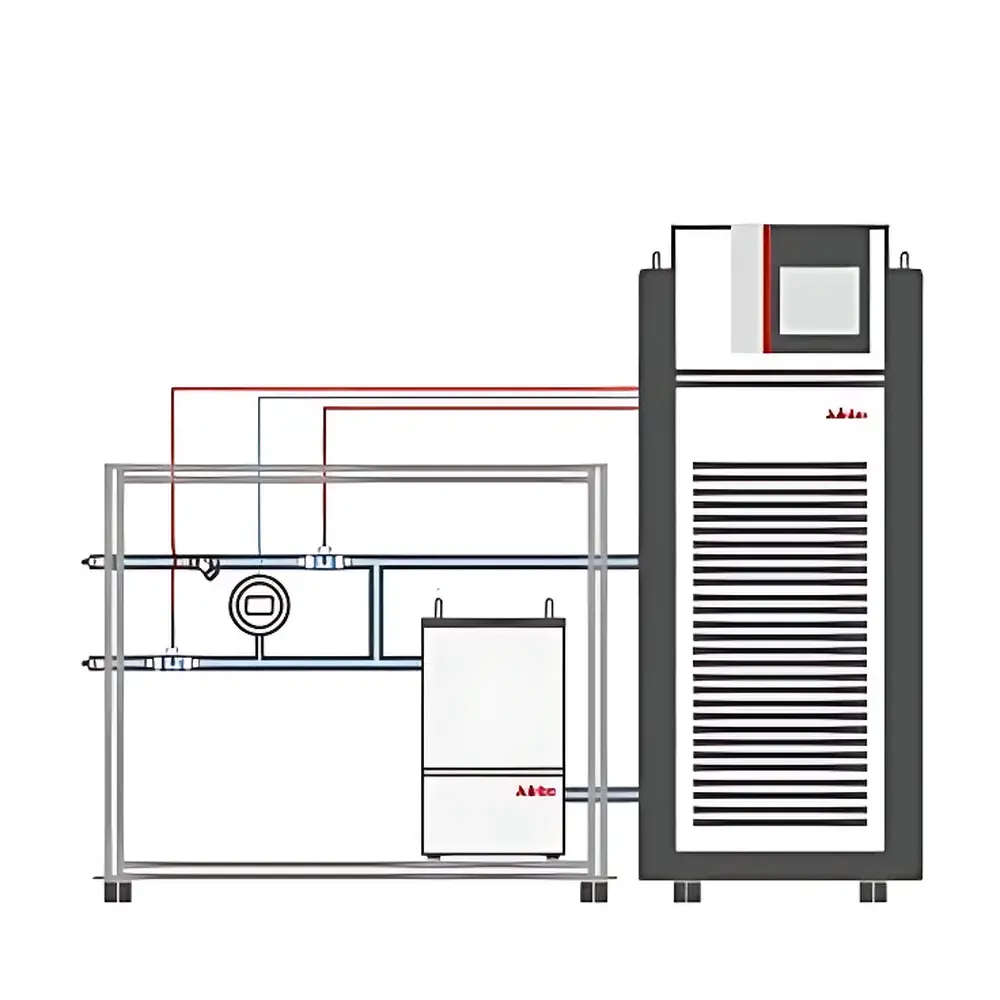
JULABO APT-50 Injector Performance Test Bench
| Brand | JULABO |
|---|---|
| Model | APT-50 |
| Origin | Germany |
| Temperature Range | –25 °C to +110 °C |
| Temperature Stability | ±0.05 °C to ±0.1 °C |
| Display | 5.7″ TFT Touchscreen, 0.01 °C Resolution |
| Heating Power | 6 kW |
| Cooling Power | 7.5 kW @ 20 °C |
| Pump Flow Rate | 35–76 L/min |
| Maximum Pump Pressure | 3.2 bar |
| Primary Circulation Pump | Integrated High-Performance Dynamic Pump |
| Heat Exchanger | Single-stage, Water-Cooled Compressor System |
| Fluid Compatibility | Glycol/Water Mixtures & Other Inert Heat Transfer Media |
| Dimensions (W×D×H) | 53 cm × 66.5 cm × 126 cm |
| Compliance | CE, RoHS, ISO 9001 Design Principles |
Overview
The JULABO APT-50 Injector Performance Test Bench is a precision-engineered thermal management and hydraulic test platform designed specifically for the dynamic evaluation of fuel injectors under controlled temperature and pressure conditions. It operates on the principle of closed-loop thermostatic circulation, integrating high-fidelity temperature regulation with real-time hydraulic parameter monitoring to replicate engine cold-start, hot-soak, and transient operating environments. Unlike generic chillers or heating circulators, the APT-50 is purpose-built for component-level validation in automotive R&D labs and Tier-1 supplier quality assurance facilities. Its core function is to maintain fuel (gasoline, diesel, biofuels, or synthetic blends) at precisely defined temperatures—ranging from –25 °C to +110 °C—while delivering stable, programmable flow rates and backpressure profiles that mirror actual injector duty cycles. This enables quantitative assessment of spray pattern integrity, opening/closing response time, volumetric delivery accuracy, and thermal hysteresis effects—all critical metrics governed by ISO 8573, SAE J1832, and OEM-specific injector qualification protocols.
Key Features
- Intelligent Dynamic Temperature Control (ICC) architecture delivering ±0.05 °C stability over extended test durations, validated per DIN EN 60751 Class A Pt100 traceability.
- EHC (Enhanced Heat Exchange) segmented impingement cooling technology enabling rapid thermal transitions—achieving ΔT of 80 K in <12 minutes without overshoot or oscillation.
- ACC (Active Compression Control) refrigeration logic that maintains sub-zero cooling capacity even at ambient temperatures up to 40 °C, eliminating condensation risk in humid test cells.
- High-torque, brushless circulation pump with selectable pressure staging (0.48–3.2 bar) and flow modulation (35–76 L/min), supporting both low-viscosity gasoline and high-viscosity biodiesel testing.
- Hermetically sealed hydraulic path with EPDM/FKM-compatible wetted materials, rated for continuous operation with 50% ethylene glycol/water mixtures and other inert heat transfer fluids.
- 5.7″ industrial-grade TFT touchscreen interface with intuitive HMI navigation, multi-user access levels, and onboard data logging (1 Hz sampling, 16 GB internal storage).
- Dual-port communication architecture: RS485 (Modbus RTU), Ethernet (TCP/IP), and optional CAN bus interface for seamless integration into vehicle ECU-in-the-loop (HIL) test rigs.
Sample Compatibility & Compliance
The APT-50 accommodates all common injector types—including solenoid-actuated, piezoelectric, and common-rail designs—with standardized SAE J1939-compliant mounting interfaces. Its fluid circuit meets ASTM D4629 requirements for hydrocarbon compatibility and features a dual-stage particulate filter (≤5 µm absolute rating) upstream of the injector inlet to prevent nozzle clogging during long-duration durability runs. The system complies with IEC 61000-6-2/6-4 for electromagnetic immunity and emission, carries full CE marking under the Machinery Directive 2006/42/EC and Low Voltage Directive 2014/35/EU, and supports GLP/GMP audit readiness via optional 21 CFR Part 11–compliant software add-ons (e.g., electronic signatures, change control logs, and user activity tracking).
Software & Data Management
JULABO’s proprietary APT-Control Suite provides PC-based configuration, remote supervision, and post-test analysis. It supports synchronized acquisition of temperature, pressure, flow, and trigger signals (TTL/RS232), exporting timestamped CSV or HDF5 files compatible with MATLAB, Python (Pandas), and LabVIEW. Automated test sequences can be scripted using a built-in state-machine editor, enabling repeatable cold-start simulations (e.g., ramp from –25 °C to 20 °C at 2 K/min while maintaining 2.5 bar backpressure). Audit trails include operator ID, parameter set version, calibration certificate expiry, and firmware revision—ensuring full traceability across development sprints and production line validation batches.
Applications
- Injector thermal response characterization under extreme ambient conditions (e.g., arctic cold-start, desert hot-soak).
- Validation of fuel conditioning systems for flex-fuel and hydrogen-enriched combustion platforms.
- Correlation studies between injector temperature drift and misfire rate in OBD-II diagnostic development.
- Long-term durability testing of piezoelectric actuators under thermally cycled load profiles.
- Support for EU Stage V and EPA Tier 4 emissions compliance testing where fuel temperature directly influences PM/NOx formation.
FAQ
What temperature uniformity can be achieved across the fuel loop during dynamic ramping?
The APT-50 maintains ≤±0.1 °C spatial deviation across a 2-meter test loop (verified with 6-point Pt100 probe mapping per ISO/IEC 17025).
Is the system compatible with ethanol-blended fuels (E85) and renewable diesel (HVO)?
Yes—the wetted path materials (SS316L, FKM seals, PTFE-lined valves) are chemically resistant per ASTM D471 and approved for continuous exposure to oxygenated fuels.
Can the APT-50 operate unattended for 72-hour endurance tests?
It supports fully autonomous operation with integrated leak detection, dry-run protection, overtemperature cutout, and email/SMS alerting via SNMP or MQTT gateways.
Does JULABO provide IQ/OQ documentation packages for regulated laboratories?
Yes—factory-issued Installation Qualification (IQ) and Operational Qualification (OQ) protocols are available upon request, aligned with ASTM E2500 and Annex 11 principles.




