
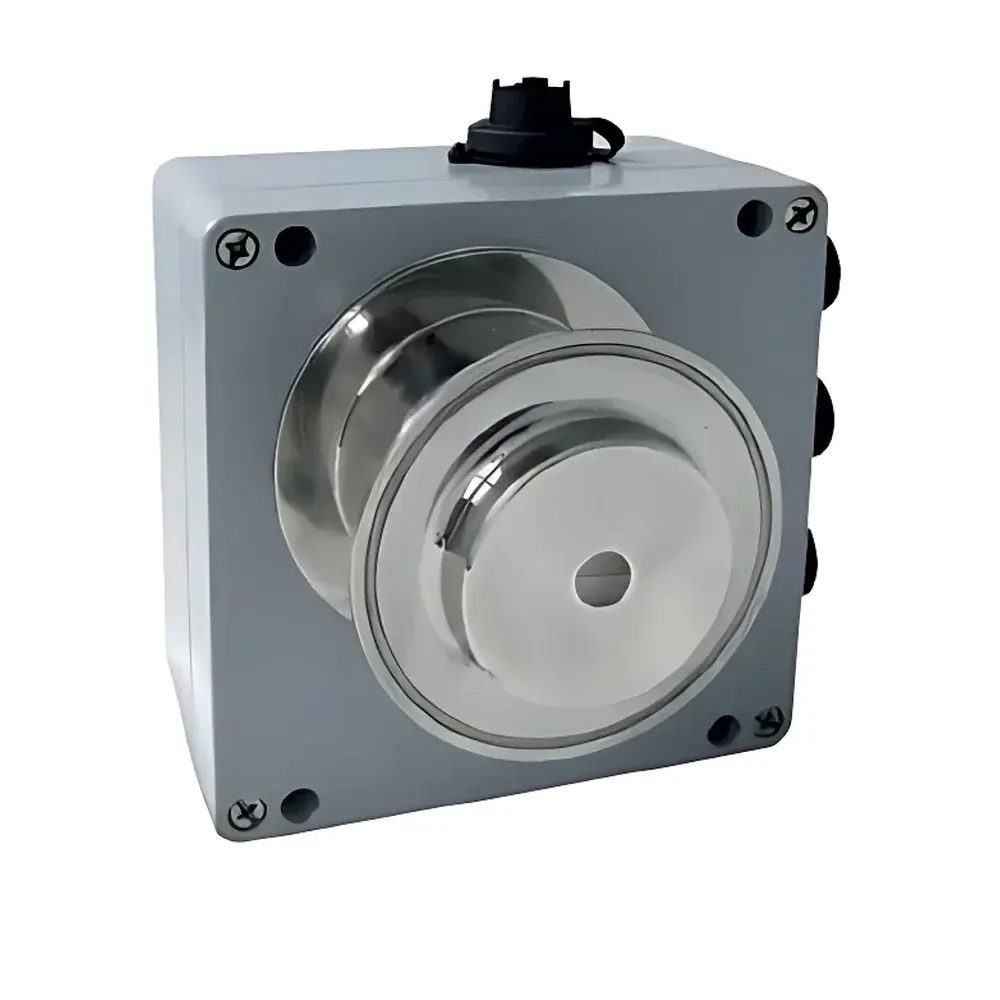
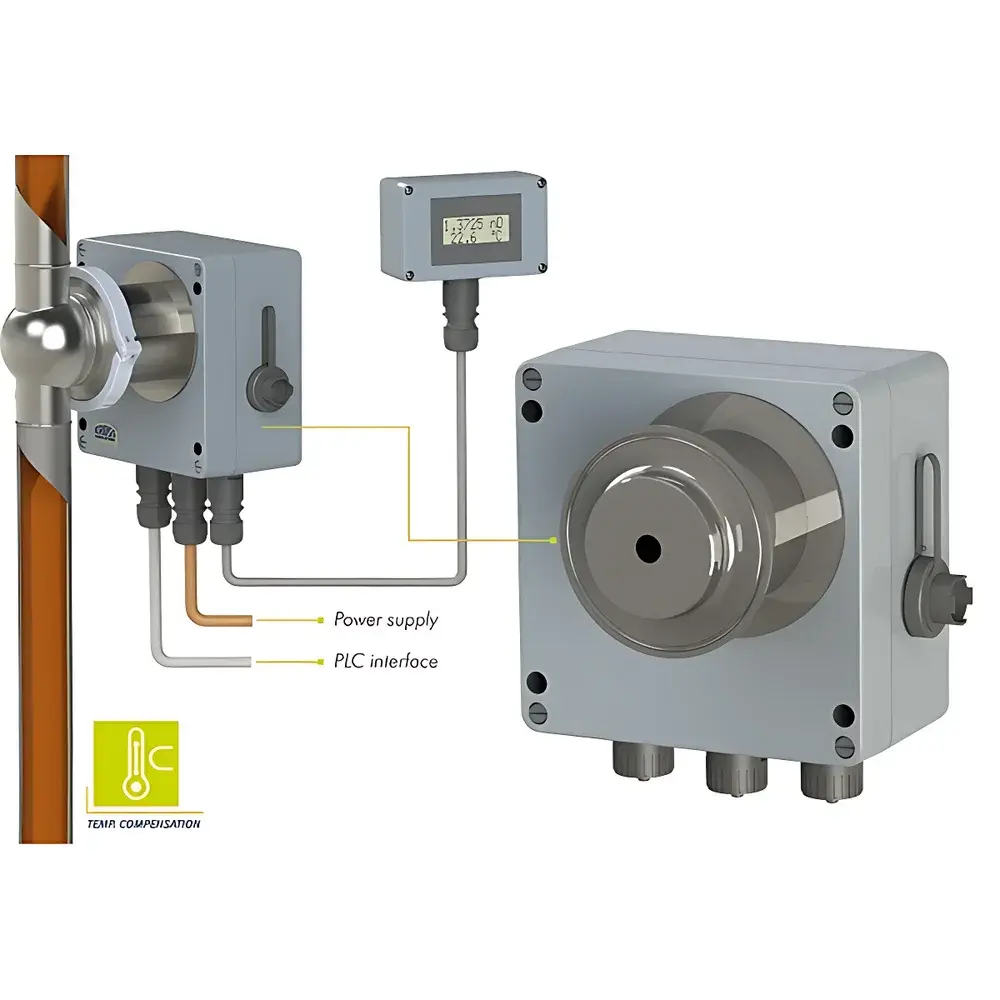
ChemTron PR21S and PR21S-T Inline Refractometers
| Brand | ChemTron |
|---|---|
| Origin | Germany |
| Model | PR21S / PR21S-T |
| Sample Compatibility | Liquid process streams in pipes or reactors |
| Temperature Range | 10–60 °C (PR21S), 10–120 °C (PR21S-T) |
| Refractive Index Range | nD 1.3200–1.5200 |
| Brix Range | 0–95 % |
| Accuracy | ±0.0002 nD, ±0.2 % Brix |
| Resolution | 0.0001 nD, 0.1 % Brix |
| Wavelength | 590 nm (LED source, >100,000 h lifetime) |
| Prism Material | Sapphire |
| Temperature Sensor | PT100 (range: 10–200 °C |
| accuracy | ±0.2 °C |
| resolution | 0.1 °C) |
| Output Signals | 4–20 mA analog, RS-232, optional PROFIBUS-DP |
| Enclosure Rating | IP65 |
| Dimensions | 18.0 × 19.0 × 18.0 cm |
| Weight | 3.5 kg |
| Temperature Compensation | ICUMSA-compliant or user-definable |
Overview
The ChemTron PR21S and PR21S-T inline refractometers are industrial-grade optical analyzers engineered for continuous, real-time measurement of refractive index (nD) and Brix concentration in liquid process streams. Based on the principle of critical angle refraction, these instruments employ a high-stability LED light source at 590 nm—optimized for minimal spectral drift and long-term photometric consistency—to illuminate a sapphire prism in direct contact with the process medium. The resulting total internal reflection boundary is precisely detected by a linear CCD array, enabling calculation of nD with metrological traceability to NIST-traceable standards. Unlike laboratory benchtop or handheld refractometers, the PR21 series operates without flow cells, bypass loops, or sample extraction—eliminating dead volumes, lag time, and maintenance associated with secondary sampling systems. Its robust, compact design allows direct insertion into pipelines or reactor walls via standard flanges (DIN/ANSI), supporting integration into continuous manufacturing environments governed by FDA 21 CFR Part 11, GMP, and GLP requirements.
Key Features
- Direct-in-line installation: No auxiliary tubing, pumps, or sample conditioning required—reduces system complexity and validation burden.
- Sapphire prism interface: Chemically inert, scratch-resistant, and thermally stable up to 200 °C surface temperature—suitable for aggressive solvents, caustic cleaners, and high-pressure applications.
- Dual-temperature variants: PR21S rated for ambient process temperatures up to 60 °C; PR21S-T integrates active cooling capability and extended thermal management for sustained operation up to 120 °C.
- ICUMSA-compliant temperature compensation: Implements standardized sucrose-solution reference curves; also supports custom polynomial or linear compensation profiles for non-sucrose matrices (e.g., glucose, fructose, invert sugar).
- High-resolution digital detection: 0.0001 nD resolution and 0.1 % Brix resolution ensure reliable discrimination between closely spaced concentration gradients in crystallization control or blending verification.
- Configurable output architecture: Standard 4–20 mA analog output with HART compatibility; RS-232 serial interface for configuration and diagnostics; optional PROFIBUS-DP module for seamless DCS/PLC integration in ISA-88/ISA-95 compliant facilities.
Sample Compatibility & Compliance
The PR21 series is validated for homogeneous, low-turbidity aqueous solutions with suspended solids < 5 ppm and viscosity < 500 cP. It is routinely deployed in food & beverage (juice concentration, syrup blending), chemical synthesis (solvent recovery, reaction endpoint detection), pharmaceutical excipient preparation, and pulp & paper black liquor monitoring. The instrument meets IEC 61000-6-2 (immunity) and IEC 61000-6-4 (emissions) standards. Its IP65-rated housing ensures protection against dust ingress and water jets during washdown operations. Calibration traceability aligns with ISO/IEC 17025-accredited procedures, and full audit trails—including calibration events, parameter changes, and firmware updates—are retained in non-volatile memory per FDA 21 CFR Part 11 data integrity requirements.
Software & Data Management
Configuration and diagnostics are performed via the ChemTron RefraLink PC utility (Windows-based), which supports password-protected user roles (Operator, Technician, Administrator), electronic signature capture, and export of time-stamped measurement logs in CSV or XML format. All communication protocols enforce CRC error checking and command authentication. For enterprise-level deployment, the device supports Modbus TCP gateway translation through compatible middleware, enabling ingestion into MES platforms such as Siemens SIMATIC IT or Rockwell FactoryTalk. Raw nD and temperature values are stored locally at configurable intervals (3–60 seconds), with interpolation applied only during reporting—not during primary measurement computation—to preserve data fidelity.
Applications
- Real-time Brix control in juice evaporation and concentrate blending lines—enabling closed-loop feedback to steam valves and feed pumps.
- Monitoring sucrose inversion kinetics during acid-catalyzed hydrolysis in confectionery production.
- Tracking solvent composition in distillation side-streams (e.g., ethanol/water, isopropanol/water) where refractive index correlates strongly with molar fraction.
- Verifying cleaning-in-place (CIP) endpoint by detecting residual sugar or detergent concentration in rinse water.
- Inline quality assurance of pharmaceutical syrups and oral solutions per USP refractometry guidelines.
FAQ
Can the PR21S measure non-sucrose solutions such as sodium chloride or ethylene glycol?
Yes—the instrument reports raw nD values independently of calibration matrix; users may apply custom conversion tables or regression models derived from empirical calibration data.
Is recalibration required after prism cleaning?
No—sapphire’s chemical stability and consistent thermal expansion coefficient ensure zero drift following CIP cycles; however, periodic verification using certified refractive index standards (e.g., Cargille nD oils) is recommended per ISO 21748.
Does the PR21S-T require external cooling water?
No—it uses passive heat sinking and internal thermal shunting; no external coolant connections are needed, though ambient cabinet ventilation must meet specified airflow minimums.
How is temperature uniformity maintained across the prism surface?
The PT100 sensor is embedded within 0.5 mm of the measurement zone, and firmware applies dynamic spatial correction based on thermal gradient modeling validated across 10–120 °C.
Can multiple PR21 units be daisy-chained on one RS-232 bus?
No—RS-232 is point-to-point; for multi-device networks, use RS-485 converters or PROFIBUS-DP with unique node addressing.




