
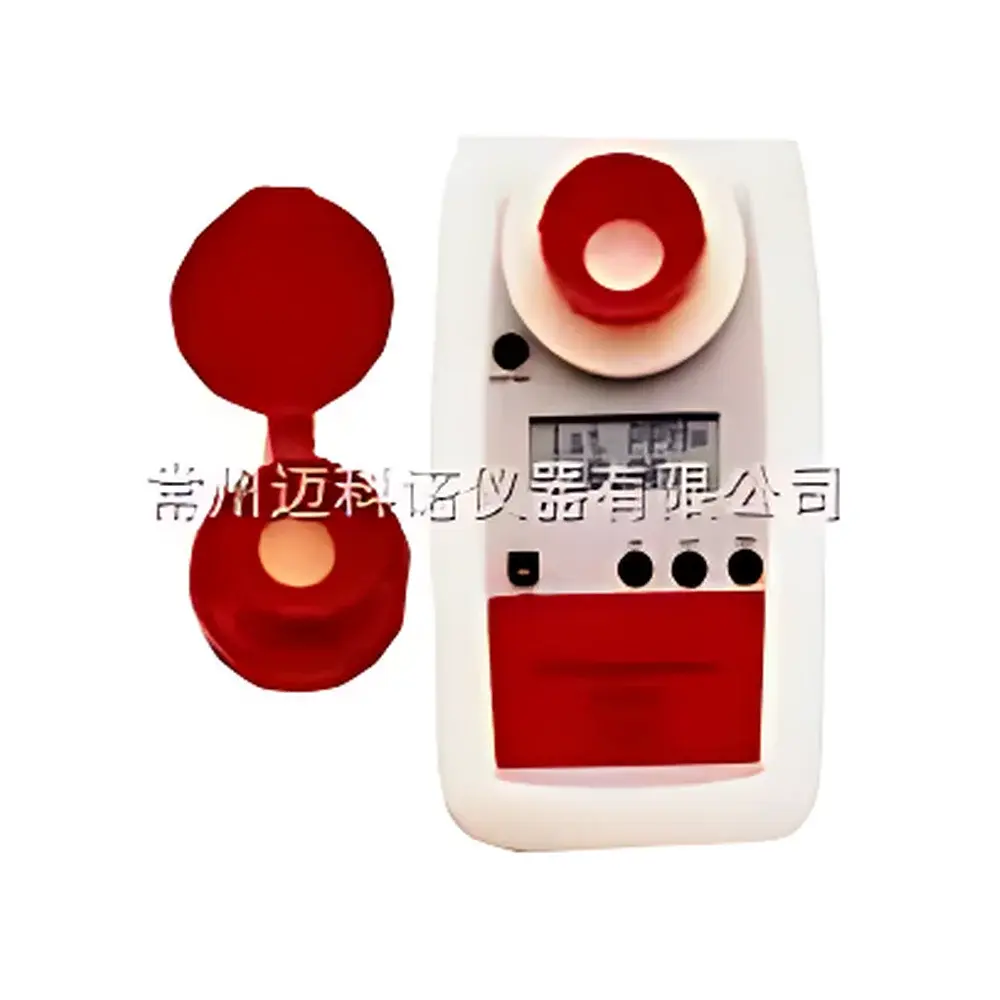
ES300 Handheld Formaldehyde Analyzer
| Origin | Zhejiang, China |
|---|---|
| Manufacturer Type | Authorized Distributor |
| Origin Category | Domestic (PRC) |
| Model | ES300 Handheld Formaldehyde Analyzer |
| Price Range | USD 420–690 (FOB) |
| Detection Principle | Electrochemical Sensor |
| Measurement Range | 0–30 ppm (typical), up to 34 ppm (over-range capability) |
| Resolution | 0.01 ppm |
| Detection Limit | 0.01 ppm |
| Repeatability | ±5% of reading |
| Sampling Method | Diffusion-based |
| Response Time (T90) | <60 s |
| Operating Temperature | −20 °C to +40 °C |
| Relative Humidity Range | 15–90% RH (non-condensing) |
| Atmospheric Pressure Tolerance | ±10% of ambient |
| Power Supply | 9 V alkaline battery (240 h typical runtime) |
| Dimensions | 120 × 63.5 × 38 mm |
| Weight | 170 g |
| Data Storage | 5 measurement records |
| Interface | RS-232 serial output |
| Alarm | 80 dB audible alert, user-configurable threshold |
| Display | Backlit LCD |
| Operating Modes | Single-point and continuous monitoring (programmable cycle: 0–480 min) |
| Filter Technology | Selective catalytic interference suppression |
| Sensor Lifetime | >2 years |
| Warm-up Time | 60 s |
Overview
The ES300 Handheld Formaldehyde Analyzer is a portable, field-deployable instrument engineered for reliable quantification of formaldehyde (HCHO) in ambient air using a calibrated electrochemical sensing principle. Designed for occupational hygiene, indoor air quality (IAQ) assessment, and post-remediation verification, the ES300 operates on diffusion-controlled sampling—eliminating the need for pumps or external power during routine operation. Its core sensor employs a three-electrode electrochemical cell optimized for selectivity toward formaldehyde in complex gas matrices. The analyzer delivers real-time concentration readouts (instantaneous values), along with time-weighted averages including Short-Term Exposure Limit (STEL, 15-min average) and Time-Weighted Average (TWA, 8-h average), as defined under OSHA and ACGIH guidelines. Built-in temperature and humidity compensation ensures stable performance across variable environmental conditions typical of residential, commercial, and light industrial settings.
Key Features
- Electrochemical sensor with >2-year operational lifetime and factory calibration traceable to NIST-traceable standards
- Dual-mode operation: single-point spot measurement and programmable continuous monitoring (cycle duration adjustable from 0 to 480 minutes)
- Integrated selective filter technology that mitigates cross-sensitivity from common interferents including CO, NO₂, SO₂, and VOCs commonly present in indoor environments
- Backlit LCD display showing real-time HCHO concentration, STEL/TWA/peak values, battery status, and alarm activation indicators
- User-configurable audible alarm (80 dB) with adjustable threshold between 0.1–30 ppm; visual low-battery warning
- On-device data storage for up to five complete measurement sessions, each containing timestamped instantaneous readings and derived averages
- RS-232 interface for direct data export to PC-based logging software or LIMS integration
- Rugged, ergonomic housing (170 g, IP54-rated ingress protection) suitable for daily field use by industrial hygienists and IAQ consultants
Sample Compatibility & Compliance
The ES300 is validated for use in non-explosive atmospheres (IEC 60079-0 compliant design principles applied) and meets general requirements for portable gas detection instrumentation per ISO 16000-23 (Indoor air — Part 23: Determination of formaldehyde — Active sampling method using electrochemical sensors). It supports compliance workflows aligned with OSHA 29 CFR 1910.1048 (Formaldehyde Standard), EU Directive 2019/1836 (amending Directive 2004/10/EC on analytical method validation), and national GB/T 18204.2–2014 (Chinese standard for formaldehyde determination in public places). The device does not require intrinsic safety certification for standard indoor deployment but must be operated outside Class I, Division 1 hazardous locations. All calibration certificates provided are issued per ISO/IEC 17025-accredited procedures.
Software & Data Management
Data retrieval is performed via the included RS-232 cable and compatible terminal emulation software (e.g., PuTTY or custom OEM utility). Exported datasets include UTC timestamps, raw sensor output (nA), compensated concentration (ppm), mode flag (single/continuous), and statistical aggregates (min/max/avg over cycle). While the ES300 itself lacks onboard GLP/GMP audit trail functionality, exported logs can be imported into validated laboratory information management systems (LIMS) supporting 21 CFR Part 11-compliant electronic signatures when paired with appropriate metadata documentation. Firmware updates are available through authorized service centers only; no field-upgradable bootloader is implemented to preserve measurement integrity.
Applications
- Post-construction and renovation IAQ verification in offices, schools, hospitals, and residential dwellings
- Ongoing occupational exposure monitoring in furniture manufacturing, plywood production, and textile finishing facilities
- Validation of HVAC system performance and air purification device efficacy
- Field screening prior to and after formaldehyde mitigation treatments (e.g., catalytic oxidation, sorbent application)
- Educational demonstrations in environmental science and occupational health curricula
- Regulatory pre-audit assessments conducted by third-party environmental consultants
FAQ
What is the recommended calibration frequency?
Annual calibration is advised under normal usage; more frequent calibration (quarterly) is required if used daily in high-concentration or high-humidity environments.
Can the ES300 be used outdoors?
Yes—within its specified operating temperature (−20 °C to +40 °C) and humidity (15–90% RH, non-condensing) ranges—but prolonged exposure to rain or direct sunlight may affect sensor stability and display readability.
Does the device support multi-gas detection?
No—the ES300 is dedicated exclusively to formaldehyde; it does not incorporate additional sensors for CO, VOCs, or other gases.
Is the filter replaceable, and where can spare filters be sourced?
Yes—the proprietary interference-suppression filter is field-replaceable every 6 months or after 1,000 hours of cumulative operation; genuine filters are supplied exclusively through authorized distributors with batch-specific calibration verification.
How is measurement uncertainty quantified?
Total expanded uncertainty (k=2) is ±5% of reading at 23 °C and 50% RH, based on combined contributions from sensor drift, temperature/humidity compensation error, and calibration reference uncertainty.







